


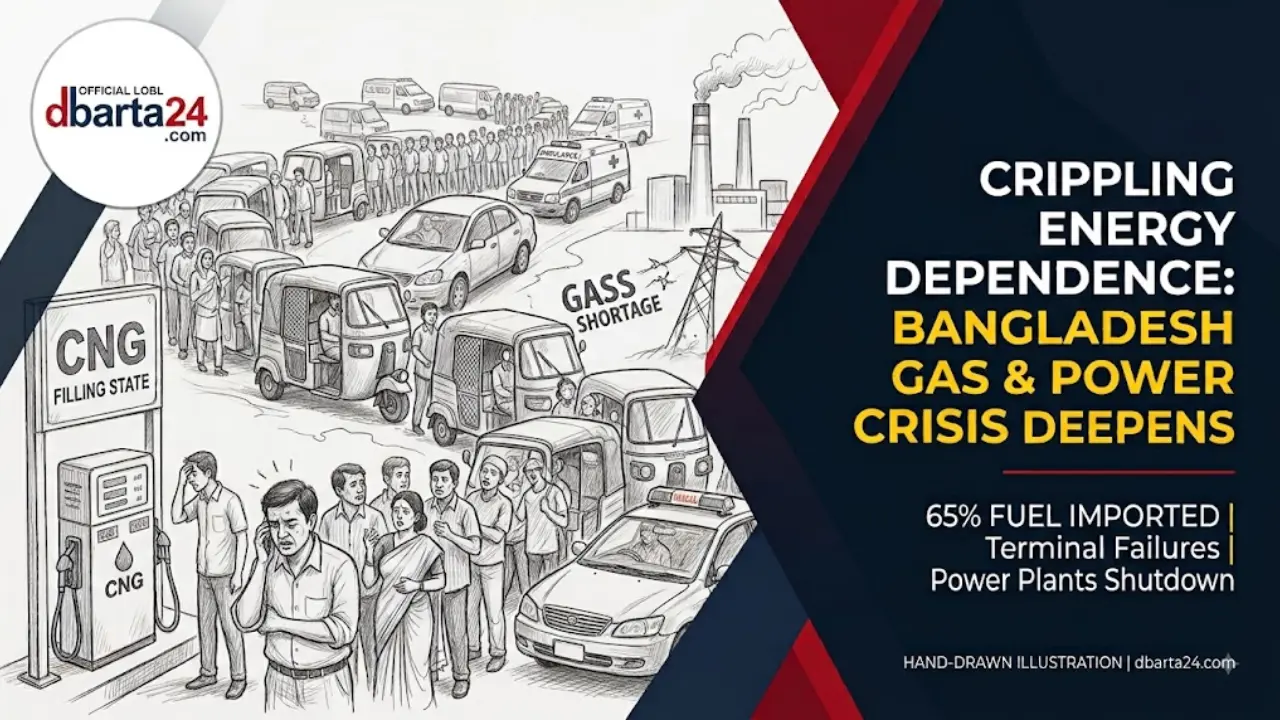
Md. Tareq; Dbarta24 — Bangladesh is grappling with an escalating energy crisis as crippling gas shortages and surging load-shedding disrupt daily life, industries, and public transport.
The vulnerability of the nation’s heavy dependence on imported energy has once again been laid bare following terminal disruptions, technical setbacks, and adverse offshore weather conditions.
With over 65 percent of used energy imported and 9 percent of power generation capacity relying on foreign energy sources, domestic distribution systems are severely strained.
Vehicles—including ambulances, private cars, and auto-rickshaws—are facing agonizingly long queues at CNG filling stations across major hubs like Dhaka’s Jatrabari.
Disruptions Hit Offshore LNG Terminals
Bangladesh’s daily natural gas demand stands at 3.8 billion cubic feet (bcf). Under normal circumstances, authorities supply up to 2.7 bcf to balance the gap, with liquefied natural gas (LNG) imports contributing around 1.05 bcf.
However, recent accidents and weather hazards have crippled this delicate arrangement.
The crisis intensified after July 21, when a fire severely damaged one of the two main offshore floating storage and regasification units (FSRUs) operated by Accelerate Energy in Maheshkhali, Cox’s Bazar.
While Summit Group’s nearby terminal temporarily offset the deficit by operating beyond capacity, adverse sea weather recently prevented new LNG vessels from offloading cargo.
Consequently, daily LNG supplies dropped significantly, bringing total natural gas delivery across the country down to approximately 2.13 bcf—the lowest level in three weeks.
“The LNG cargo vessel is nearby, but adverse weather has prevented the transfer of LNG at the terminal. The energy division is working with all stakeholders to restore gas supplies quickly,” stated Anindy Islam, State Minister for Power, Energy, and Mineral Resources.Power Generation Plunges, Driving Heavy Load-Shedding
The gas shortfall has directly hit electricity generation, reducing power output by nearly 1,500 megawatts (MW).
Combined with ongoing coal shortages at major thermal power plants and reduced cross-border electricity imports due to weather and outstanding bills, grid operators have been forced to implement extensive load-shedding exceeding 3,400 MW daily during peak heat hours.
While expensive liquid-fuel power plants could technically bridge part of the gap, power utility officials are exercising caution to avoid ballooning financial losses.
Structural Import Vulnerability and the Path Forward
Energy experts emphasize that repeated shocks—from global conflicts such as the Russia-Ukraine war to localized terminal outages and natural hazards—highlight the inherent risk of an import-centric policy.
“Bangladesh became heavily import-dependent far too early. If this hadn’t happened, we might not be facing such a deep crisis today,” noted M. Shamsul Alam, Energy Advisor to the Consumer Association of Bangladesh (CAB). “While import management needs immediate fixing, curbing corruption and systemic leakage is critical to relieve financial pressure.”
Addressing the broader policy environment, Power, Energy, and Mineral Resources Minister Iqbal Hasan Mahmud emphasized long-term solutions:
“The previous administration failed to build sustainable energy infrastructure, which is why the shutdown of a single LNG terminal has created nationwide turmoil. We inherited this deep-seated crisis and are actively managing it.”
To reduce import exposure over the long run, the current administration has initiated offshore oil and gas exploration tenders while expediting renewable energy expansion plans.
However, analysts caution that in the immediate term, reliance on managed imports remains unavoidable.