


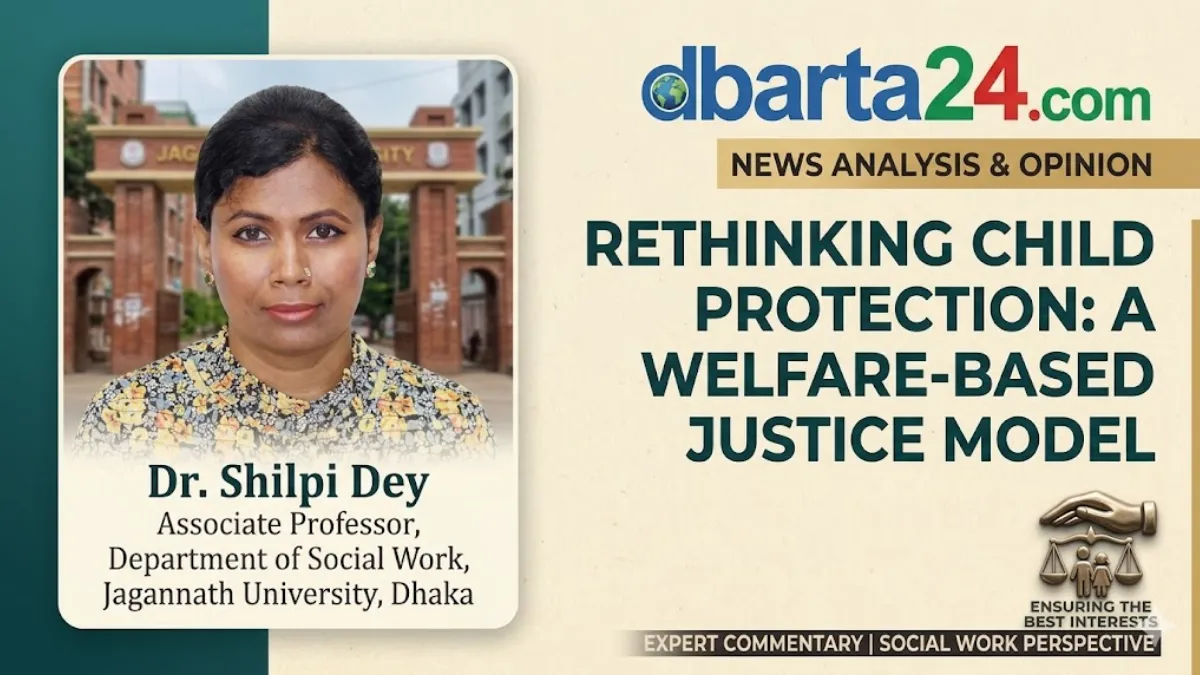
Dr. Shilpi Dey – The United Nations Convention on the Rights of the Child (UNCRC), 1989 specifies a collective commitment to protecting children’s rights. At present, in total, 196 countries have signed up to the UNCRC.
In 1990, Bangladesh was one of the first countries to sign and ratify the UNCRC to ensure care and protection of children.
As a part of its commitment twelve year ago Government of Bangladesh passed the Children Act (Shishu Ain, 2013; amended in 2018, repealing the previous Children Act 1974.
The Act is considered as a great achievement for ensuring the care and protection, above all best interests of children under the juvenile justice system in Bangladesh, yet major concerns persist in establishing a truly welfare-based model in which the needs of children are prioritized over their deeds.
In Bangladesh, the involvement of children under the system either for ‘coming in contact with the law’ as victims or ‘coming in conflict with the law’ offenders are increasing.
However, there are no up-to-date statistical records of how many children and young people come under the justice system. They are ‘coming into contact with the law’ for reasons such as running away from home, underage marriage, victims of human trafficking; and ‘coming into conflict with the law’ for theft, snatching, drug dealing, sex offense, and murder.
The available statistics of Department of Social Services-DSS (2023) show that most of the children and young people who are detained under the JJS are predominantly boys.
Many girls who were detained in the juvenile justice system in Bangladesh had a history of victimization. In addition, they are mostly detained as victims of offenses rather than as offenders.
Akter (2021) noted that in the JJS, almost 55% of the detained girls were victims of crime, while the rest ‘came into conflict with the law’ for offenses including murder, drug dealing, theft, human trafficking and others.
Akter also mentioned that 55% of the detained girls were sent into detention for ‘coming into contact with the law’, while 45%, were ‘coming into conflict with the law’ and are sent to the same Center, and a third category of girl detainees is those who have committed status offenses (e.g. running way from home, eloping with boyfriends, and under aged married).
According to national and international guidelines, detention should be used only as a measure of last resort for children. In Bangladesh, there are three government-run centers, called Child Development Center-CDC for children who come under the juvenile justice system: two centers for boys and one for girls under the DSS of the Ministry of Social Welfare.
Evidence shows that children are being detained in these Centers for a wide range of legal reasons from being victims of offences (e.g., sex, human trafficking, domestic violence, and so on) to being accused of crimes (e.g., underage marriage, theft, murder and so on); and that detention is often used as a first resort. This practice is particularly common in the case of girls.
In 2019, General Comment No. 24 of the UN Committee on the Rights of the Child (2019) expressed the concerns regarding using detention as a first resort, poor conditions of the detention center or institutions, abuse and neglect under the care.
The Committee has recommended raising the Minimum Age of Criminal Responsibility (MACR), which is currently set at 7 years in the country. It emphasizes the importance of diversion measures and community-based programs, and stresses that detention should be used only as a last resort, for the shortest possible period, and subject to regular review.
It further recommends ensuring a child-friendly approach to guide all processes within the juvenile justice system to ensure that the best interests of the child are upheld.
It further recommends adopting a child-friendly approach to guide all processes within the juvenile justice system so that the best interests of the child are fully protected.
Bangladesh should adopt a welfare-based justice model to ensure the best interests of children under the justice system. In this regard the JJS should focus on the needs of the children rather than the deeds.
For children those who have come in conflict with law for minor offense, diversion, probation and condition release services should be offered rather than being detained.
Victims of offenses should receive appropriate care and, where institutional care is required, should be accommodated in facilities entirely separate from those housing children in conflict with the law.
They should not be placed in the same Center such as the CDC where they would be required to share the same space or live under the same roof.
When they will be in detention, the trail should be done as quick as possible, skill training should be provided, social reintegration and social rehabilitation program should be taken.
Therapeutic program should be offered to ensure their mental well-being, gender responsive and trauma informed practice should be ensured.
In order to ensure the care and protection of children under the justice system children friendly justice should be adopted, the MACR should be increased, detention should be used a last resort and the separate treatment of children than adult should be ensure with completely separately infrastructure.
Author : Associate Professor, Department of Social Work, Jagannath University, Dhaka