


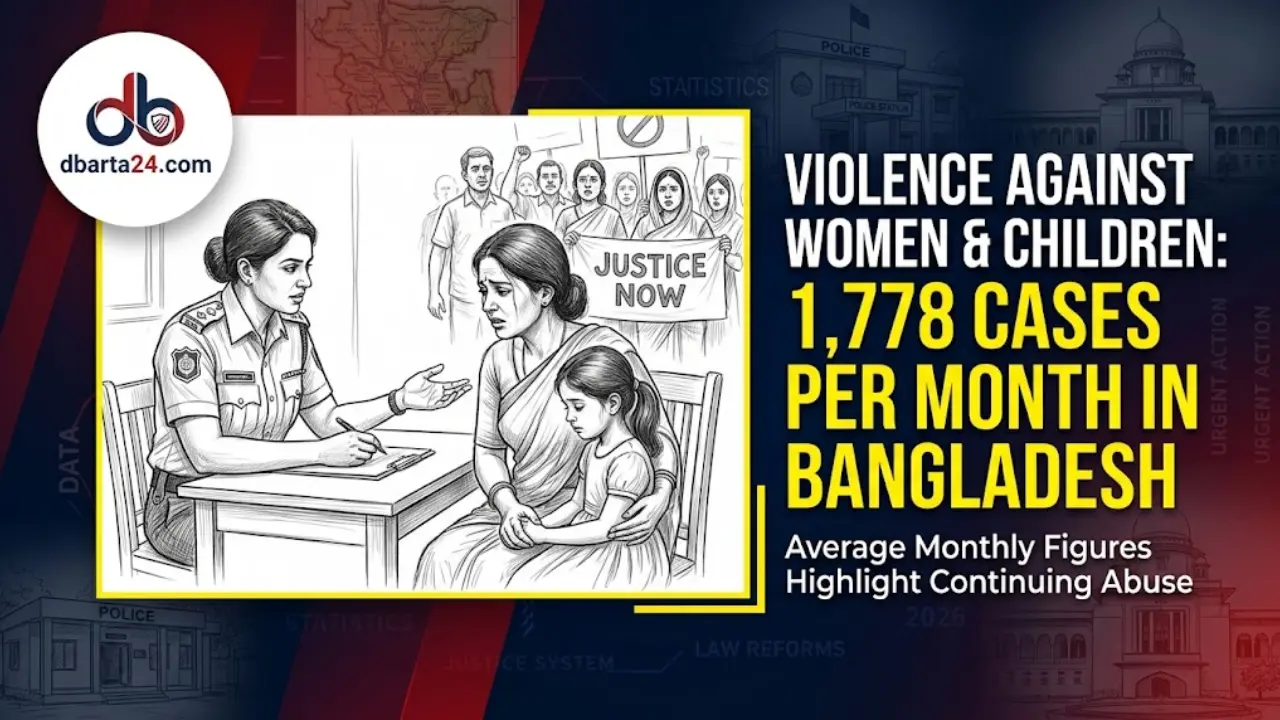
Muabia Labony; Dhaka – Despite high-profile quick convictions and recent legislative overhauls, gender-based and child violence remains pervasive across Bangladesh.
Official police statistics reveal that an average of 1,778 cases of abuse against women and children are recorded every month across the country.
However, legal experts and rights advocates warn that these figures represent merely the tip of the iceberg, as widespread social stigma, intimidation, and institutional hurdles prevent thousands of victims from seeking justice.
Alarmingly Low Conviction Rates Hindering Justice
A groundbreaking joint study by the Supreme Court of Bangladesh and BRAC highlights a severe crisis within the judicial process: the conviction rate in cases tried under the Prevention of Oppression Against Women and Children Act stands at a meager 3%.
The research—which analyzed 4,040 cases across 46 tribunals in 32 districts—found that while the law mandates trial completion within 180 working days, a case takes an average of three years and seven months (1,370 days) to resolve.
-
Acquittal Rate: Approximately 70% of accused individuals are acquitted due to flawed investigations and compromised evidence.
-
Out-of-Court Settlements: Around 10% of cases end in informal compromises under social pressure.
-
Key Bottlenecks: Delays are largely driven by absent witnesses, missing forensic or DNA reports, outmoded investigative practices like the banned “two-finger test,” and a complete lack of witness protection.
“Out of all the cases filed over violence against women and children, only a handful see justice, while the majority remain stuck without progress. The punishment of perpetrators must be made visible to create an effective deterrent.”— Salma Akter, Executive Director, Bangladesh National Woman Lawyers Association (BNWLA)Monthly Breakdown of Recorded Cases (2026)
According to Police Headquarters data, a total of 12,446 cases were registered nationwide between January and July 2026, including 886 within the Dhaka Metropolitan Police (DMP) jurisdiction.
| Month | Nationwide Cases | DMP Cases |
| January | 1,281 | 108 |
| February | 1,181 | 96 |
| March | 1,485 | 111 |
| April | 2,011 | 168 |
| May | 1,952 | 134 |
| June | 2,200 | 138 |
| July | 2,336 | 131 |
| Total (7 Months) | 12,446 | 886 |
Global Concern and Legislative Response
The alarming surge in brutal assaults, rapes, and homicides prompted UNICEF to express deep concern over child safety in Bangladesh.
The UN agency emphasized that violence is increasingly occurring in spaces where children should be safest, calling for urgent institutional accountability, child-friendly policing, and comprehensive mental health support for victims.
In response to growing public outrage, the Parliament passed the Prevention of Oppression Against Women and Children (Amendment) Bill, 2026 on April 10.
The amended legislation aims to streamline investigations, enforce strict trial timelines, protect victim privacy, and uphold a zero-tolerance stance against gender-based violence.
“Violence against women and children has always been a persistent issue. Data shows that 82% of women experience physical, mental, financial, or sexual abuse at home. Addressing this requires political willpower, professional and unbiased policing, and robust community-level prevention.”— Prof. Dr. Omar Faruk, Department of Criminology and Police Science, Mawlana Bhashani Science and Technology UniversityThe Path Forward
Criminologists and social analysts stress that legislative amendments alone cannot curb the systemic violence without strict, unbiased enforcement. Dr. Tauhidul Haq, Associate Professor at the Institute of Social Welfare and Research, Dhaka University, emphasized that the state must treat all incidents with equal urgency regardless of the victim’s socio-economic status.
Integrating gender sensitivity education into school curricula and fostering community-wide intolerance toward abuse are vital steps toward building a safe, secure society for Bangladesh’s women and children.