


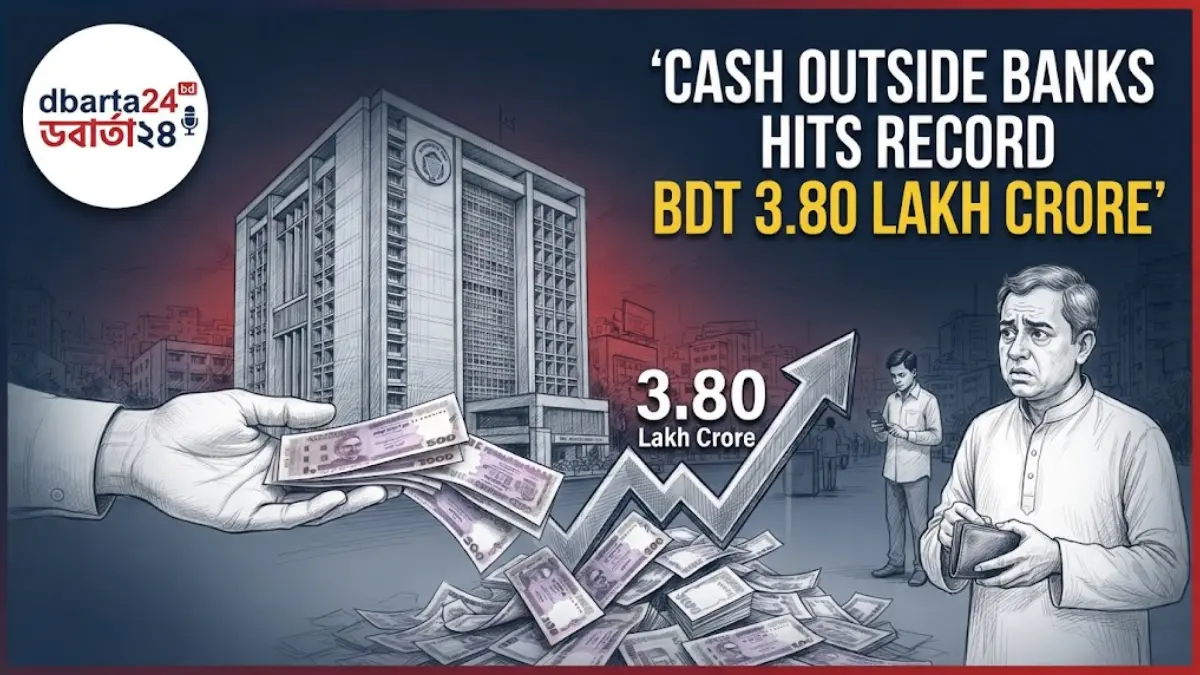
Shah H Khan; Dbarta24 – Despite the rapid expansion of digital payment infrastructure across Bangladesh, the circulation of cash outside the banking system has surged to an all-time high.
According to Bangladesh Bank data, currency outside banks stood at 3,49,374 crore BDT at the end of May, which further climbed to cross 3,80,000 crore BDT by June and July.
Economists and bankers view this massive liquidity outside formal institutions as concerning, attributing the trend to persistent high inflation, a cash-reliant informal economy, a large shadow economy, limited financial inclusion, and lingering crises of confidence within the banking sector.
A Decade-Long Upward Trend
Historical data from the central bank highlights a consistent rise in cash retention outside formal accounts.
In 2011, currency outside banks was recorded at 58,417 crore BDT. By June 2021, it scaled up to 2,09,517 crore BDT, reaching 2,36,448 crore BDT in June 2022, and touching 2,91,913 crore BDT by June 2023.
Although stability fluctuated mildly through 2024 and 2025, a sharp escalation followed. By June of last year, the amount stood at 2,96,451 crore BDT, before ballooning significantly over the next twelve months.
Central bank currency management officials noted that unrest surrounding Islami Bank in June accelerated this cash outflow. Panic-driven withdrawals stripped the bank of nearly 25,000 crore BDT in deposits, prompting Bangladesh Bank to provide approximately 13,000 crore BDT in loans to manage the liquidity crunch.
However, Mohammad Zahir Hossain, an executive director of Bangladesh Bank and the appointed administrator at Islami Bank Bangladesh PLC, stated, “Islami Bank’s daily transactions are now normal.
The money taken from the central bank will be repaid in installments. Many customers who withdrew money out of panic have returned to the bank.”
Paradox of Rising Deposits and Cash Spikes
Interestingly, while cash outside banks is increasing, deposit growth within the formal banking sector remains robust.
Bangladesh Bank figures show that deposits grew by 1,63,522 crore BDT during the first 11 months (July to May) of the 2025–26 fiscal year, compared to an increase of 89,774 crore BDT during the same period the previous fiscal year.
By the end of May, total customer deposits in banks reached 20,41,692 crore BDT, marking an 11.41 percent growth.
Dr. Fahmida Khatun, Executive Director of the Centre for Policy Dialogue (CPD) and a member of the Bangladesh Bank board of directors, pointed out the contradiction. “With the modernization of the payment system, the size of the informal economy should decrease. But in reality, the flow of cash outside banks is increasing, and at the same time, deposits are also growing. It is necessary for the Ministry of Finance and Bangladesh Bank to investigate why this is happening,” she stated. She added that an expanding informal economy implies capital originating from unverified sources, which necessitates scrutiny over tax compliance, alongside growing concerns regarding corruption, black money, and institutional distrust.
Digital Expansion vs. Ground Realities
City Bank Managing Director and CEO Mashrur Arefin observed that surging commodity and service prices require larger amounts of physical cash for everyday purchases. He believes that if inflation drops back to 5 percent, cash outside banks could halve.
Furthermore, Arefin noted that digital payment infrastructure remains inadequate relative to demand, pointing out that compared to millions of retail shops, the distribution of QR codes, POS machines, cards, and internet banking is still limited.
He emphasized that trust deficits also drive cash preference, as people in many areas lacking strong bank branches tend to hoard money at home.
Despite these hurdles, technology-driven payments have scaled massively. Mobile Financial Services (MFS) process roughly 2.5 lakh crore BDT monthly, while debit, credit, prepaid cards, and internet banking applications handle another 2.5 lakh crore BDT every month.
Central bank initiatives like ‘Bangla QR’ and real-time platforms like RTGS and NPSB are increasingly utilized, making the concurrent spike in physical cash deeply concerning.
Arief Hossain Khan, Executive Director and Spokesperson for Bangladesh Bank, voiced apprehension over the trend: “All merchants in the country have been brought under Bangla QR. All digital payment mediums are now more popular and faster. Even then, the increase of cash outside the bank is a matter of concern. The big question is whether people are turning away from banks.”