


Muhammad Tareq – Bangladesh has entered the new fiscal year 2026-27 under contrasting economic indicators.
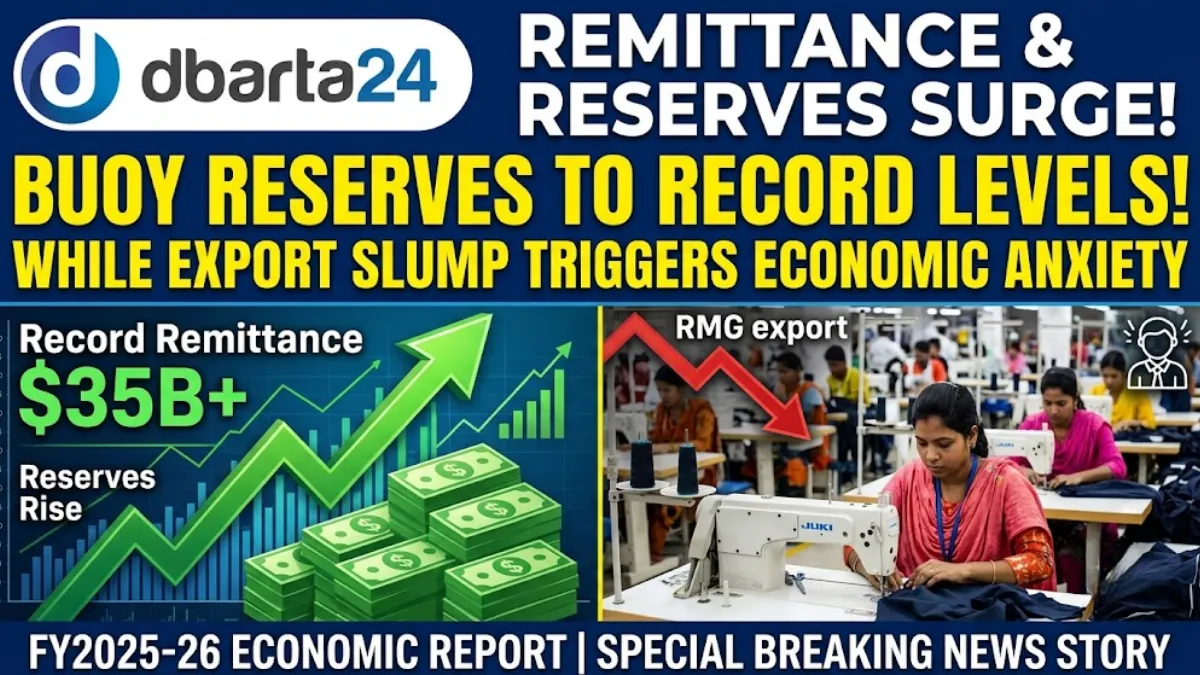
A historic surge in inward remittances has pushed foreign exchange reserves to a comfortable position, offering much-needed breathing room for the economy.
However, this relief is heavily countered by a persistent slump in export earnings—driven by global trade conflicts and Middle East geopolitical tensions—which has led to factory closures and job losses.
Economists and business leaders suggest that while the immediate financial pressure has eased due to record-breaking expatriate inflows, long-term stability hinges on a revival of global demand, successfully navigating intense market competition, and the resolution of ongoing international conflicts.
Record-Breaking Remittance Inflow Drives Reserve Recovery
Despite major geopolitical turbulence in the Middle East, remittance inflows through formal banking channels hit an all-time high in the outgoing fiscal year (FY2025-26).
Data from the Bangladesh Bank reveals that Bangladeshi expatriates sent home approximately $35.20 billion up to June 27, marking a phenomenal 16% year-on-year growth.
This builds upon a momentum that began two years ago following major political shifts in the country, which catalyzed a 27% growth in FY204-25, pushing the figure past the $30 billion milestone for the first time.
The central bank highlighted that monthly inflows consistently hovered around $3 billion between December and May.
Consequently, the country’s foreign exchange reserves have strengthened significantly. As of last month, total reserves climbed to $36.08 billion.
Under the International Monetary Fund’s (IMF) BPM-6 reporting manual, the usable reserves rose to $31.53 billion, up from $26.74 billion on June 30 of the previous year.
“The primary driver behind this remittance spike is a significant reduction in the illegal Hundi money-laundering channels,” said Mustafa K. Mujeri, former Chief Economist of the Bangladesh Bank. “The price gap between official and unofficial dollar rates has narrowed considerably, while sending and receiving money through legal avenues has become much easier. To sustain this upward trajectory, the government must look toward exploring new labor markets and exporting skilled manpower.”
Exporters Stumble Amid Global Headwinds and Tariff Wars
While the supply of foreign currency brings relief, the export sector—the secondary pillar of the economy—tells a grim story.
During the first 11 months (July–May) of the outgoing fiscal year, merchandise exports dropped by 2.5% to $43.80 billion, compared to $44.95 billion during the corresponding period of the previous fiscal year.
According to the Export Promotion Bureau (EPB), export figures exceeded $4 billion only in July, January, April, and May, while dropping to the $3 billion range in the remaining months.
Exporters point to aggressive protectionist measures adopted in major Western markets. Following reciprocal import tariffs imposed by US President Donald Trump last year, Bangladeshi readymade garments (RMG) faced massive setbacks in the United States.
Additionally, the outbreak of the Iran conflict drove up global fuel prices, forcing the Bangladesh government to buy energy at premium rates—further straining manufacturing margins and triggering a wave of factory closures and worker layoffs.
Rising Competition and The Road Ahead
Industry insiders warn that geopolitical stabilization remains critical for a full economic recovery.
A complete resolution of conflicts involving Iran, the US, and Israel is expected to bolster expatriate income, while a rebound in global consumer demand could rescue the export sector.
However, the European Union (EU) market presents severe headwinds, as competing nations intensify their market strategies.
“A persistent slowdown grips the global market, and our local leverage is limited,” stated Fazlul Hoque, former President of the Bangladesh Knitwear Manufacturers and Exporters Association (BKMEA). “China is pursuing an aggressive marketing strategy within the EU market, and we must match that aggression to avoid losing our market share. The government needs to formulate a strategic roadmap in consultation with industry stakeholders, while entrepreneurs must intensify efforts to enhance competitiveness and product diversification through all available state policy support.”