


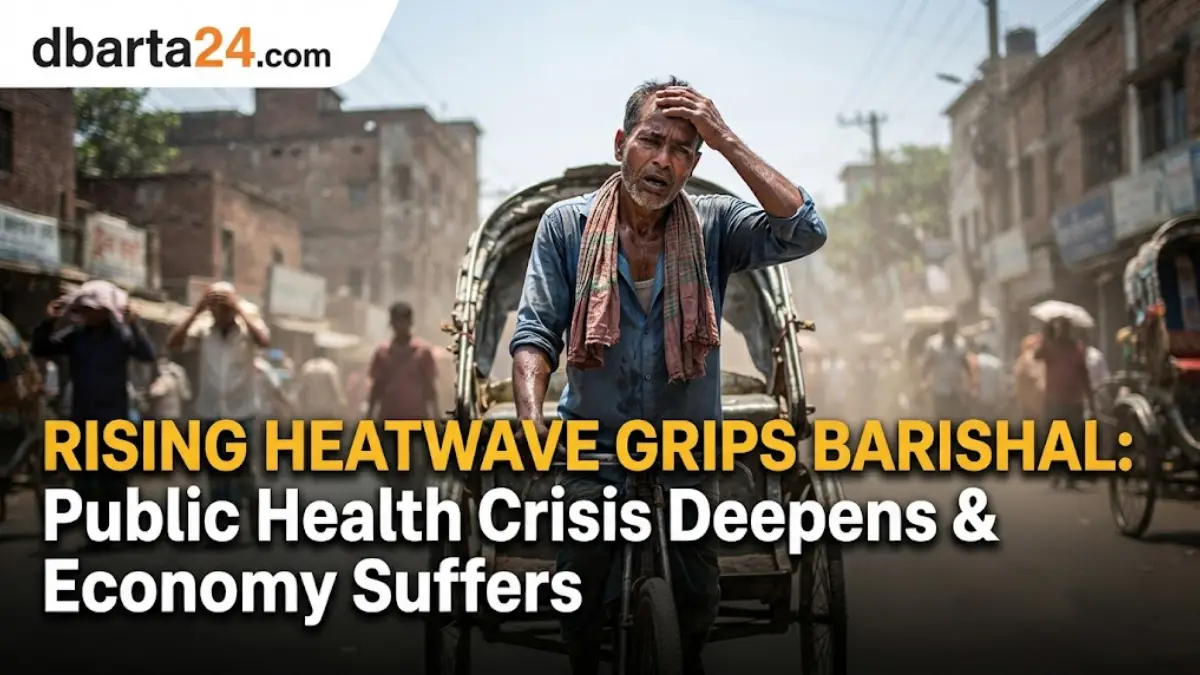
Ali Yousuf, Barishal Correspondent; Dbarta24 – The southern region of Bangladesh is facing an escalating climate crisis as Barishal steadily grows warmer while experiencing a noticeable decline in rainfall.
This shifting weather pattern is not only triggering severe environmental stress but is also directly eroding human productivity, inflating household expenses, and creating critical public health hazards across the division.
A compelling historical analysis conducted by Barishal University geology and mining engineering faculty members, Md. Abdullah Salman and Faisal Ahmed, sheds light on this alarming trend.
Published in the 2020 Malaysian Journal of Geosciences, the research combined Bangladesh Meteorological Department data from 1961 to 2019 with datasets from NASA and NOAA.
The study revealed that over a 60-year span leading up to 2019, Barishal’s maximum temperature rose by $0.33^\circ\text{C}$, while average annual rainfall decreased by $0.18\text{ mm}$.
Most notably, nighttime temperatures are climbing faster than daytime temperatures, with maximum temperature increases peaking in June and minimum temperatures rising most rapidly in February.
Economic Strain on Laborers and Households
The changing climate has translated into harsh economic realities for everyday residents. Summer temperatures regularly surpass $40^\circ\text{C}$, and erratic monsoon rains offer little to no cooling relief.
-
Shrinking Incomes: Outdoor workers bear the brunt of the heat. Rickshaw-puller Abul Kalam (48) from the Sagardi area notes that he can no longer work his usual long hours due to exhaustion, severely cutting down his daily income.
-
Soaring Living Costs: Residents like Abdur Razzaq from Rupatoli report having to run electric fans around the clock, making air conditioning a near-necessity and driving up utility expenses.
-
National Impact: According to a 2024 World Bank report titled “Ending Plight: The Impacts of Heat, Health and the Economy in Bangladesh,” heatwaves cost the country roughly 25 million working days and $1.78 billion in economic losses in 2024 alone.
Escalating Health Risks
Rising temperatures and humidity are breeding grounds for vector-borne and waterborne diseases. Medical professionals report spikes in heat stroke, dehydration, cardiovascular distress, and respiratory complications.
-
Waterborne and Vector-Borne Diseases: Outbreaks of dengue and diarrhea have surged in recent years. In 2025 alone, 21,815 individuals sought treatment for dengue in government hospitals, resulting in 51 deaths, while continuous high patient volumes persist into 2026.
-
Skin Infections: Overcrowded settlements like the Palashpur slum experienced widespread outbreaks of scabies—a contagious skin condition exacerbated by extreme heat and high humidity.
-
Financial Burden of Treatment: Patients hospitalized for climate-induced illnesses face heavy out-of-pocket costs for diagnostics and medicine, even when primary care is free.
“The combination of rising temperatures and declining rainfall is depleting soil moisture, increasing irrigation dependency, and worsening coastal salinity. Waterlogging, salinity, and irregular rainfall together create complex risks to public health.”
— Md. Abdullah Salman, Environmental Geophysicist and PhD researcher at the University of Nebraska-Lincoln
Salman emphasizes that Barishal is transitioning into a warmer and more humid climate, making advance warnings, urban greening, water body preservation, and climate-resilient agriculture vital.
A Local Solution: Nature’s Blueprint
Amid the concrete expansion, Barishal’s historic Raja Bahadur Road and surrounding areas stand out as a natural oasis. Featuring dual tree-lined corridors, ponds, a massive park, and centenarian British-era trees with a dense canopy, this area remains remarkably cool during heatwaves.
Urban planners and environmentalists point out that such green corridors are essential models for urban temperature regulation.
Furthermore, a 2025 study published in the Journal of Urban Forestry and Urban Greening underscores that mitigating urban heat requires not just random tree-planting, but layered urban greening and deliberate, sustainable architectural planning.
Barishal’s climate trajectory serves as an urgent wake-up call for urban planners and policymakers alike.
Without proactive measures—such as expanding green spaces, protecting water bodies, and upgrading public health infrastructure—the compounding economic and physiological costs of extreme heat will continue to burden the region’s vulnerable populations.