


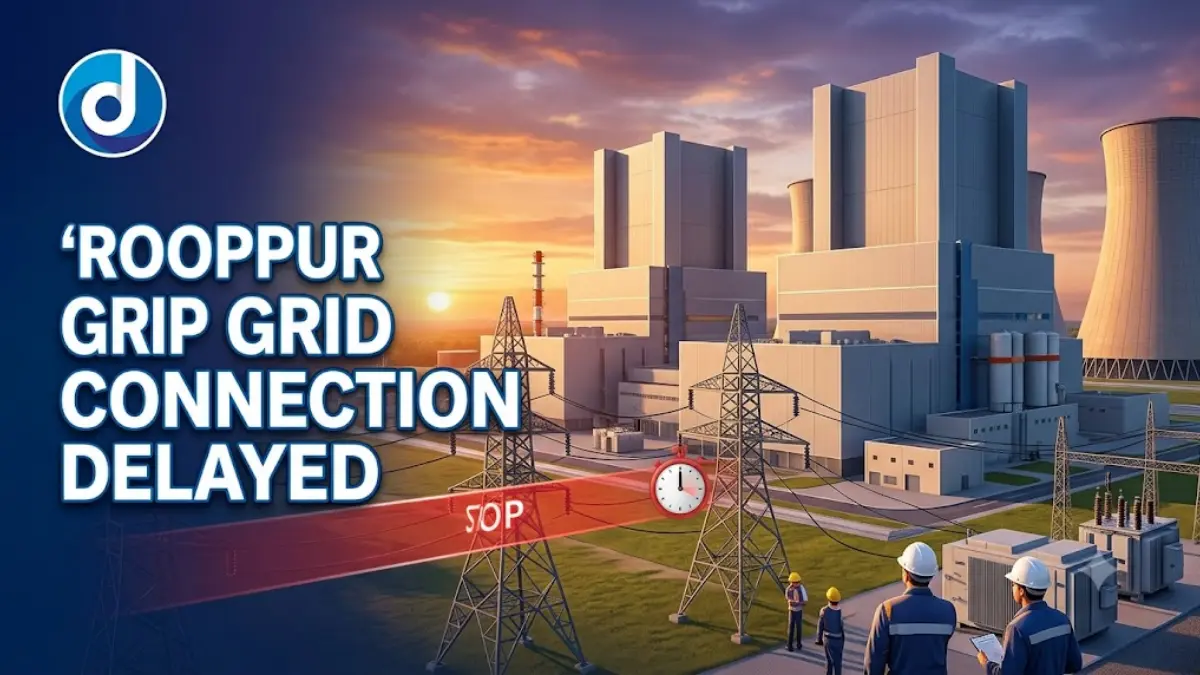
Rahman Ataur; Dbarta24 — The anticipation of drawing nuclear power into Bangladesh’s national grid has met a temporary setback.
The first unit of the flagship Rooppur Nuclear Power Plant (RNPP), which was scheduled to supply an experimental 300 megawatts (MW) of electricity to the national grid by the end of August, will not meet its target date.
The delay stems from an ongoing regulatory review process. Although fundamental technical evaluations have been successfully completed, the project management is awaiting the crucial ‘B-2’ commissioning license from the Bangladesh Atomic Energy Regulatory Authority (BAERA). Without this formal authorization, commencing power generation remains legally and operationally restricted.
Technical Readiness Achieved, Regulatory Clearance Awaited
According to project officials, fuel loading for the first unit commenced on April 28, following which fuel assembly and initial safety assessments were completed smoothly.
However, transitioning to the next critical phase—achieving reactor “criticality,” where a controlled nuclear chain reaction is initiated to generate heat—requires the mandatory B-2 commissioning permit.
Dr. Md. Zahidul Hassan, Managing Director of Nuclear Power Plant Company Bangladesh Limited (NPCBL), confirmed that Unit-1 is at the final threshold prior to energy generation.
“Following regulatory authorization, fuel loading and 90 essential technical and safety tests were successfully conducted,” Dr. Hassan stated. “We are now awaiting BAERA’s final inspection report and subsequent license issuance to proceed to the next phase.”
He further clarified that securing the license will not trigger instantaneous power supply. “Once the license is granted, controlled nuclear reactions will begin in the reactor. Following that, an additional four to six weeks of stringent testing and preparation will be required before experimental electricity generation can commence,” he added.
Safety First: Regulatory Rigor and Expert Perspectives
Addressing the timeline, BAERA Chairman Md. Mahamudul Hasan emphasized the stringent protocols governing nuclear safety licenses.
He noted that issuing a commissioning license at this stage is a highly complex and sensitive procedure that demands absolute verification of all test parameters against international safety standards.
The regulatory chief did not specify an exact date for issuing the permit, reinforcing that compliance takes precedence over deadlines.
Reinforcing this approach, former RNPP Project Director Dr. Shawkat Akbar stated that uncompromising safety standards govern nuclear infrastructure worldwide.
“There is zero room for compromise when it comes to safety in a nuclear power facility. Every single phase must be meticulously executed and verified before advancing to the next,” Dr. Akbar noted.
Background and Project Scope
The $12.65 billion Rooppur Nuclear Power Plant, located in Ishwardi, Pabna, is Bangladesh’s maiden nuclear energy endeavor, constructed with financial and technical assistance from Russia.
The plant features two Russian-designed VVER-1200 reactors, each capable of generating 1,200 MW of power. Upon full operationalization of both units, the facility will add a combined capacity of 2,400 MW to the national power grid, significantly bolstering the country’s baseload energy security.
While the delay postpones immediate grid addition, project authorities maintain that adhering strictly to global atomic safety protocols remains the utmost priority to ensure long-term operational integrity and public safety.