


Foreign Desk: While the discussion about ISRO’s Chandrayaan-3 continues, now Russia has also joined the race for the Moon. After five decades, they are also sending their lander to the moon.
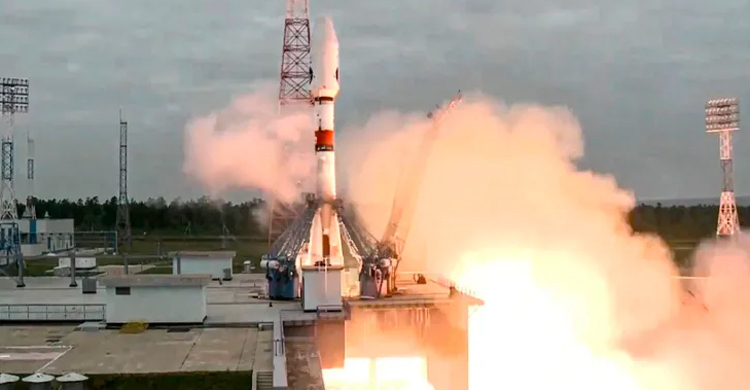
On Friday (August 11), Russia’s Luna-25 flew to the Moon from the Russian Space Research Center. Their destination is the South Pole of the Moon.
Meanwhile, India’s Chandrayaan-3 is moving towards the south pole of the Moon. Russia claims that their lander is also going to land on the moon at about the same time as Chandrayaan-3. In such a situation, there is already an atmosphere of competition as to who will reach the South Pole first, whose expedition will be successful.
ISRO’s Chandrayaan passed towards the Moon on 14 July. The Russian lander was launched 28 days later. Luna-25 will reach the Moon’s orbit within five days of launch.
As per the plan, it is scheduled to land on the south pole of the Moon on August 23. On that day, Chandrayaan-3 can also land on the moon.
Russian space research agency Roscosmos has claimed that Luna-25 will reach the Moon’s orbit within five days of launch. After this, it will take another five to seven days for the Moon to revolve around the South Pole.
Nowadays, the South Pole of the Moon is still unknown. All previous missions from Earth to the Moon were in the northern hemisphere of the satellite.
The South Pole is immersed in eternal darkness. There is no sunlight. This area covered with thick ice sheets is extremely inaccessible.
That’s why no campaign has been successful here so far. Four years ago, Chandrayaan-2 failed during a soft landing on the south pole of the Moon.
However, Russia has said that the Russian lander will not create any hindrance in India’s lunar mission despite the landing time being almost the same. There is no possibility of a collision between Chandrayaan-3 and Luna-25.
History will be made if Luna-25 successfully lands before Chandrayaan-3 on the uncharted South Pole of the Moon. In such a situation, the credit for the successful campaign on the South Pole will go to Russia.