


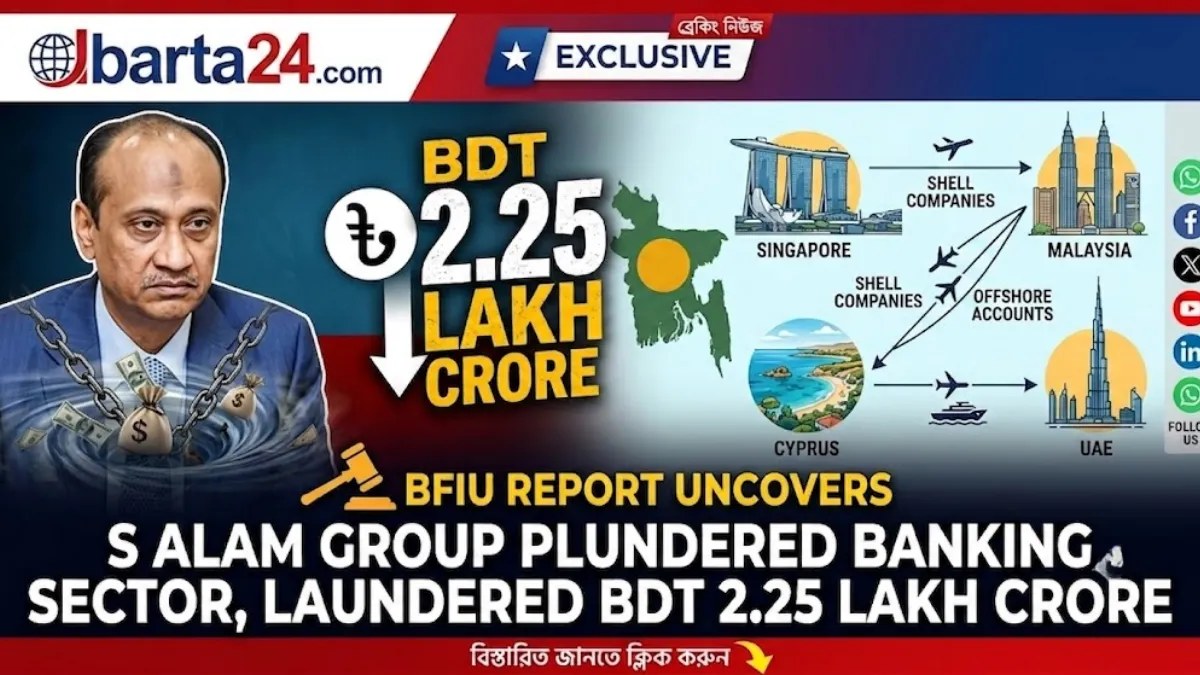
Special Correspondent — In what is being described as one of the most audacious financial heists in global history, the controversial conglomerate S Alam Group systematically embezzled and laundered approximately BDT 2.25 lakh crore ($18.7 billion approx.) from the domestic banking sector during the 15-year rule of the ousted Awami League government.
The explosive findings were detailed in the annual report for the fiscal year 2024-25 published by the Bangladesh Financial Intelligence Unit (BFIU).
While the state intelligence agency masked the conglomerate under the pseudonym “S Group” as a case study, senior BFIU officials have explicitly confirmed to the media that the entity in question is indeed the Chittagong-based S Alam Group.
An Unprecedented Systemic Collapse
According to the BFIU report, the scale of corruption represents a “systemic and unprecedented failure” of Bangladesh’s financial architecture.
S Alam Group weaponized political clout and reportedly deployed state intelligence agencies to forcefully seize control of seven commercial banks and one major financial institution.
Once internal control was established, the group replaced independent boards with trusted family members and loyal associates.
This total dominance allowed them to rewrite internal banking regulations, bypass risk-assessment protocols, and clear massive loans without regulatory oversight.
The Mechanics of the Plunder
The investigation exposes a highly sophisticated network of fraud split between direct operations and fictitious entities:
-
The Loan Disparity: S Alam Group withdrew BDT 2.25 lakh crore against collateral valued at a mere BDT 32,000 crore, leaving the banking sector exposed to catastrophic debt defaults.
-
Shell Companies: BDT 90,000 crore was pulled under the names of 43 directly linked enterprises. An additional BDT 98,000 crore was extracted through an intricate web of fake or “shell” companies, while the remaining BDT 37,000 crore was siphoned through alternative channels.
Global Laundering Networks & Golden Passports
The plundered capital was successfully moved out of Bangladesh through complex money laundering mechanisms, including hundi networks, inflated international trade invoices, and specialized trust accounts.
The BFIU confirmed that the siphoned funds were used to build vast empires of offshore assets across four primary destinations: Singapore, Malaysia, Cyprus, and the United Arab Emirates (UAE).
To secure their exit and evade legal repercussions, the core beneficiaries of the S Alam Group acquired citizenships in three different foreign countries. This multi-citizenship status is expected to heavily complicate state efforts to extradite the culprits and recover the laundered wealth.
The revelations by the BFIU underscore the deep-rooted crony capitalism that eroded Bangladesh’s financial sector over the last decade and a half.
As the interim administration pledges aggressive banking reforms, the S Alam scandal stands as the ultimate test case for the state’s capability to track offshore wealth, break monopolistic corporate capture, and restore public trust in the country’s bleeding financial institutions.