


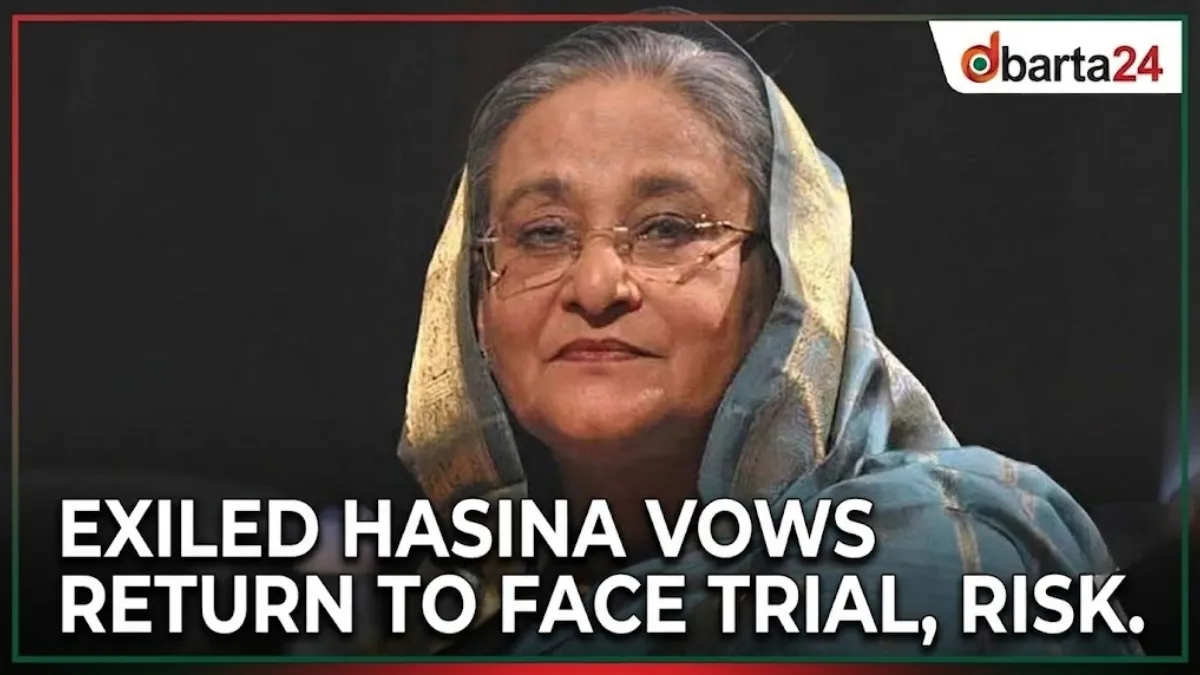
International Desk — Former Bangladeshi Prime Minister Sheikh Hasina has stated she is fully aware of the personal and legal risks, including execution, but remains determined to return to Bangladesh to face judicial proceedings.
Speaking in a written interview with Japan’s Kyodo News, the 78-year-old ousted leader emphasized that while the nation needs healing, “reconciliation cannot mean impunity,” insisting that all accountable parties must face proper legal due process.
Sheikh Hasina fled to India on August 5, 2024, following a massive student-led popular uprising against her administration.
In her absence, Bangladesh’s International Crimes Tribunal sentenced her to death in November 2025 over allegations of ordering lethal force against anti-government protesters.
According to United Nations estimates, around 1,400 people lost their lives during the violent unrest in July and August 2024, largely due to security force actions.
Sheikh Hasina has consistently denied ordering killings, describing the tribunal’s verdict as “politically motivated” and alleging that political opponents orchestrated the unrest.
In a prior interview with Reuters, the former prime minister signaled plans to return to Bangladesh alongside other exiled senior Awami League leaders by December to surrender to the court.
Addressing her potential fate upon return, Hasina told Kyodo News, “They may send me to prison. They may even try to hang me. I am aware of those risks.”
She reiterated her rejection of the charges, advocating for an independent evaluation of the violence: “If independent foreign forensic experts examine the cause of death for each individual and identify the specific weapon or bullet used, the truth can still be revealed.”
Meanwhile, the Bangladeshi government has formally requested her extradition from India.
A spokesperson for India’s Ministry of External Affairs confirmed receipt of the application, noting that New Delhi is reviewing the matter under legal and judicial frameworks.
Earlier this month, Information Advisor Zahed Ur Rahman affirmed that the government is actively seeking her extradition while promising her a fair opportunity for self-defense.
Reflecting on the nation’s political trajectory, Hasina underscored the geopolitical importance of domestic stability: “A stable Bangladesh is crucial not only for Bangladesh itself, but also for South Asia, the Bay of Bengal region, development partners, and countries like Japan that have invested trust, resources, and friendship in our development journey.”
With the Awami League currently banned from political activities in Bangladesh—preventing its participation in the 13th parliamentary elections—Hasina noted that the coming decade could serve as a period of restoration, provided democracy is restored and citizens are allowed to decide their own future.