


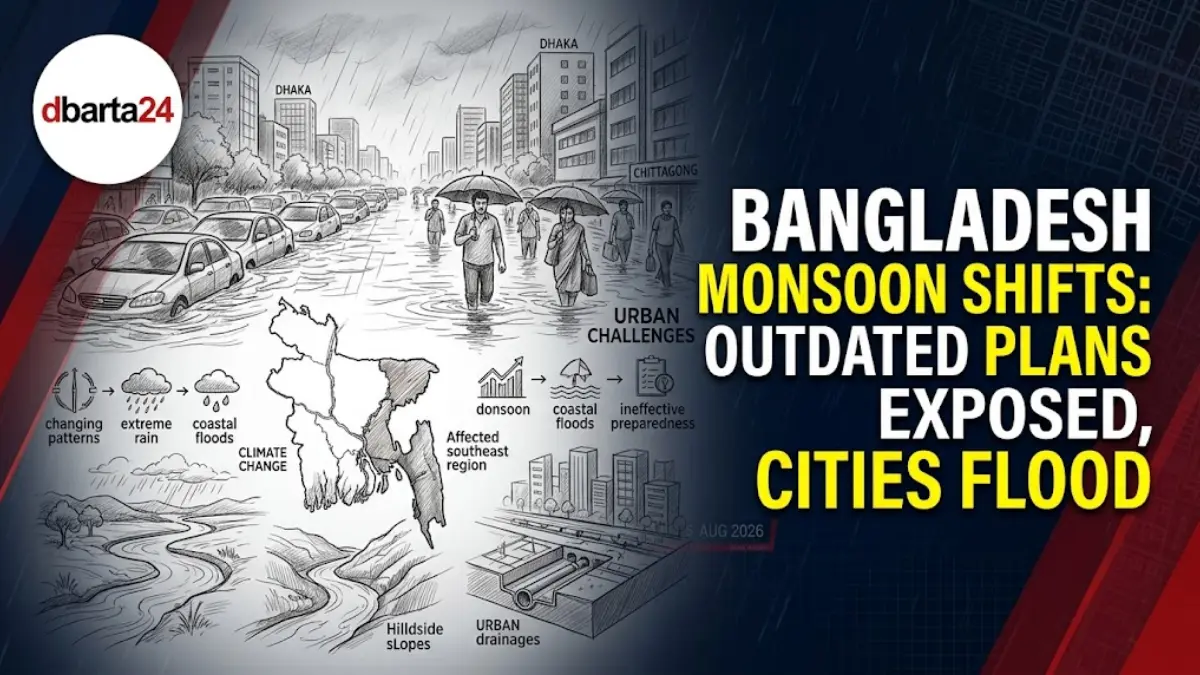
Muyabia Labony; Dbarta24 — Bangladesh is confronting a rapid and alarming shift in its seasonal weather patterns. The monsoon season now brings erratic rainfall, severe localized flash floods, and widespread urban waterlogging across major cities.
However, climate experts warn that national urban planning, infrastructure maintenance, and disaster preparedness remain trapped in outdated models—leaving millions increasingly vulnerable.
An Unprecedented Monsoon Season
Data from the Bangladesh Meteorological Department (BMD) reveals a stark disruption in the traditional climate cycle.
Following an unusually dry period from late November through early March, the country experienced intense heatwaves accompanied by a 76% surge in April rainfall above monthly averages.
June saw a near 29% drop in expected rain alongside multiple prolonged heatwaves, only for nature to reverse course dramatically in July.
National rainfall in July surged by 35.6% above normal averages, reaching a countrywide average of 666 mm compared to the standard 491 mm.
The deviation was most severe in the Khulna division, which recorded 53% more rain than average, followed closely by Chittagong at 51%.
Between July 5 and July 12, the southeastern coastal belt endured massive, short-duration downpours. Chittagong registered 1,454 mm of rain over just eight days—including a single-day record of 412 mm on July 7, marking the city’s highest single-day rainfall in four decades.
Neighboring coastal areas experienced similar extremities, with Bandarban recording 1,102 mm and Cox’s Bazar receiving 846 mm during the same eight-day period.
Shortly after, Dhaka was overwhelmed by 97 mm of rain within hours, submerging large swathes of the capital.
Meteorological records dating back to 1953 rank this intense eight-day deluge as the second-highest rainfall event in the nation’s recorded history, distinguished primarily by its vast geographical spread across the entire southeastern region.
Changing Dynamics: From River Floods to Urban Submersion
Environmental analysts emphasize that the challenge facing Bangladesh is no longer confined to traditional riverine flooding driven by upstream river overflow.
The disaster landscape has evolved into a complex mix of rapid flash floods, landslide risks in hilly terrains, and acute urban inundation.
“Bangladesh typically experiences three types of floods: river overflows, hill torrents, and urban flooding,” said Professor A.K.M. Saiful Islam from the Institute of Water and Flood Management at the Bangladesh University of Engineering and Technology (BUET). “This season, all three phenomena unfolded almost simultaneously.”
Professor Islam highlighted the structural complexities in coastal hubs like Chittagong, where sluice gates on the Karnaphuli River must remain closed during high tides.
Without heavy-duty, synchronized pumping stations, stormwater cannot discharge into the river, causing rapid citywide waterlogging. “It is high time to introduce hyper-local, area-specific flood forecasting alongside specialized urban flood warning systems,” he added.
Climate Drivers Behind the Shift
Long-term climate studies corroborate these observations. The BMD’s Changing Climate of Bangladesh report notes that while overall seasonal rainfall totals between 1980 and 2023 have remained relatively stable, the distribution pattern has altered significantly.
Cities like Dhaka and Rajshahi lose an average of 2.7 rainy days per decade, leading to longer dry spells interrupted by sudden, extremely heavy rainfall events.
“Over the past decade, the southwest monsoon has been entering the country two to five days later than normal,” explained BMD meteorologist Md. Bazlur Rashid.
“Instead of steady, multi-day rainfall upon arrival, the monsoon starts weak and later triggers short-duration, high-intensity rain events. Depression tracks originating in the Bay of Bengal have also shifted, pushing concentrated moisture toward the southeast.”
Senior meteorologist Abul Kalam Mallik attributed these localized torrents to global atmospheric phenomena like El Niño, which alter convergence zones and generate rapid, moisture-heavy convective systems.
Meanwhile, former BMD Director Samarendra Karmakar noted that while extreme rainfall events occurred in 1987, 1988, and 1998, current climate conditions trigger flash deluges over much shorter timeframes, demanding faster emergency response capabilities.
A Call for Structural Reform
As the climate reality changes, experts stress that merely issuing weather bulletins is no longer sufficient.
Mitigating future risks will require integrated governance across state agencies, comprehensive drainage modernization, aggressive restoration of choked canals and wetlands, and improved urban waste management.
Without aligning infrastructure and emergency response mechanisms to match these changing monsoon dynamics, Bangladesh’s urban centers and vulnerable rural zones will remain exposed to increasingly destructive seasonal shocks.