


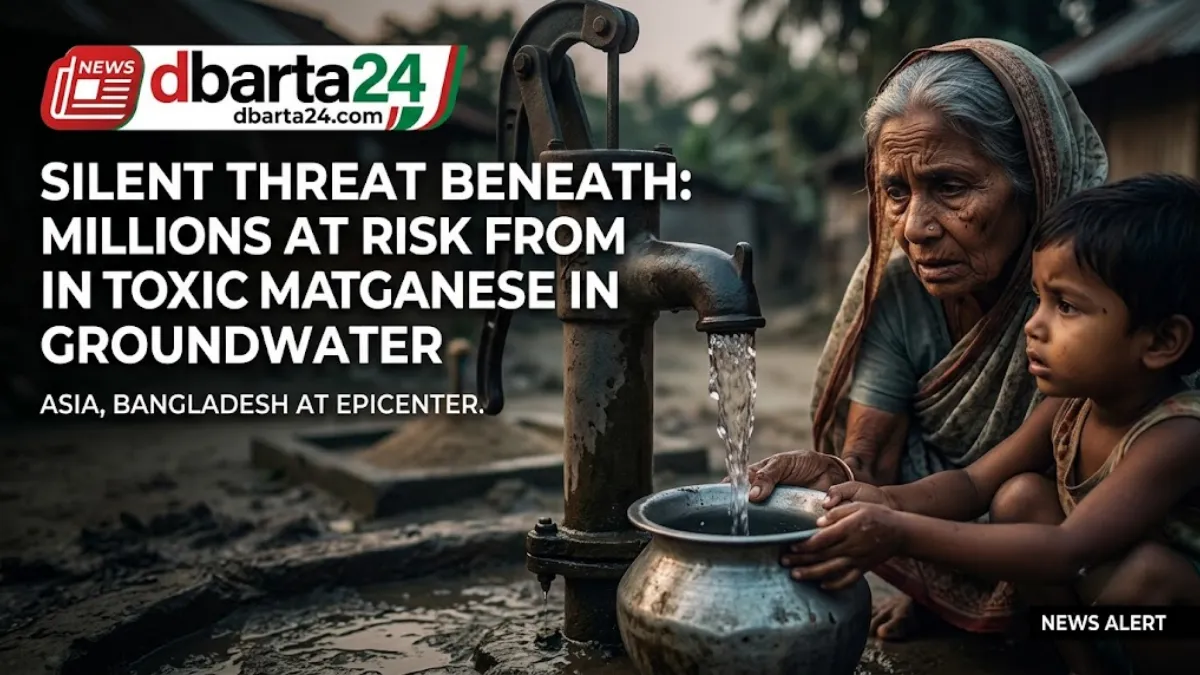
M K Alam — A new global environmental study has unveiled a hidden public health crisis lurking beneath the Earth’s surface.
While international concern has long focused on arsenic and nitrate contamination, researchers have now identified high levels of manganese in groundwater as a grave threat affecting between 180 million and 220 million people worldwide—far higher than previously estimated.
According to a groundbreaking study published in the journal Nature Water by Joel Podgorski and Michael Berg from the Swiss Federal Institute of Aquatic Science and Technology (Eawag), approximately 90 percent of the affected population lives in densely populated regions of Asia.
South Asia at the Epicenter
The newly mapped global distribution of groundwater manganese risks highlights young sedimentary river basins in South and Southeast Asia as the most vulnerable zones.
The Ganges-Brahmaputra Delta—spanning Bangladesh and India—has been identified as one of the primary global hotspots.
Other critical areas include Vietnam’s Mekong Delta, Hanoi’s Red River Delta, portions of Pakistan, and the Mississippi River Basin in the United States.
The contamination occurs naturally through geochemical processes: in oxygen-deprived subsurface environments, microbial reactions cause manganese oxides present in sediments to dissolve directly into the surrounding water table.
Severe Risks to Brain Development and Children
Although manganese is an essential nutrient required in small amounts through food, elevated concentrations in drinking water make it toxic.
Recognizing its severe health impacts, the World Health Organization (WHO) significantly tightened its safety guidelines in 2021, reducing the recommended threshold in drinking water from 400 micrograms per liter to just 80 micrograms per liter.
Chronic exposure to excessive manganese damages the human central nervous system and impairs cognitive and behavioral development in children and infants.
“Until now, the main focus has been on waterborne risks like arsenic, fluoride, and nitrate. In contrast, manganese is still largely ignored and tested only sporadically,” said geochemist and co-author Michael Berg.
Infrastructure Deficits Exacerbate Asia’s Crisis
While elevated manganese levels are also present in parts of Europe—such as Italy’s Po Delta and regions stretching from Poland to Germany—populations there remain largely protected due to centralized, advanced water treatment networks.
In contrast, millions in Asia rely directly on untreated shallow tubewells and private groundwater sources.
“Asian regions are extremely densely populated, and a large portion of the population relies directly on untreated groundwater,” noted Joel Podgorski, environmental scientist and lead author of the study.
The Arsenic Misconception and Simple Solutions
The study highlighted a vital finding for water testing protocols: despite forming under similar geochemical conditions, high levels of arsenic and manganese rarely coexist in the exact same wells.
Only 4 percent of high-risk areas exhibited dangerous levels of both elements simultaneously.
Podgorski issued a clear warning to public health officials and households: “If someone tests a tubewell for arsenic and finds it safe, they cannot immediately declare the water safe for consumption. You must specifically test for manganese as well.”
Fortunately, remediation is straightforward. When manganese-laden water is exposed to oxygen, the chemical oxidizes into solid particles that settle at the bottom.
The element can be filtered out entirely using standard sand filtration systems and basic aeration techniques, offering a low-cost solution for vulnerable communities.