


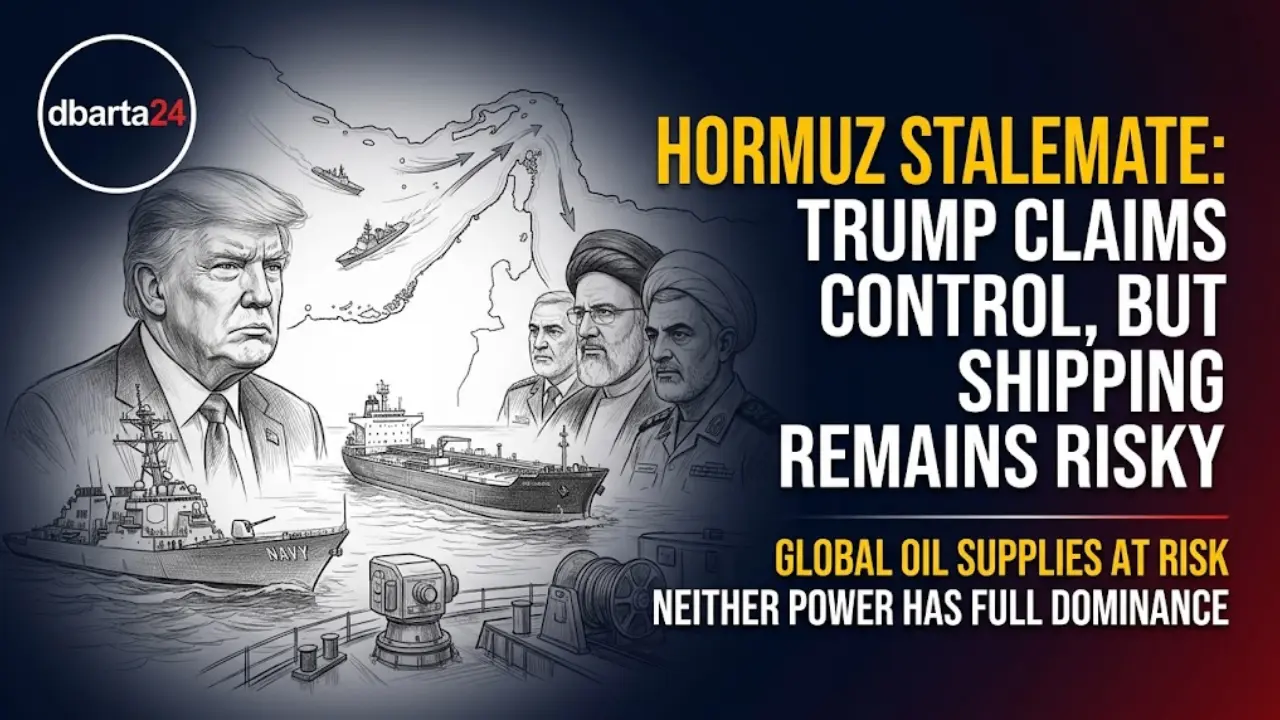
Dbarta24 International Desk— Six months into the conflict between the United States and Iran, the Strait of Hormuz—one of the world’s most critical maritime chokepoints—remains in a state of severe paralysis.
Global oil reserves are depleting rapidly, yet Washington and Tehran remain locked in a fiery war of words over who actually controls the vital waterway.
Despite claims by US President Donald Trump that Washington exercises total command over the strait and that the US Navy has cleared the area of sea mines, military analysts and intelligence experts paint a starkly different picture.
The reality on the water is one of mutual attrition, where neither power holds total sway, leaving international shipping companies unwilling to navigate the hazardous corridor.
A Drastic Drop in Maritime Traffic
Prior to the outbreak of hostilities, approximately 120 commercial vessels navigated the Strait of Hormuz daily. Today, that number has plummeted to a mere handful.
While the US Navy maintains a naval blockade of Iranian ports, Washington has been unable to guarantee absolute security for third-country commercial vessels passing through the Gulf.
According to maritime security data from the United Kingdom, at least 54 vessels have been attacked or damaged in and around the strait since the conflict began, with at least three ships destroyed entirely.
Continuous threats from loitering drones and anti-ship missiles have caused marine insurance premiums to skyrocket, effectively shutting out standard commercial transit.
| Strait of Hormuz Metric | Pre-Conflict | Current Status |
| Daily Commercial Vessel Transit | ~120 ships/day | Fewer than 10 ships/day |
| Global Petroleum Flow Share | ~20% of global oil supply | Severely restricted / Stalled |
| Documented Ship Attacks | Baseline | 54 vessels damaged; 3 destroyed |
Strategic Leverage and Political Stakes
The narrow passage handles nearly 20% of the world’s petroleum traffic, giving Iran a distinct geographical advantage. Analysts suggest Tehran is using this strategic bottleneck as an economic weapon.
Rising global energy costs and market volatility are placing immense domestic pressure on President Trump ahead of the upcoming US midterm elections in November—a dynamic Tehran hopes could force Washington into a diplomatic concession.
Conversely, while the US possesses overwhelming military and economic power, American forces in the Middle East face operational fatigue from continuous warfare.
Observers note that any significant drawdown of US forces would risk forfeiting long-term American influence across the region.
Iranian leaders have forcefully dismissed Washington’s narrative of control. Iranian Foreign Minister Abbas Araghchi criticized US intelligence assessments in a public statement:
“Dangerous as fake news is, fake intelligence is far worse. Washington imposed a war on Iran based on fake intelligence, and it is making another big miscalculation over Hormuz.”
Echoing this stance, Hossein Taeb, head of Iran’s paramilitary Basij force, claimed that US naval and air operations have failed to subdue Iran, asserting that management and operational control of the strait remain firmly in Iranian hands.
Shift to a Low-Key Economic Strategy
In response to the prolonged impasse, Washington appears to be pivoting its strategy. Rather than threatening immediate escalation, President Trump signaled a strategy focused on applying sustained economic pressure on Tehran.
Describing the current posture as “low-key,” the administration is aiming to leverage domestic inflation and currency strain within Iran, utilizing slow-paced diplomatic channels in an effort to soften Tehran’s bargaining position over time.
However, sources close to the negotiations report zero movement on a lasting cease-fire or returning to previous frameworks.
“One of the main points in mediated talks was the US returning to an interim agreement and setting a timeline for fulfilling commitments. But there has been no progress whatsoever,” an Iranian official told Reuters on condition of anonymity.Regional Spillover: Iraq Asserts Airspace Sovereignty
As regional tensions rise, neighboring states are seeking to distance themselves from direct involvement in the conflict.
Iraqi Prime Minister Ali al-Zaidi re-emphasized that Iraqi territory and airspace would not be permitted as a launchpad for military actions against any neighboring nation.
Speaking during an inspection of the Air Defense Command Operations Center, Prime Minister al-Zaidi underscored that Iraq’s sovereignty remains absolute, warning that any unauthorized entry into Iraqi airspace or violation of its national security would face immediate intolerance.