


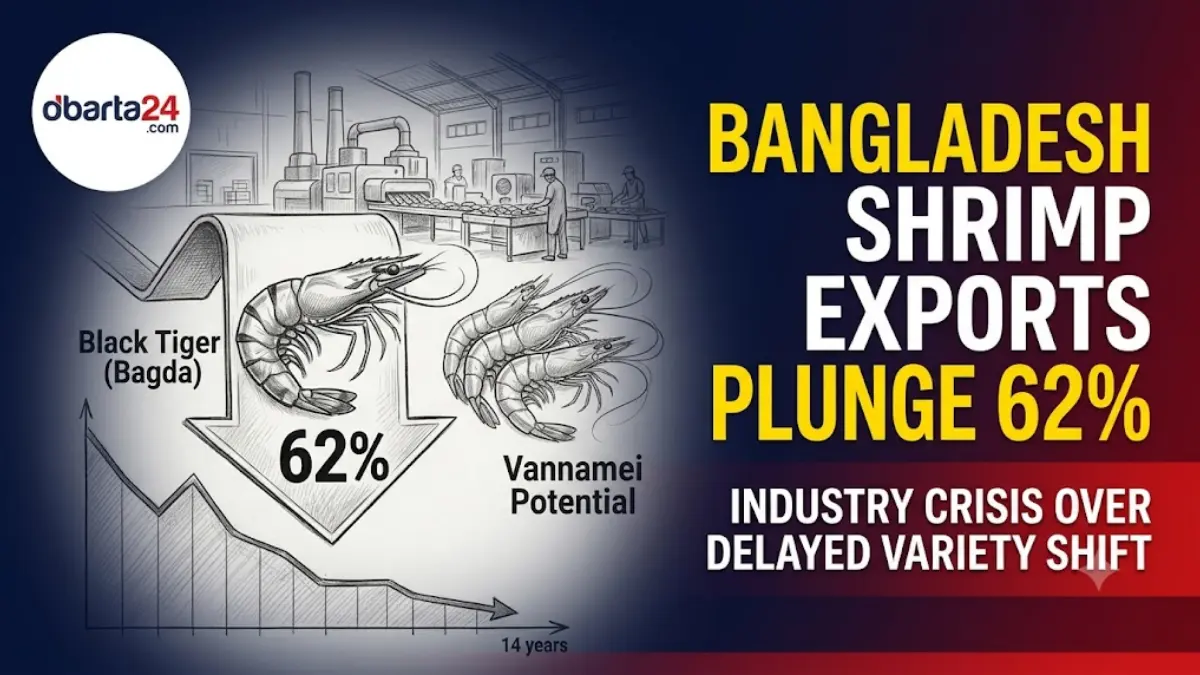
Mustafa Islam; Dbarta24 — Bangladesh’s once-thriving frozen shrimp export sector is confronting an unprecedented downturn, with export volumes dropping nearly 62% over the last 14 years.
A persistent reliance on traditional Black Tiger (Bagda) shrimp, coupled with a delayed transition toward high-yielding, cost-effective Vannamei species, has severely eroded the country’s competitiveness in key international markets.
According to data from the Export Promotion Bureau (EPB), Department of Fisheries, and the Bangladesh Frozen Foods Exporters Association (BFFEA), Bangladesh exported nearly 50,000 tonnes of shrimp valued at $570 million in FY2012–13.
By the end of FY2025–26, export volumes tumbled to just 19,000 tonnes, generating $285.61 million—marking a steep drop of 31,000 tonnes in volume and a loss of $284.4 million in annual revenue over 14 years.
Yield Disparity and Raw Material Shortages
The crisis stems primarily from changing consumer preferences in global markets across Europe, China, and the United States, where high-yield Vannamei shrimp dominates due to lower price points.
While Bangladesh cultivates shrimp across 262,980 hectares of land, production remains largely traditional. Vannamei farming yields 10 to 12 times more shrimp per hectare than Black Tiger varieties, yet commercial cultivation of Vannamei in Bangladesh has struggled to gain operational momentum.
This raw material scarcity has crippled the processing industry. Of the 122 seafood exporting firms that once operated nationwide with a collective capacity exceeding 400,000 tonnes, only 30 to 35 remain active today. Most processing units have either shut down operations or leased out their infrastructure.
“Bangladesh lost its global position in shrimp exports long ago,” noted Shyamal Das, Managing Director of MUC Foods. “While global demand favors Vannamei shrimp, Bangladesh failed to seize the opportunity and remains stuck planning around Black Tiger exports. Without urgent field-level implementation of government policies, shrimp risks becoming a commodity restricted solely to our domestic market.”Global Competition Intensifies
While Bangladesh struggles with structural inertia, competing nations are pouring massive capital into modern aquaculture. Indonesia, for instance, has launched the government-backed Waingapu Integrated Shrimp Farming Project spanning 2,150 hectares in East Sumba.
Supported by a 7.2 trillion IDR ($398.6 million) investment, the facility aims to produce 52,000 tonnes annually by 2028.
Furthermore, price disparities at home weaken local exporters. According to industry leaders, small-sized shrimp from India, Indonesia, and Vietnam trade internationally at $4 to $5 per kilogram, whereas similar shrimp fetch over $7 per kilogram inside Bangladesh’s domestic market due to localized demand and low supply.
Industry Calls for Policy Realignment and Infrastructure Support
In total, Bangladesh earned $443.42 million from frozen fish and seafood exports in FY2025–26—a marginal growth of 0.42% compared to $441.58 million in FY2024–25.
Frozen shrimp accounted for $285.61 million of the total revenue, while frozen fish contributed $94.13 million and other aquatic products generated $63.68 million.
To address the funding bottleneck, the government and Bangladesh Bank have structured a BDT 2,000 crore fund dedicated to the fisheries sector.
However, industry representatives emphasize that land access remains a key prerequisite for recovery.
“Exporters alone cannot purchase vast tracts of land for commercial farming,” stated Tariqul Islam Zahir, Acting President of the BFFEA. “If the government provides land leases for shrimp farming, entrepreneurs can invest directly, supply farmers with technical and financial logistics, and guarantee buy-backs of the harvest.”