


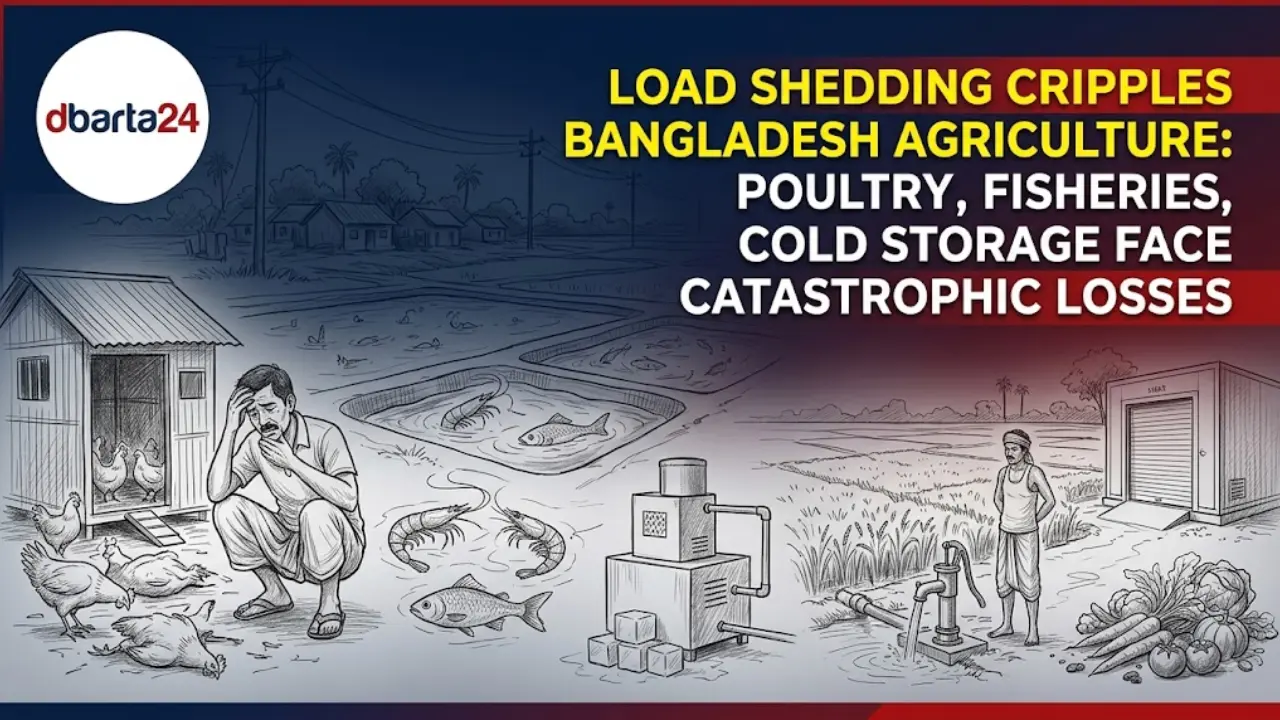
Dbarta24 Report – Severe power outages combined with ongoing gas shortages are devastating Bangladesh’s agricultural supply chain, striking a critical blow to the nation’s poultry, aquaculture, and crop preservation sectors.
While urban centers suffer load shedding lasting five to six hours daily, rural farming hubs report blackouts stretching from 10 to 16 hours a day.
The energy crisis has led to mass poultry deaths, severe oxygen depletion in shrimp farms, and escalating operational costs that threaten smallholder farmers across the country.
The national crisis hits during the peak Hilsa fishing season, when ice demand surges. Fish preservation requires continuous 12-to-15-hour freezing cycles for ice block production.
Constant power interruptions have forced ice plants in major coastal hubs—including Cox’s Bazar, Barishal, Patuakhali, Chandpur, and Noakhali—to operate at barely one-third of their normal capacity.
In Patuakhali’s Mohipur and Alipur fishing ports, 36 ice plants are producing a fraction of their standard output.
The resulting shortage has doubled the price of an ice block from BDT 150 to BDT 300, forcing trawlers to stall fishing trips or transport ice via trucks from distant districts like Khulna at exorbitant rates.
The aquaculture sector faces a parallel emergency. In Khulna, home to roughly 80% of Bangladesh’s shrimp processing plants, prolonged blackouts prevent farmers from running oxygen aerators in semi-intensive shrimp enclosures (ghers).
Aquaculture experts warn that drop in dissolved oxygen levels under scorching heat risks killing off entire harvests of vulnerable shrimp fry.
Concurrently, the poultry sector is experiencing severe heat-stress mortality. Without steady electricity to power fans and cooling systems, ambient temperatures inside sheds spike rapidly.
In Abhaynagar, Jashore, a power cut lasting eight consecutive hours caused the sudden suffocation death of over 400 market-ready chickens at a small family farm, inflicting losses exceeding BDT 300,000.
Compounding the problem, sky-rocketing utility bills and the heavy reliance on costly diesel generators are driving thousands out of business.
According to the Bangladesh Poultry Industries Association (BPIA), the number of active poultry farmers in Bangladesh has plummeted from nearly 200,000 prior to 2020 down to roughly 136,000—a loss of 64,000 producers in under five years.
Crop farmers face similar disruptions as delayed irrigation cycles leave fields dry, while operators of cold storage units across districts like Comilla and Rajshahi rely on expensive diesel fuel to prevent potatoes, onion crops, and seeds from rotting.
Industry leaders warn that unless rural electricity supplies are prioritized immediately, the cascading production costs will push basic food prices far beyond the reach of average consumers.