


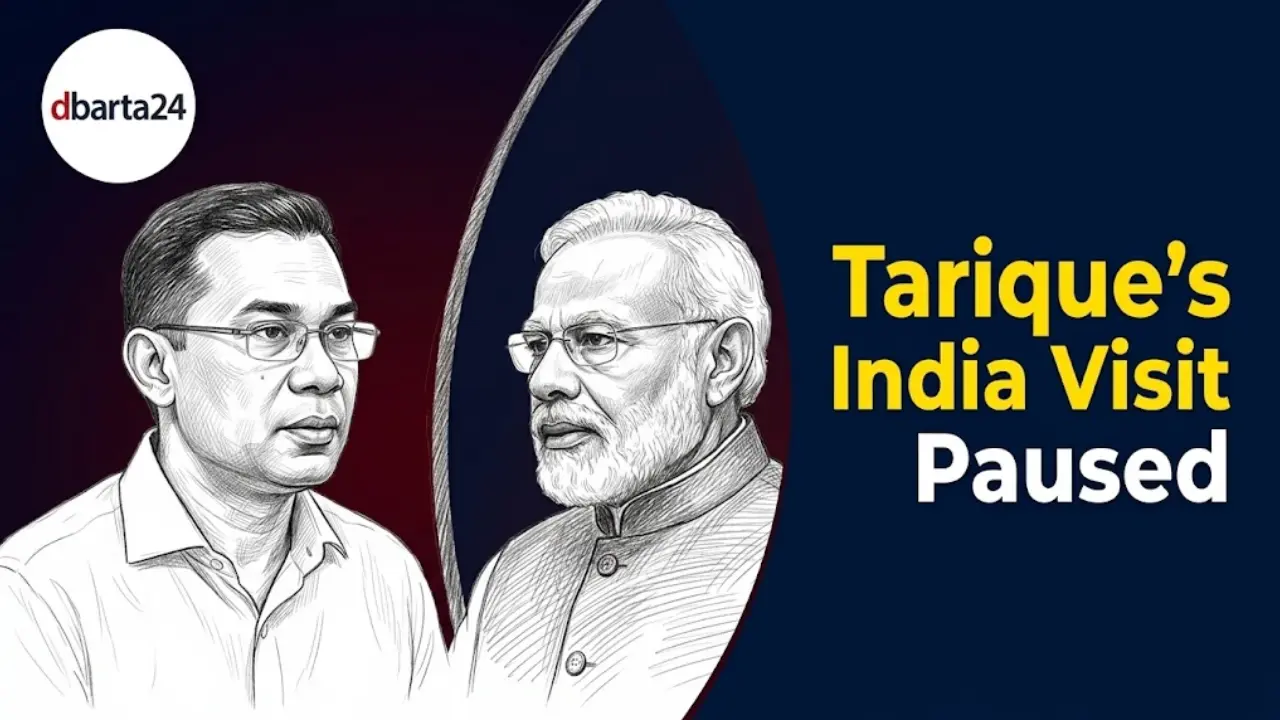
Dbarta24 Special Correspondent — Weeks of high-level diplomatic deliberations regarding Bangladeshi Prime Minister Tarique Rahman’s maiden state visit to India have effectively hit a standstill.
While both neighboring nations continue behind-the-scenes efforts to normalize bilateral ties, recent public statements by ousted former Prime Minister Sheikh Hasina in New Delhi have reignited diplomatic friction.
Dhaka maintains that a “conducive environment” must be created before any high-level summit can take place, placing the expedited extradition of Sheikh Hasina at the center of its demands.
India, meanwhile, has refrained from making any official public commitment regarding the timeline of the visit.
Why the High-Stakes Visit Hit a Roadblock
Official communications between Dhaka and New Delhi had been active over recent weeks, with India extending an invitation for a bilateral visit originally anticipated between August 21 and August 25.
However, neither government ever officially confirmed the schedule.
The diplomatic trajectory shifted significantly following an August 5 press conference hosted by Sheikh Hasina in New Delhi.
The Bangladesh Ministry of Foreign Affairs expressed deep concern, arguing that allowing public political statements by the former ruler on Indian soil undermines the atmosphere required for bilateral normalization.
While Indian officials maintained that the event carried no government sponsorship, Dhaka’s position remained firm.
State Minister of Foreign Affairs Humayun Kabir signaled that Bangladesh is in no hurry regarding the state visit, noting that Dhaka is actively assessing the exact nature of the relationship New Delhi seeks with the newly formed administration.
The Core Stumbling Block: Sheikh Hasina’s Extradition
The presence of Sheikh Hasina in India remains the single largest point of contention in current bilateral dynamics
Having fled to India in August 2024 following a massive student-led popular uprising, she faces numerous criminal charges in Bangladesh.
In November 2025, the International Crimes Tribunal sentenced her to death in absentia—charges she has dismissed as politically motivated.
Dhaka has formally requested her immediate extradition alongside other fugitive suspects under the existing Bangladesh-India Extradition Treaty.
While the treaty facilitates cross-border transfers, it contains specific exception clauses governing political offenses, creating a complex legal impasse.
New Geopolitical Realities and Emerging Friction
Under the previous regime, New Delhi enjoyed exceptionally close ties with Dhaka. However, the 2024 political shift has recalibrated the region’s diplomatic equations.
The BNP-led government under Tarique Rahman has actively broadened its diplomatic horizon, pursuing stronger engagement with global and regional partners including the United States, China, and Pakistan.
This strategic pivot has drawn keen attention from New Delhi. Dhaka has articulated a firm “Bangladesh First” doctrine grounded in sovereign equality, national dignity, non-interference in internal affairs, and mutual interest.
Beyond geopolitical alignments, long-standing disputes continue to test the relationship:
-
Border Security & Fencing: Tensions persist over India’s unilateral border fencing initiatives along the 4,096-kilometer shared frontier.
-
Migration Disputes: Unilateral pushbacks of alleged undocumented migrants without prior diplomatic verification have raised concerns in Dhaka.
-
Inflammatory Rhetoric: Anti-Bangladesh rhetoric by certain political figures in India has further complicated public perception and diplomatic goodwill.
Official Stances and Strategic Analysis
Despite the current chill, Indian diplomatic channels remain cautious. Responding to queries regarding the visit, Indian External Affairs Ministry Spokesperson Randhir Jaiswal stated that he had nothing to offer at the moment.
However, Indian External Affairs Minister S. Jaishankar highlighted a foundational principle for moving forward, noting that the Bangladesh-India relationship must pass the “test of mutual interest”—meaning bilateral ties must strictly serve and balance the strategic goals of both nations.
Regional foreign policy experts emphasize that a delayed or postponed visit does not signify a breakdown of bilateral ties:
-
Sanjay Bhardwaj, Professor at the Center for South Asian Studies, Jawaharlal Nehru University, noted that while India remains deeply interested in expanding economic and infrastructure cooperation, Sheikh Hasina’s extradition request presents a formidable diplomatic hurdle.
-
Sreeradha Datta, South Asia Specialist at O.P. Jindal Global University, emphasized that direct dialogue remains indispensable. She noted that as immediate neighbors, Bangladesh and India cannot decouple, adding that healing political wounds requires active political engagement and pragmatic, interest-based collaboration rather than mere passage of time.
-
Shakil Ahmed, Assistant Professor of Government and Politics at Jahangirnagar University, observed that domestic political dynamics in both countries are now directly shaping foreign policy, with the Bangladeshi public increasingly demanding a relationship defined by self-respect and mutual dignity.
Looking Ahead
While the exact timeline for Prime Minister Tarique Rahman’s visit to India remains uncertain, the current impasse underscores a pivotal transition.
Whether through trade, border security, or regional strategy, the future of Bangladesh-India relations will depend on how effectively both capitals navigate the complex realities of extradition, strategic autonomy, and mutual respect.