


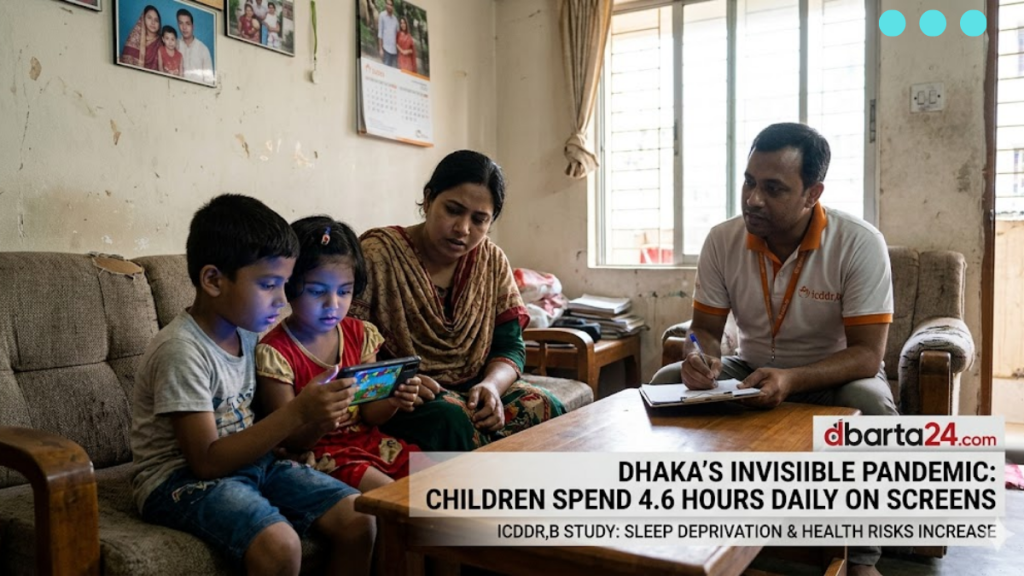
Labonnya Liza ; Dhaka: A growing number of children in the capital are suffering from chronic headaches, vision impairment, and increased irritability. Health experts point to a singular culprit: “Screen Addiction.”
A recent study conducted by icddr,b reveals that children in Dhaka spend an average of 4.6 hours per day on digital devices, a trend researchers are calling an “invisible pandemic.”
The Sleep and Health Gap
The study, conducted between 2022 and 2024 across six English and Bengali medium schools, surveyed 420 children aged 6 to 14. The findings, published in the Journal of Medical Internet Research (JMIR) Human Factors, are alarming:
-
83% of children use screens for more than two hours daily.
-
Heavy users (2+ hours) get only 7.3 hours of sleep, while 8 to 10 hours are required for healthy development.
-
One-third of participants suffer from eye problems.
-
80% experience frequent headaches.
Mental Health and Behavioral Risks
Mental health expert Dr. Mekhla Sarkar noted that screen scrolling creates internal stress despite appearing enjoyable. “There is a direct link between headaches and mental health disorders in children,” she stated.
The study found that nearly two out of every five children suffer from anxiety, hyperactivity, or other psychological issues.
According to Bangladesh Bureau of Statistics (BBS) data, roughly 55.89% of children aged 5 to 17 own a mobile phone, and over 30% use the internet regularly. Experts blame the lack of open playgrounds in Dhaka and parents using devices as “digital pacifiers” to keep children quiet.
Global Guidelines vs. Local Reality
The World Health Organization (WHO) recommends:
-
Under 2 years: No screen time at all.
-
2 to 4 years: Maximum 1 hour per day.
-
School-going children: Maximum 2 hours of recreational screen time.
While countries like the UK issued formal state guidelines this year, Bangladesh currently lacks a national policy regarding children’s digital consumption.
Leena Ferdous, Director of Kidz Leadz Pre-school, emphasized that government intervention is needed to bring children back to “paper and pen.”
The “20-20-20” Rule and Expert Advice
To mitigate physical damage, researchers suggest the 20-20-20 rule:
Every 20 minutes, look at something 20 feet away for at least 20 seconds to reduce eye strain.
Dr. Shahria Hafiz Kakon, lead scientist of the icddr,b study, recommends encouraging creative habits:
-
Engaging in debates and group studies.
-
Visiting libraries.
-
Gardening or outdoor activities like Kabaddi or Ha-du-du.
-
Using large screens (desktops) in common family areas rather than private handheld devices.
Experts conclude that while some cases of extreme addiction require clinical hospitalization, the primary solution lies in parental awareness and setting strict household rules.