


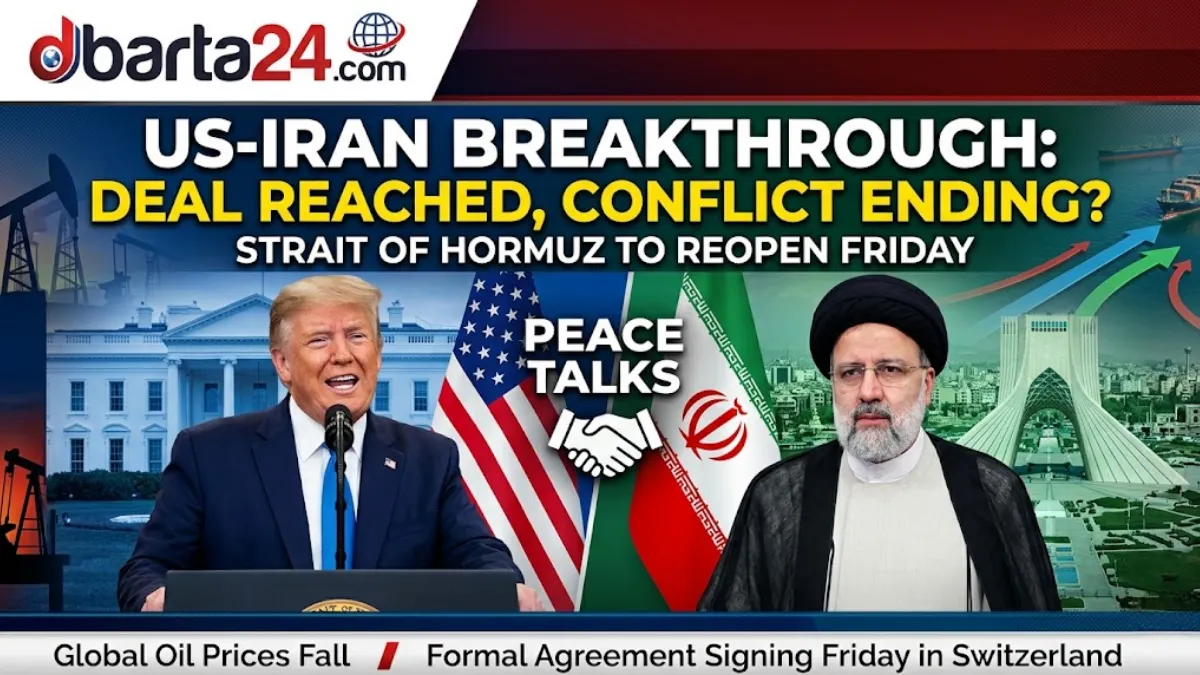
International Desk — Officials from the United States and Iran have announced a landmark framework agreement aimed at ending military conflict, lifting US blockades on Iranian ports, and reopening the critical Strait of Hormuz.
While the preliminary breakthrough has already triggered a sharp drop in global oil prices, the highly contentious future of Iran’s nuclear program remains unresolved and has been deferred to upcoming negotiations.
The formal memorandum of understanding is scheduled to be signed this Friday in Switzerland.
Trump and Shehbaz Sharif Confirm the Breakthrough
The diplomatic breakthrough was first made public on Sunday at approximately 5:30 PM Washington time. US President Donald Trump announced on his social media platform, Truth Social:
“The deal with the Islamic Republic of Iran is now done.”
Shortly before Trump’s post, Pakistani Prime Minister Shehbaz Sharif announced that the breakthrough was achieved in the early hours of Monday morning through Pakistan’s diplomatic mediation.
Posting on X (formerly Twitter), Prime Minister Sharif confirmed that the agreement mandates an immediate and permanent cessation of military operations across all fronts, explicitly including Lebanon.
The inclusion of Lebanon marks a major turn in events. Discussions surrounding Lebanon had been deadlocked for weeks, during which both Israel and Hezbollah sustained heavy exchanges of fire despite international calls for a ceasefire.
60-Day Ceasefire and Broader Talks Ahead
The Secretariat of Iran’s Supreme National Security Council issued a statement confirming that all military operations and conflicts, including those in Lebanon, would permanently halt starting Monday night.
Iranian Deputy Foreign Minister Kazem Gharibabadi clarified that a 60-day ceasefire period will be utilized to negotiate a more comprehensive, long-term agreement.
Those broader talks will address the easing of US sanctions on Iran and determine the future of Iran’s nuclear program.
Israel has not issued an official reaction to the announcement. However, Israeli officials previously maintained that they were not a party to the bilateral US-Iran negotiations.
Global Markets React as Strait of Hormuz Reopens
President Trump announced that the Strait of Hormuz—a vital maritime artery for global oil and gas supplies that the US claims Iran had effectively blockaded for months—will officially reopen this Friday.
Simultaneously, Trump ordered the lifting of US blockades on Iranian ports. Writing on Truth Social, he stated:
“Ships of the world, start your engines. Let the oil flow!”
The global energy markets reacted instantaneously on Monday. Brent crude futures plummeted by nearly 4%, while US West Texas Intermediate (WTI) dropped by over 4.6%. Asian stock markets saw a notable upward trend following the de-escalation news.
Domestic Pressure and the Nuclear Question
The conflict had put immense domestic political pressure on Trump and the Republican Party. With the upcoming midterm elections in November, public dissatisfaction had been mounting over surging domestic fuel prices.
However, Trump faces pushback from within his own party. A faction of hawkish Republicans strongly opposes any compromises until Iran’s nuclear program is completely dismantled.
Senator Lindsey Graham, known for his hardline stance on Iran, welcomed the immediate cessation of hostilities but emphasized that he would strictly scrutinize the next phase of nuclear negotiations.
Graham reminded the administration that under US law, any final nuclear agreement with Iran must be submitted to Congress for review and a vote.
The Shadow of the 2015 Nuclear Deal
The upcoming negotiations will face historical baggage. During his first presidential term, Trump unilaterally withdrew the US from the 2015 multilateral Iran nuclear deal (JCPOA), which was brokered under Democratic President Barack Obama.
That original deal offered Iran sanctions relief in exchange for strict limits and international monitoring of its nuclear activities.
Following the US withdrawal, Iran aggressively accelerated its uranium enrichment. It has accumulated over 400 kilograms (approximately 900 pounds) of highly enriched uranium, bringing it close to weapons-grade purity.
The future of this stockpiled material is expected to be the most critical and difficult agenda item in the upcoming Switzerland talks.
This diplomatic breakthrough comes after a devastating cycle of violence that began on February 28, when initial strikes inflicted thousands of casualties, primarily among Iranian and Lebanese citizens.
Iran had retaliated by targeting Israel and US bases in the Gulf region, alongside enforcing the Hormuz blockade, which prompted the US counter-blockade on Iranian ports.