


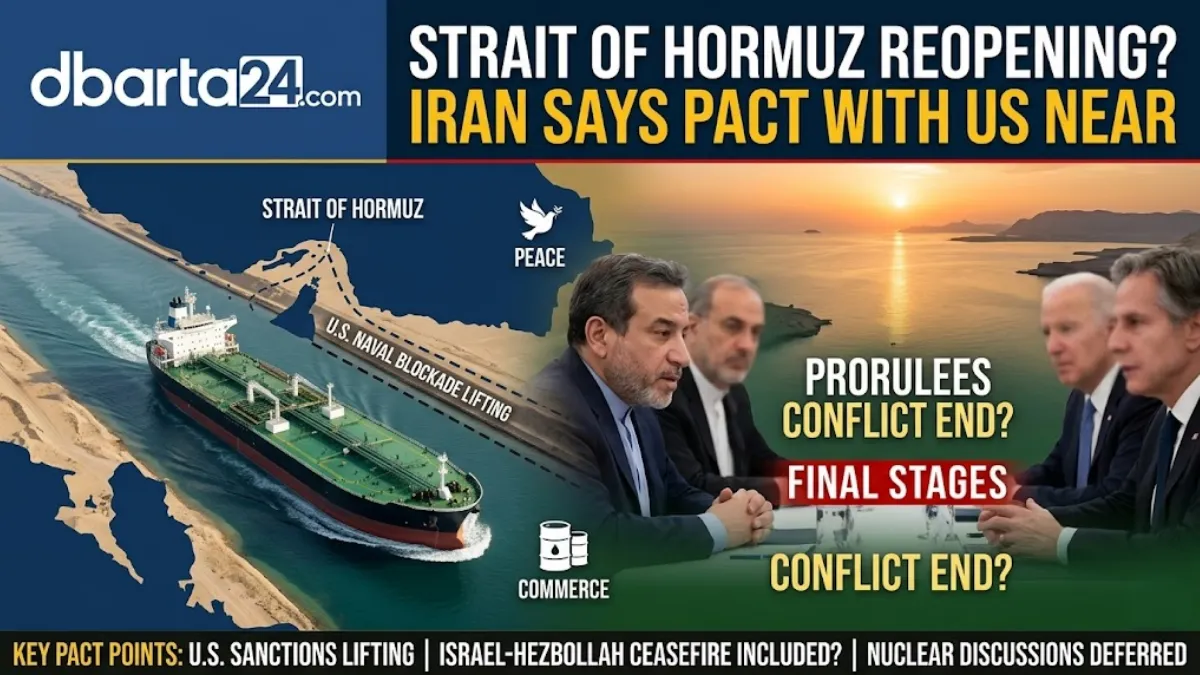
International Desk – An agreement with the United States aimed at ending the ongoing conflict and reopening the critical Strait of Hormuz is in its final stages, according to Iranian Foreign Minister Abbas Araghchi.
Speaking to state television, Araghchi noted that the pact includes the lifting of US-imposed sanctions on Iran, though discussions regarding Iran’s nuclear program will be deferred to a later date.
US officials have partially confirmed elements of the deal, emphasizing that economic benefits will only be unlocked once Iran fulfills its commitments. The conflict originally erupted on February 28 following joint US and Israeli strikes across various locations in Iran.
In response, Iran launched retaliatory attacks against Israel and US allies in the Gulf region, effectively halting traffic through the Strait of Hormuz—a vital global maritime choke point for oil and liquefied natural gas (LNG).
Despite agreeing to a temporary ceasefire framework in April, sporadic skirmishes between US and Iranian forces have persisted, including two rounds of retaliatory strikes this week.
US President Donald Trump stated on Thursday that he called off a planned strike against Iran because negotiators had “just reached a wonderful understanding,” indicating a formal pact could be signed very soon.
Following this, Iranian media published a purported 14-point outline of the agreement on Friday.
However, President Trump dismissed the leak, stating the published details had “no relationship” to the actual agreed terms and were “not inline with reality.”
Hours later, Pakistani Prime Minister Shehbaz Sharif confirmed that an understanding on the Memorandum of Understanding (MoU) had been reached between the US and Iran, and it is now awaiting final approval.
According to state media quoting Foreign Minister Araghchi, members of Iran’s Supreme National Security Council remain divided between supporters and opponents of the latest terms. Araghchi admitted that a unanimous consensus has not yet been reached, saying, “At this moment, we have to wait. If approved, the agreement will be signed remotely.”
Israel is not participating in these ongoing negotiations, which aim to extend the ceasefire and launch broader talks on sensitive issues like Iran’s nuclear program.
For decades, Western nations have accused Iran of attempting to develop nuclear weapons—a claim Tehran denies, maintaining its program is strictly for peaceful research and power generation.
Briefing journalists on Friday afternoon, US officials confirmed that under the current framework, the Strait of Hormuz will be reopened in exchange for the US lifting its naval blockade on Iranian shipping.
These initial steps are set to take effect almost immediately, triggering a 60-day negotiation window focused heavily on Iran’s enriched uranium—a key component required for nuclear weaponry.
US officials stated that negotiations intend for this enriched uranium to be destroyed internally before being completely removed from the country, though the exact execution mechanism remains finalized.
On the financial front, Iran will not receive any upfront funds or immediate monetary relief, contrary to claims in Iranian media suggesting frozen assets would be released prior to the start of critical talks.
Instead, US officials clarified that Iran will be reintegrated into the global economy step-by-step as sanctions are progressively rolled back and assets unfrozen based on compliance.
The agreement also calls on Iran to cease funding its proxy networks, specifically targeting Hezbollah and other allied groups across the Middle East.
US officials stressed that this MoU is not built on trust or verbal assurances but relies heavily on “effective implementation”—meaning economic relief is strictly contingent on verified actions taken by Tehran.
While cautious optimism exists across Washington, Tehran, Islamabad, and Doha (acting as a mediator), parties acknowledge there is still a way to go. Similar iterations of the pact came close to finalization over the past two months before collapsing at the last minute.
According to the US administration, the defining difference this time is a much higher level of optimism and more transparent discussions regarding the pact’s contents.
Meanwhile, Foreign Minister Araghchi concluded, “As soon as the final phase of our talks is completed, this agreement will be signed and officially announced. It could happen within the next few days.
I am very optimistic.” He re-emphasized that the primary pillar of the MoU remains the withdrawal of the US naval blockade against Iran.
Regarding the Strait of Hormuz, Araghchi noted that its operational management “will not be the same as before.”
Since shutting down the passage, Iran has demanded transit fees from vessels, whereas the US maintains that the waterway must remain free and open to all international shipping.
Approximately 20 percent of the world’s total oil and LNG supplies pass through this strategic channel.
The senior Iranian official further asserted that the MoU covers the cessation of the ongoing conflict between Israel and Hezbollah.
While previous US reports hinted that Lebanon-related matters might be excluded, Iran reportedly insisted on their inclusion.
Meanwhile, the Israeli Prime Minister has issued a stern warning, stating that Israel will launch a full-scale military campaign if Hezbollah continues its attacks on northern Israel.