


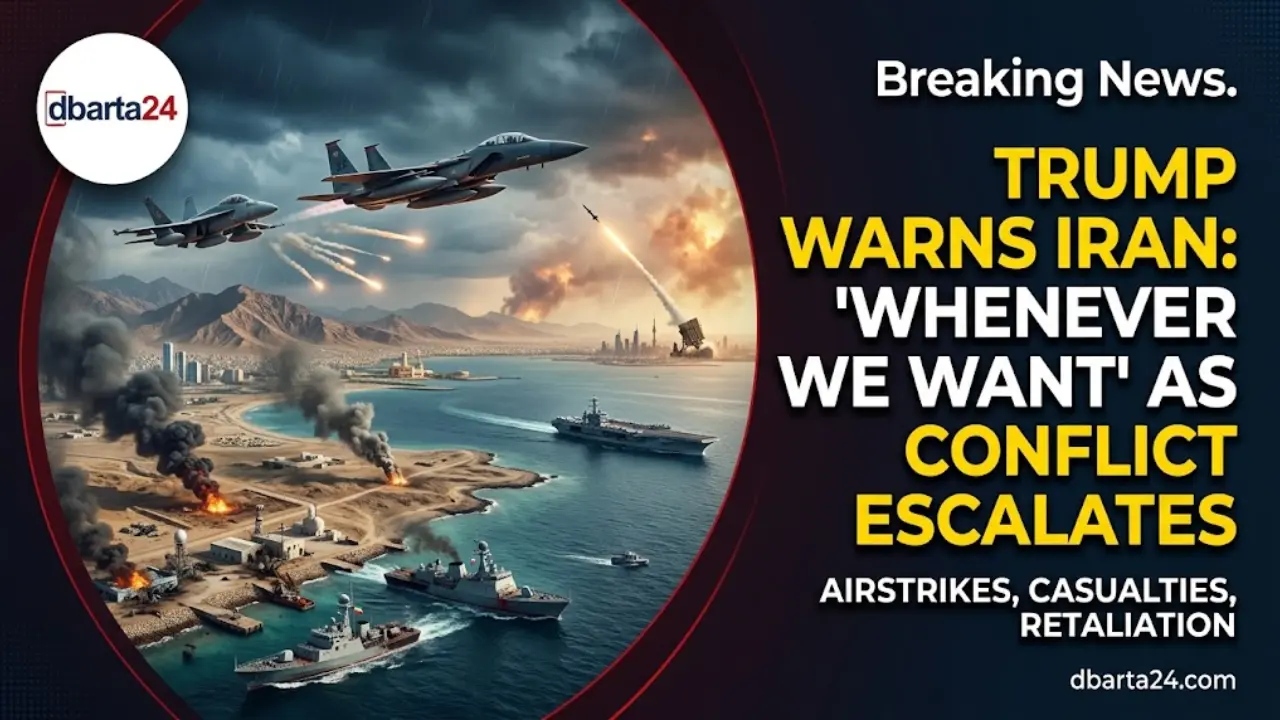
Dbarta24 Desk — Tensions in the Middle East reached a dangerous flashpoint after US President Donald Trump declared that a potential war with Iran would not last long, asserting that the United States military stands ready to strike inside Iranian territory “whenever it wants.”
The bold declaration comes amidst a sharp escalation in direct military engagements between Washington and Tehran, resulting in significant casualties, retaliatory missile strikes across the Gulf, and international outcry over civilian deaths.
Rising Toll and Devastating Human Cost
According to Iranian health officials, recent US military operations have left at least 18 people dead and 142 others injured, including a high proportion of women and children.
Hossein Kermanpour, a spokesperson for Iran’s Ministry of Health, detailed in a post on X (formerly Twitter) that the casualty figures span strikes occurring between August 30 and September 2.
“Behind every single one of these numbers is a human life and a family,” Kermanpour stated, confirming that the injured include 61 women and 44 minors, while two women and a child were among the deceased.
Tehran further reported military losses, stating that three Iranian combat pilots and six navy personnel were killed in the recent standard operations.
Regional Retaliation and Gulf Friction
The current cycle of hostilities mark a dramatic spike following months of friction that reignited in July. Following massive US strikes across several targets in Iran, Iranian forces launched retaliatory attacks aimed at positions in Kuwait, Bahrain, and the United Arab Emirates (UAE).
Tehran claimed these strikes specifically targeted US bases in response to military actions against Iranian soil.
However, a US official speaking to Al Jazeera refuted Iran’s assertions, stating that no US facilities in the region—including those in Kuwait—were hit in the latest barrage.
Meanwhile, Kuwaiti military command confirmed that its air defense systems were actively intercepting incoming Iranian drones and missiles.
The cross-border strikes have sparked intense concern among Gulf nations:
-
Bahrain’s Condemnation: Bahrain’s Ministry of Foreign Affairs issued a strong statement condemning Iran’s attacks on Kuwait, calling them a direct violation of international law and national sovereignty. Bahrain warned that Tehran’s actions undermine efforts to de-escalate regional hostilities and urged the UN Security Council to take decisive steps to force Iranian compliance.
UN Alarm Over Civilian Impact and Controversial Target Reports
The rapidly expanding conflict has raised alarm at the highest international levels. United Nations Secretary-General António Guterres voiced deep concern over reports of rising civilian casualties, highlighting allegations surrounding a strike on a wedding ceremony.
Through his spokesperson, Stéphane Dujarric, the UN chief called for an immediate halt to active military operations.
“The Secretary-General condemns all attacks against civilians and emphasizes that all parties must abide by their obligations under international humanitarian law,” Dujarric noted.
In response to reports regarding civilian infrastructure, Captain Tim Hawkins, spokesperson for US Central Command (CENTCOM), issued an official statement maintaining Washington’s operational protocols:
“We are aware of the reports, which originated in Iranian state media. The US military does not target civilian infrastructure,” Hawkins wrote via email.
The reported incident at the wedding has drawn parallels to an earlier, devastating strike on a school in Minab during the opening phase of the campaign, which reportedly left 160 dead—marking one of the largest civilian loss incidents in decades.
While the Pentagon has yet to officially comment on the Minab incident, intelligence reports cited by Reuters suggest the strike may have resulted from outdated target tracking.
Members of the US Congress from the Democratic Party have demanded the full release of findings from ongoing administrative investigations into the incidents, though reports have not yet been formally submitted to lawmakers.
As rhetorical threats translate into kinetic strikes across multiple borders, the situation remains highly volatile.
With international bodies urging restraint and regional air defenses on high alert, the risk of a wider, uncontainable conflict in the Gulf continues to grow by the hour.