


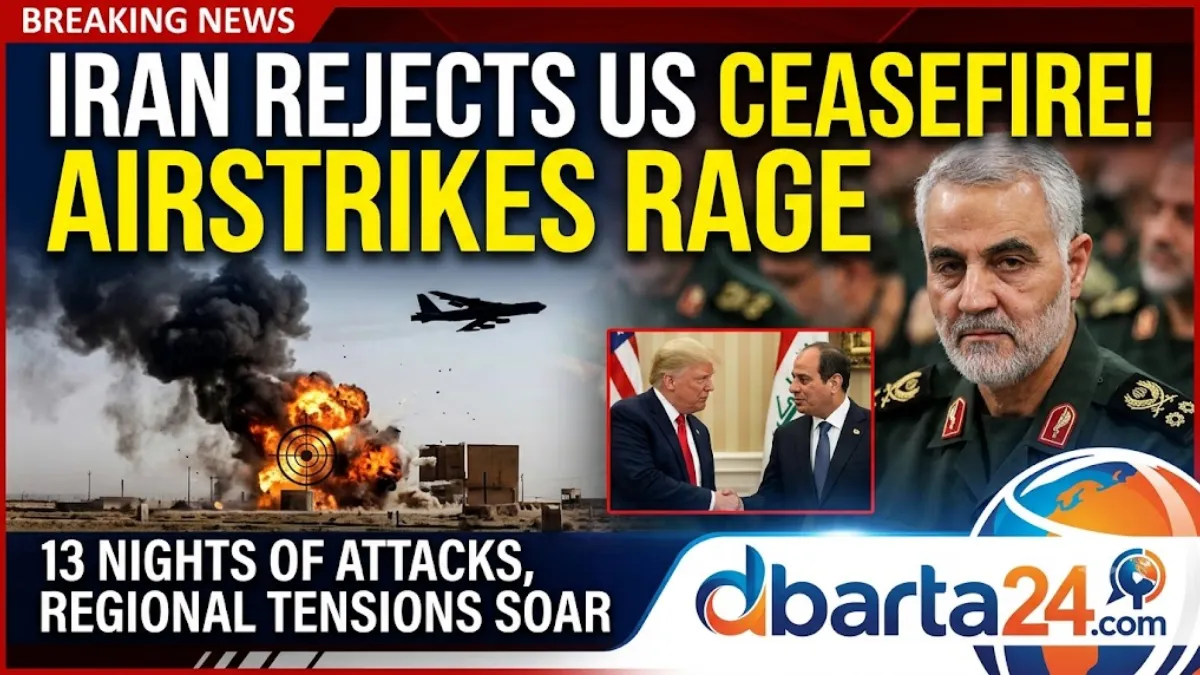
Dbarta24 Desk – Iran has reportedly rejected a temporary ceasefire proposal put forward by US President Donald Trump, which was delivered to Tehran by Iraqi Prime Minister Ali al-Zaidi.
The rejection comes at a critical juncture as Washington threatens to expand its military campaign, and ongoing strikes continue to devastate Iran’s critical infrastructure.
According to a report by The New York Times, citing anonymous sources, the diplomatic maneuver took place just days after Al-Zaidi met with Trump at the White House. However, Baghdad has strongly contested this narrative.
The Iraqi Prime Minister’s office issued a statement via the Iraqi News Agency, labeling the report “completely baseless” and disconnected from reality, while urging media outlets to verify information through official channels rather than relying on anonymous leaks.
The Core Stumbling Block
While the precise details of the American proposal remain undisclosed, anonymous Iranian officials indicated that Tehran is not interested in any temporary arrangement that leaves the strategic control of the Strait of Hormuz ambiguous.
During his high-profile visit to Tehran, Prime Minister Al-Zaidi and his delegation held extensive talks with Iranian President Masoud Pezeshkian, Chief Negotiator Brigadier General Mohammad Bagher Ghalibaf, and Foreign Minister Abbas Araghchi.
Reflecting on the meeting, Foreign Minister Araghchi emphasized the deep economic, political, and security ties shared between neighboring Iraq and Iran.
He noted that while Al-Zaidi shared insights from his recent Washington trip, the breakdown in communication does not stem from a lack of intermediaries.
“The problem is not the delivery of messages,” Araghchi told state television. “The problem lies in the attitude of the United States, which is irrational, greedy, and driven by a mentality of control.”
Thirteen Nights of Escalation
Tensions between Washington and Tehran have reached a boiling point over recent weeks. US forces have carried out sustained strikes against Iranian military bases, alongside critical infrastructure including railways, airports, bridges, and ports.
On Thursday, the conflict entered its 13th consecutive night of US bombardment, targeting strategic locations such as Khorramabad, Jask, Ahvaz, Bandar Abbas, and Qeshm Island.
The strikes resulted in civilian casualties, with official reports confirming four dead and two injured in Ahvaz, and two others wounded in Bandar Abbas.
In neighboring Iraq, Erbil Airport temporarily suspended operations due to drone activity before reopening later in the day.
In retaliation, the Iranian military launched a barrage of drones and ballistic missiles targeting US military installations across the region, striking locations in Jordan, Bahrain, and Kuwait.
While Tehran confirmed a successful hit on Jordan’s Al-Azraq airbase, both Bahrain and Kuwait reported that their air defense systems successfully intercepted the incoming Iranian missiles.
Warning Washington of the mounting consequences of its actions, Araghchi declared that if such aggressions continue, President Trump “will have to pay a heavy price to end the war.”
Geopolitical Spillovers and the UK’s Role
The theater of conflict is threatening to expand further. Iran’s Foreign Ministry accused the United Kingdom of acting as an active accomplice to the United States.
Following the accusations, the Islamic Revolutionary Guard Corps (IRGC) issued a stern warning, stating that any nation providing military assistance to the US must be prepared for severe consequences and retaliation.
Reports indicate that Tehran’s threats are specifically aimed at British military bases in the region.
Although the UK government has maintained that it will not be dragged into a direct war despite American proposals, it has permitted the US military to utilize British bases for defensive operations.
Responding to the IRGC’s warnings, the UK government affirmed that its forces remain fully prepared for self-defense at all times.
As diplomatic efforts falter and military engagements intensify across multiple borders, the rejection of the ceasefire highlights a deep-seated distrust between Tehran and Washington.
With both sides dug into their strategic positions and regional allies being drawn into the crossfire, the prospects for immediate de-escalation in the Middle East remain bleak.