


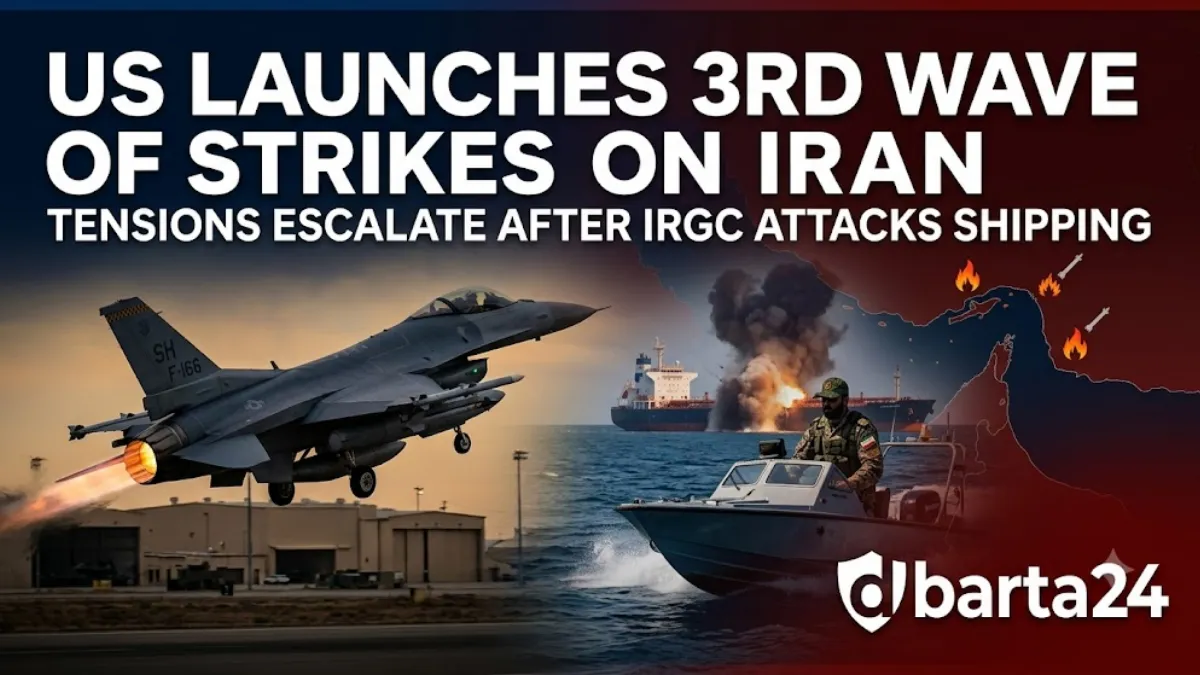
INTERNATIONAL DESK — The United States military has launched a third wave of airstrikes against various targets inside Iran, escalating an already volatile situation in the Middle East.
The military action follows a direct assault by Iran’s Islamic Revolutionary Guard Corps (IRGC) on a commercial vessel in the strategically vital Strait of Hormuz.
Escalation in the Strait of Hormuz
According to the United States Central Command (CENTCOM), the latest military intervention was triggered after the IRGC attacked a Cyprus-flagged commercial ship operating within the Strait of Hormuz.
The assault inflicted severe damage on the vessel. CENTCOM reported that the ship caught fire and sustained critical engine damage, leaving it unable to continue its journey. Search and rescue operations are currently underway for one crew member who remains missing following the incident.
In response to the provocation, CENTCOM affirmed that American military operations will persist to degrade Iran’s capability to launch attacks against civilian mariners and commercial shipping vessels navigating the critical maritime corridor.
Massive Explosions Rock Coastal Iran
Iranian state broadcaster IRIB confirmed that multiple explosions shook the country’s southern and southwestern coastal regions as the strikes commenced.
Residents in the southern areas of Asaluyeh and Bandar-e Dayyer reported hearing numerous detonations. Specifically, five explosions were recorded in Bandar-e Dayyer in Bushehr province, while four took place in Asaluyeh.
The air raids expanded across major port cities, with three explosions reported in both Bandar Abbas and Sirik, and at least two blasts heard in the port city of Chabahar.
The heaviest bombardment appeared to target the port city of Jask in the southern Hormozgan province, where residents reported hearing more than ten explosions.
Concurrently, Iran’s semi-official Mehr News Agency reported that air defense systems were heavily activated in Bandar-e Mahshahr, located in the southwestern coastal province of Khuzestan, in an attempt to intercept incoming threats.
Tehran Shuts Down Strategic Shipping Lane
The latest kinetic exchange comes shortly after Iran announced the total closure of the Strait of Hormuz—a choke point responsible for the transit of a significant portion of the world’s oil supply.
Tehran justified the closure by claiming it had intercepted and halted a vessel that was allegedly navigating through an unauthorized route.
The IRGC Navy issued a formal statement defending the seizure, asserting that the targeted ship had disabled its maritime tracking system, thereby endangering maritime safety.
“The Strait of Hormuz will remain closed until further notice and until the end of US intervention in this region,” the IRGC Navy declared in a statement, omitting specific details regarding the identity or ownership of the seized vessel.
Tehran has issued a stern warning to Washington and its allies, promising a “severe response” to any counter-measures taken against its territorial actions.
The Path Forward
With the Strait of Hormuz effectively locked down and US fighter jets actively striking Iranian infrastructure, maritime security experts warn of a catastrophic disruption to global trade.
The international community is closely watching whether diplomatic channels can de-escalate the standoff, or if the region is on the precipice of a full-scale conventional conflict.