


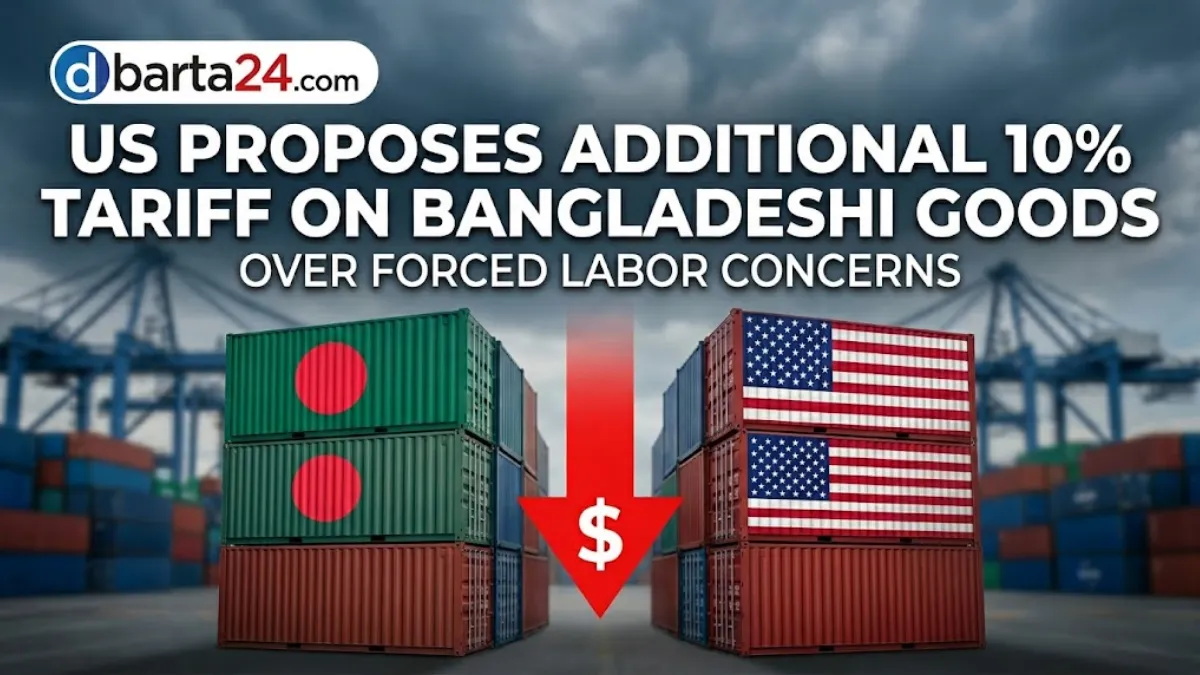
Mustafa Sumon ; Dhaka – The United States is planning to impose an additional 10% tariff on products imported from Bangladesh. The U.S. Trade Representative (USTR) has proposed this extra tariff, ranging from 10% to 12.5%, on a new list comprising 60 countries, including Bangladesh.
The USTR cited these countries’ failure to enforce restrictions on importing goods manufactured using forced labor as the reason for the proposed tariffs. If implemented, the total tariff on Bangladeshi exports to the U.S. market will jump to 26.5%, up from the current average rate of 16.5%.
According to a report published on the USTR website last Tuesday, the penalizing tariffs aim to address failures in banning forced-labor products. This move would impact major U.S. trading partners, including China, the European Union, and Japan.
However, the tariff rate will vary: countries that have fully or partially banned forced-labor imports face a 10% additional tariff, while those without such restrictions will face a 12.5% hike.
Responding to the development, Miran Ali, President of the Bangladesh Garment Manufacturers and Exporters Association (BGMEA), stated that the U.S. allegations of forced labor against Bangladesh are entirely baseline-less. He emphasized that Bangladesh’s industry does not require or practice forced labor. He urged the government to strongly counter these unfounded claims.
The USTR report noted that while Bangladesh previously lacked regulations against forced-labor imports, it has recently committed to reforms under a trade agreement. Consequently, Bangladesh was placed in the lower 10% penalty tier, while non-committal countries face the maximum 12.5% tariff.
The investigation revealed that Bangladesh failed to legally ban or restrict goods produced through forced labor, a practice the report labeled “unreasonable” and damaging to fair competition for U.S. producers. However, because Bangladesh signed an Accord on Trade Reform (ATR) promising to restrict such imports, its penalty was capped at 10%.
The report specifically highlighted the apparel and textile sectors, noting that Bangladesh imports significant amounts of cotton from China—particularly the Xinjiang region—where a high risk of forced labor exists.
Bangladesh uses this cotton to manufacture garments exported to the U.S., creating what the USTR calls unfair competition. Other countries mentioned facing similar supply chain risks include India, Pakistan, Vietnam, and Sri Lanka.
According to International Labour Organization (ILO) data cited in the report, approximately 27.6 million people worldwide were victims of forced labor as of 2021.