


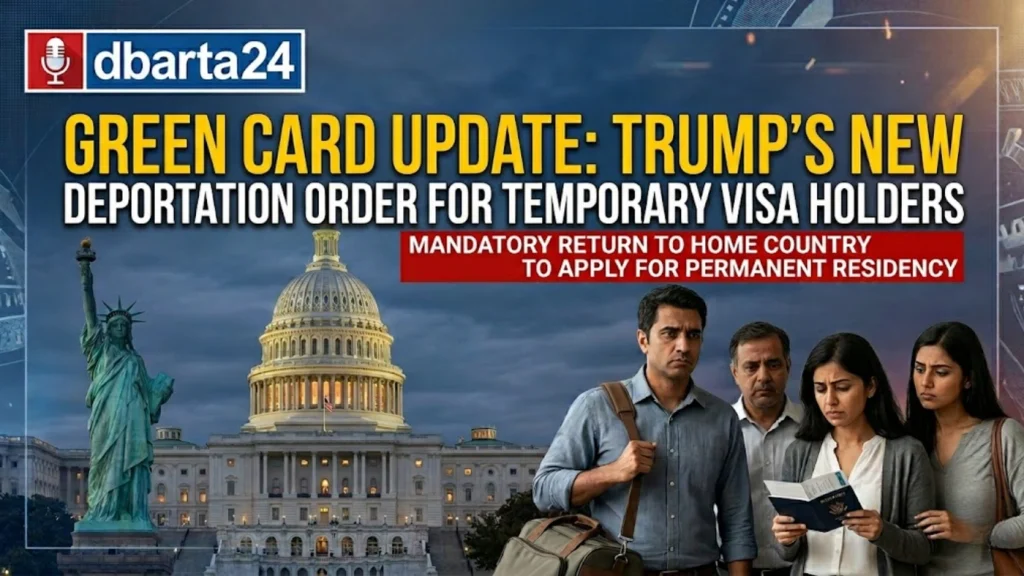
Sabuj Yusuf From NewYork – The Trump administration has announced a strict new policy requiring foreign nationals on temporary visas to return to their home countries if they wish to apply for a U.S. Green Card. According to the administration, this move aims to tighten loopholes and bring greater order to the legal immigration system.
The U.S. Citizenship and Immigration Services (USCIS) clarified in its new guidance that applying for an “Adjustment of Status” (changing to permanent residency from within the United States) is not an automatic right. Instead, it remains entirely at the discretion of immigration authorities.
“Closing Legal Loopholes”
In a statement posted on X (formerly Twitter), the U.S. Department of Homeland Security (DHS) confirmed that foreign nationals currently in the U.S. on temporary visas must return home to process their Green Card applications. The administration emphasized that this policy is designed to prevent applicants from using legal loopholes to transition to permanent residency without leaving the country.
USCIS noted that the U.S. immigration framework was originally structured under the assumption that temporary visa holders would return home once their authorized period or purpose of stay concluded. However, the agency stated that applications will still be reviewed on a case-by-case basis, meaning the rule may not apply uniformly to everyone.
Strict Evaluation Criteria
Immigration officers have been instructed to rigorously evaluate whether applicants have previously violated visa conditions. Key factors under scrutiny will include:
-
Overstaying authorized periods.
-
Unauthorized employment.
-
Fraud or misrepresentation.
-
Compliance with terms established during initial entry into the U.S.
Exceptions to the Rule: USCIS highlighted that certain “dual-intent” visa categories legally allow holders to stay temporarily while simultaneously pursuing permanent residency. However, holding these visas still does not guarantee Green Card approval.
Outcry from Human Rights Organizations
Immigrant rights advocacy groups have fiercely criticized the decision. They warn that the policy could force vulnerable applicants back into dangerous or unstable environments in their home countries. Human rights organizations are particularly concerned about the impact on victims of human trafficking, abused children, and asylum seekers.
HIAS, a prominent non-profit refugee protection organization, warned that forcing vulnerable immigrants to leave the United States as part of the permanent residency process poses severe risks to their safety.
Analysts view this move as a continuation of the Trump administration’s broader efforts to restrict immigration and limit long-term residency pathways. This policy follows previous measures aimed at shortening visa durations for international students, cultural exchange participants, and foreign journalists.