


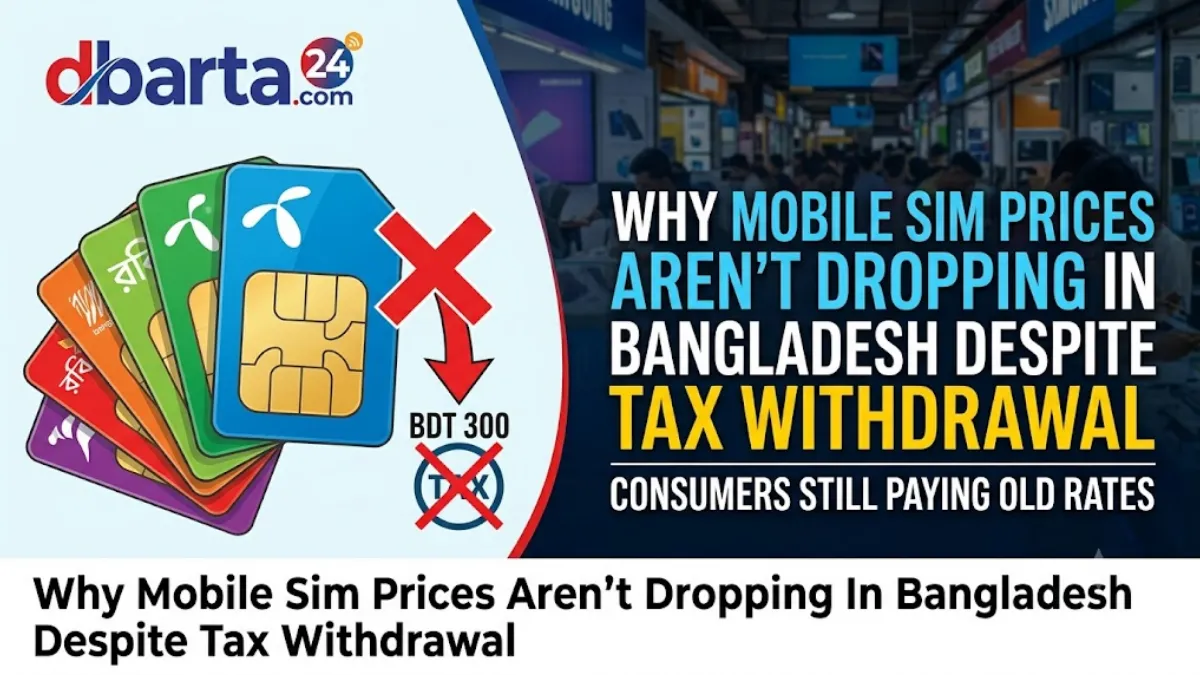
Business Desk – Following the complete withdrawal of the BDT 300 tax on mobile SIM cards in the national budget for the 2026-27 fiscal year, consumers expected a significant drop in prices.
However, weeks into the new fiscal year, retail realities tell a different story. Prepaid SIM cards continue to retail between BDT 200 and BDT 400 across the country, prompting questions from consumers and the government alike.
The government waived the tax—incurring an estimated revenue loss of BDT 1,200 crore—with the explicit goal of driving digital inclusion, boosting new subscriptions, and generating long-term revenue through expanded mobile usage.
Current Market Rates and Pricing Disparities
A review of official operator channels shows varying price structures. Market leader Grameenphone currently offers prepaid SIMs across seven categories, with most priced at BDT 400, alongside a specialized SIM at BDT 497 and postpaid connections at BDT 1,499.
Banglalink maintains a standard price of BDT 400 for its prepaid connections, while Robi offers its SIMs at BDT 200. State-owned Teletalk provides options ranging from BDT 100 to BDT 250.
Telecom insiders attribute these differences to distinct corporate strategies. Dominant market players often target higher-value users with premium packaging, while smaller operators lower entry barriers to aggressively acquire new subscribers.
The Real Cost of a SIM Card
To understand why retail prices remain unchanged, it helps to look beyond the physical piece of plastic.
According to industry sources, the direct production cost of a SIM card—including the chip, plastic fabrication, packaging, and logistics—ranges between BDT 60 and BDT 80, a figure susceptible to global chip market fluctuations.
However, the final retail cost includes several other operational expenses:
-
Distributor and retailer commissions
-
Biometric customer registration costs
-
Marketing and retail network maintenance
-
Per-number licensing fees paid to the regulator
-
Complimentary bundle offers (pre-loaded minutes, data, and SMS)
Operators Defend Pricing, Cite Past Subsidies
Mobile network operators argue that the tax withdrawal does not equate to an instantaneous profit margin increase. For years, companies heavily subsidized SIM distribution.
When the BDT 300 tax was active, the actual cost of deploying a single SIM to the market hovered between BDT 550 and BDT 600.
The tax elimination has effectively lowered the operators’ subsidy burden rather than pocketing extra revenue, as production and operational costs remain unchanged.
“Even after the tax withdrawal, old stocks of SIM cards remain in the market, which are being sold at previous prices. We have initiated plans to bring new SIMs to the market at more affordable rates within the next two to three weeks.”
— Sharfuddin Ahmed Chowdhury, Head of Communications, Grameenphone
Robi’s leadership mirrored this sentiment, emphasizing that the tax was only one variable in a complex retail ecosystem.
“The final retail price of a SIM does not depend solely on the SIM tax. It involves the cost of SIM chips, distributor commission, retailer commission, logistics, operational costs, and various commercial expenses. Those remain unchanged.”
— Shahed Alam, Chief Corporate and Regulatory Officer, Robi
Meanwhile, Banglalink has taken a slightly more strategic approach by selectively lowering entry costs for younger demographics.
“Banglalink has reduced the price of its ‘Rise’ SIM by 33 percent to make AI-driven digital experiences more accessible to the youth.”
— Taimur Rahman, Chief Corporate and Regulatory Affairs Officer, Banglalink
Government Watching Closely
The lack of immediate price relief for everyday citizens has caught the attention of policymakers. The government expects the telecom sector to align with its vision of a highly connected digital economy.
“If consumers do not reap the benefits of such a massive tax exemption, it is a major loss. The government has already raised the issue and discussed the matter with mobile operators.”
— Rehan Asif Asad, Prime Minister’s Advisor on Post, Telecommunications, and ICT
While promotional and informal sidewalk sales occasionally offer deeply discounted SIMs—often driven by distributors trying to hit monthly sales targets or operators executing localized subscriber acquisition drives—the standard retail market remains steady.
Consumers will likely have to wait a few more weeks to see if newly manufactured batches reflect the tax break on store shelves.