


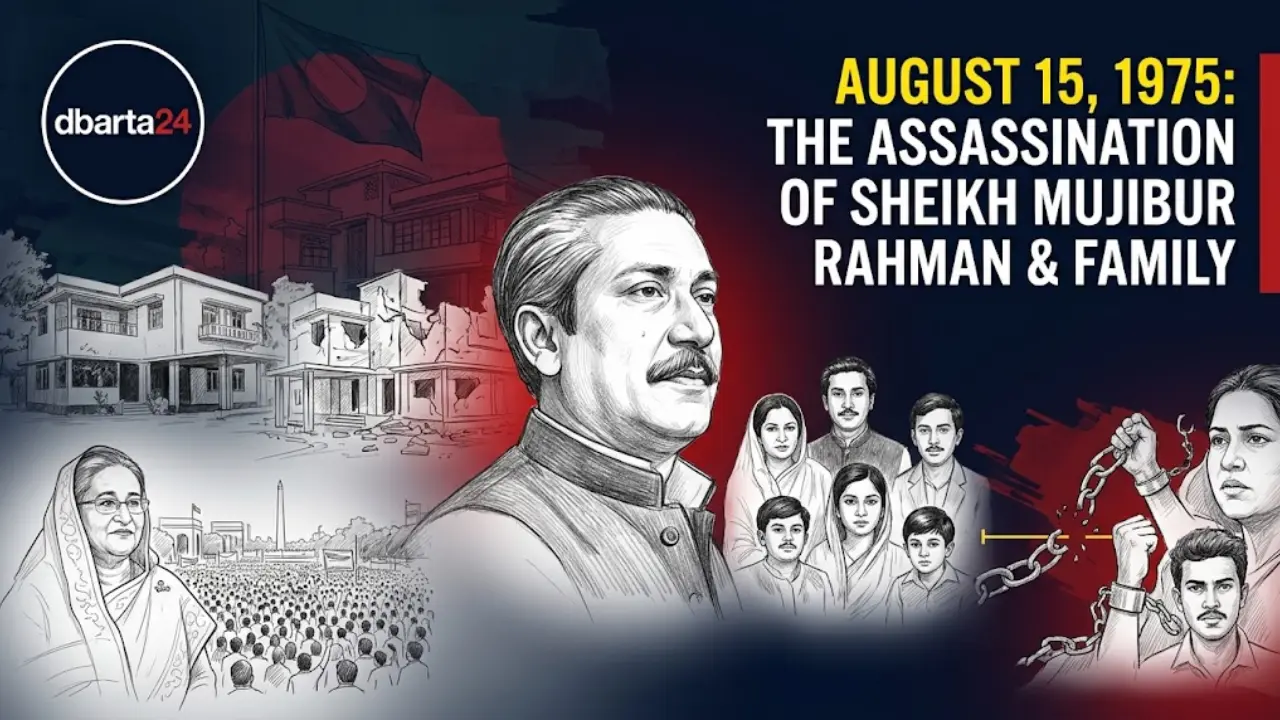
Special Correspondent; Dbarta24 — August 15 marks the 51st death anniversary of Sheikh Mujibur Rahman, the founding leader of Bangladesh.
On this day in 1975, a group of derailed military officers assassinated Sheikh Mujib alongside most of his family members at his residence on Dhanmondi 32 in Dhaka, marking one of the darkest chapters in the nation’s political history.
The brutal overnight raid claimed the lives of Sheikh Mujibur Rahman, his wife Begum Fazilatunnesa Mujib, their three sons—Sheikh Kamal, Sheikh Jamal, and 10-year-old Sheikh Russel—and daughters-in-law Sultana Kamal and Rozi Jamal.
Sheikh Mujib’s brother Sheikh Abu Naser, his Chief Personal Security Officer Colonel Jamil, Special Branch Officer Siddiqur Rahman, and army member Syed Mahbubul Haq were also killed as they attempted to protect the family.
Simultaneously, secondary military squads launched targeted attacks on the residences of his extended family. Sheikh Fazlul Haq Mani, leader of the Awami Yuva League and nephew of Sheikh Mujib, was killed along with his pregnant wife, Arzu Mani.
Another raid on the home of Sheikh Mujib’s brother-in-law Abdur Rab Serniabat resulted in his death alongside several family members and relatives, including children.
Sheikh Mujib’s two daughters, Sheikh Hasina and Sheikh Rehana, survived the massacre as they were staying in Brussels, Belgium, at the time.
Political Rise and the Liberation Struggle
Sheikh Mujibur Rahman emerged as the undisputed figurehead of Bangladesh’s independence movement during the late 1960s.
Anchored in nationalist ideology, his leadership unified the public against autocratic rule and economic disparity.
His historic March 7, 1971 address at the Ramna Racecourse (now Suhrawardy Udyan) served as the catalyst for the nine-month War of Independence. Addressing a gathering of hundreds of thousands, Sheikh Mujib declared:
“The struggle this time is the struggle for our emancipation; the struggle this time is the struggle for independence.”Legal Proceedings and Judicial Outcome
The judicial process for the August 15 killings began 21 years later, following the Awami League’s return to power under Sheikh Hasina in 1996.
The government subsequently declared August 15 as National Mourning Day and established it as a public holiday.
On November 8, 1998, a trial court handed down death sentences to 15 individuals charged in the assassination case. The Appellate Division of the Supreme Court later upheld the death penalty for 12 convicts.
To date, execution of the verdict has been carried out for six individuals. One convict died abroad while evading arrest, and five remaining fugitives remain at large.
Shift in Political Landscape
During Sheikh Hasina’s consecutive 15-year tenure starting in 2009, August 15 was commemorated nationwide with month-long programs, including tributes at the Dhanmondi 32 portrait and his mausoleum in Tungipara, Gopalganj.
However, following the July mass uprising in 2024 that brought an end to Sheikh Hasina’s administration, the political landscape shifted significantly.
In the altered political context, the interim government canceled the official public holiday associated with August 15.
The historical residence at Dhanmondi 32—which had functioned as the Bangabandhu Memorial Museum—was vandalized and set on fire during the events of August 5, 2024, and suffered further structural destruction six months later.