


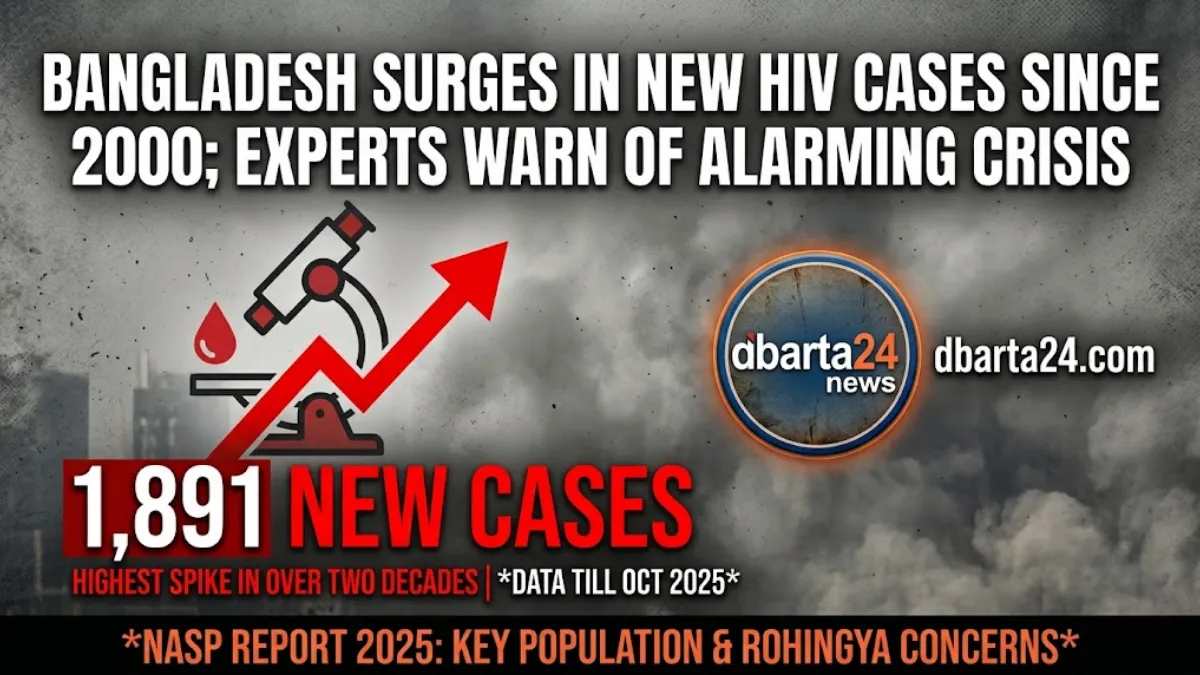
Khairul Alam ; Health Desk – Bangladesh has recorded its highest-ever single-year spike in new HIV cases since 2000.
According to a newly released official report, the number of newly diagnosed patients has reached unprecedented levels, triggering serious concerns among public health experts.
Between November of last year and October of this year, a total of 1,891 individuals tested positive for HIV.
This marks a stark increase of 453 cases compared to the previous year. Paradoxically, this surge in infections was detected despite the fact that nearly 200,000 fewer people underwent screening compared to the prior reporting period.
These findings were published in the ‘HIV/AIDS Situation Report-2025’ on Monday.
On a positive note, HIV-related fatalities saw a decline, with 254 deaths recorded during this period, down from 326 deaths reported in the previous year.
The Directorate General of Health Services’ (DGHS) National AIDS/STD Control Programme (NASP) unveiled the data during an event at the National Institute of Cancer Research and Hospital auditorium to mark World AIDS Day.
At the venue, medical experts emphasized the urgent need to expand testing and treatment, strengthen coordination between public and community organizations, and deepen awareness campaigns at the grassroots level.
Understanding Bangladesh’s HIV Landscape
Since Bangladesh detected its very first HIV case in 1989, the country has recorded a cumulative total of 14,313 cases, with 2,666 individuals succumbing to the disease.
Health officials estimate the total pool of infected individuals in the country to be around 17,480, meaning roughly 18% of people living with HIV in Bangladesh are still unaware of their status.
Fewer Tests, Higher Detection: The Demographics
Data shows that 14.21 lakh people underwent standard HIV testing over the past year—a drop of 1.91 lakh from the previous period. Additionally, 10.72 lakh people were screened as part of routine health checkups.
Officials noted that the overall drop in testing stems primarily from a decline in outgoing migrant workers seeking screenings, dropping from 13.05 lakh to 10.11 lakh.
Out of the 1,891 newly infected individuals, 217 belong to the Rohingya community.
Explaining the spike in detection amid fewer total tests, Dr. Zubaida Nasrin, Deputy Director of the National AIDS/STD Control Programme, pointed to targeted efforts:
“The number of detections has increased mainly because testing was expanded heavily among the ‘Key Population’.”
The “Key Population” refers to high-risk groups, including people who inject drugs (PWID), female and male sex workers, and transgender communities.
Testing within these groups expanded significantly to 1.17 lakh over the past year, up from 96,922 in the previous year.
A deeper analysis of the newly infected demographic reveals:
-
Risk Profile: 56% belong to the key high-risk population, 12% are expatriates/migrants, 11% are Rohingyas, and the remaining represent the general public.
-
Gender Distribution: 81% are male, 18% are female, and 1% identify as Hijra (transgender).
-
Age and Marital Status: 52% are married, while 42% are unmarried. The most economically active age bracket, 25–49 years, accounted for 63% of the cases, followed by the 20–24 age bracket at 21%.
Disrupted Preventive Measures and Treatment Gaps
The surge follows the conclusion of a government-backed targeted intervention program in June last year.
The expiration of this project severely disrupted the free distribution of preventive services, such as condoms and sterile needles/syringes, among high-risk groups.
When questioned if the program’s closure directly accelerated the infection rate, Dr. Zubaida Nasrin stated:
“While the closure of the program did cause some initial difficulties, it cannot be cited as the sole or direct reason for the rise in infections. We need further comprehensive research to pinpoint all contributing factors.”
Simultaneously, the rate of HIV-positive patients receiving life-saving treatment dropped from 78% last year to 74% this year.
A DGHS official attributed this drop to a growing number of patients discontinuing their medications for more than three consecutive months.
Despite the worrying spike in new cases and the drop in treatment compliance, the report highlighted some silver linings. Currently, 82% of the estimated total HIV-positive population in Bangladesh are aware of their status.
Furthermore, an impressive 91% of those actively undergoing treatment have successfully achieved viral suppression, meaning the level of the virus in their bodies has been reduced to undetectable levels.
Going forward, sustaining this suppression and re-engaging dropped-out patients will be critical to keeping the epidemic in check.