


Khairul Alam ; Health Desk – Newly released public health data for 2025 highlights a stark geographical disparity in Bangladesh’s battle against HIV.
While border districts and major urban divisions are experiencing a notable surge in infections, the three districts comprising the Chittagong Hill Tracts (CHT) continue to report the lowest transmission rates in the country, despite sharing international borders.
According to the National AIDS-STD Control Programme of the Directorate General of Health Services (DGHS), Bangladesh witnessed a significant rise in HIV cases in 2025, with 1,819 new infections detected compared to 1,438 cases in 2024.
This spike, alongside an increase in Sexually Transmitted Diseases (STDs), marks the highest transmission level recorded in the country over the last decade and a half.
Urban Centers and Border Belts Drive the Surge
The data confirms a multi-year trend: Dhaka Division continues to lead the nation in HIV diagnoses, closely followed by Chittagong Division.
In 2025, Dhaka recorded 650 new cases, up from 406 in 2024 and 342 in 2023. Chittagong reported 376 cases in 2025, compared to 326 in 2024 and 246 in 2023.
Public health expert Abu Jamil Faisal attributes this concentration to high testing volumes, as patients heavily migrate to major cities for healthcare.
He also noted that urban centers host higher concentrations of high-risk demographics, including intravenous drug users, men who have sex with men (MSM), and returnee migrant workers.
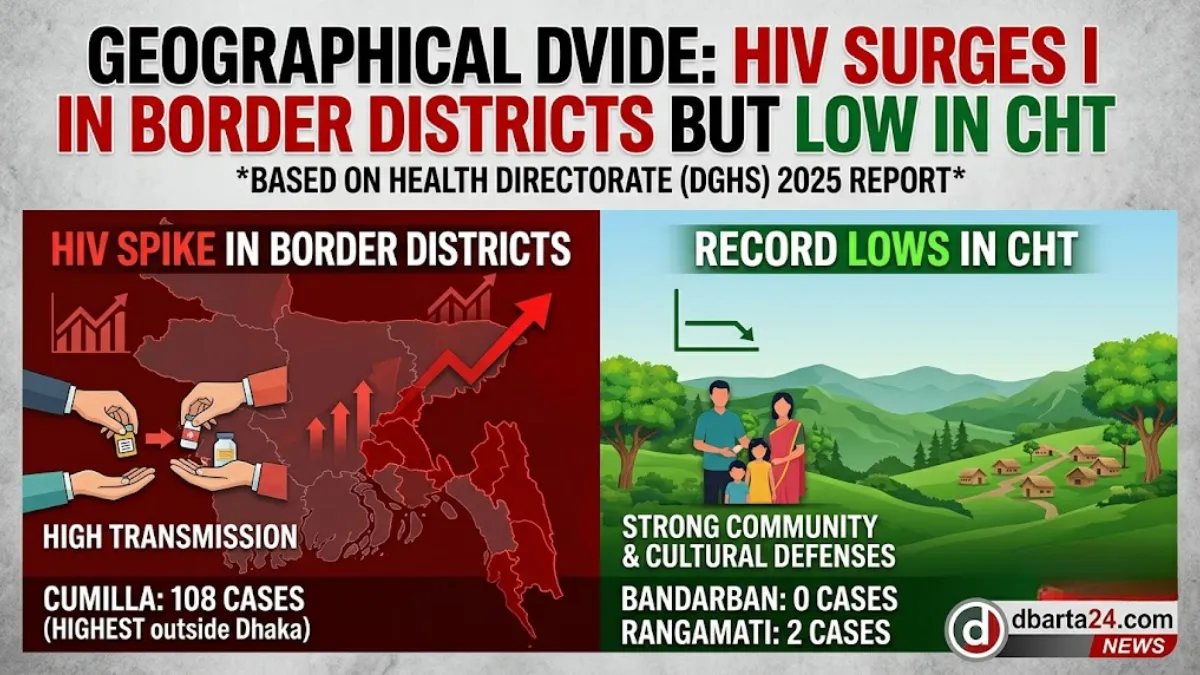
Outside the capital, border districts are emerging as major hotspots. In 2025, districts like Cumilla, Jashore, Brahmanbaria, Mymensingh, and Rajshahi reported significant infection numbers. Cumilla alone registered 108 cases, the highest for any single district outside Dhaka.
Commenting on the crisis, Cumilla’s Civil Surgeon, Ali Noor Mohammad Bashir Ahmed, expressed severe concern:
“The rise in HIV-positive individuals in Cumilla is undoubtedly alarming. Being a border district, there is a constant cross-border movement of people. Additionally, the illicit use of injectable drugs and a large population of expatriate workers returning home contribute heavily to these numbers.”
Similarly, Jashore’s Civil Surgeon, Dr. Md. Masud Rana, identified illegal drug trafficking and unregulated border crossings as primary drivers.
Public health experts emphasize that unauthorized border movements leave no room for medical screening, allowing the virus to spread undetected across communities.
Why the Chittagong Hill Tracts Defy the Trend
Covering nearly one-tenth of Bangladesh’s total landmass, the three hill districts—Rangamati, Khagrachhari, and Bandarban—share international borders with India and Myanmar.
Yet, their transmission rates remain extraordinarily low. In 2025, Bandarban recorded zero new cases, while Rangamati and Khagrachhari reported only two cases each. Historically, in 2016, Bandarban and Khagrachhari had zero cases, while Rangamati had just one.
DGHS officials attribute this anomaly to lower population densities and fewer outbound migrant workers from the region.
However, local experts point toward deeper socioeconomic and cultural factors.
Dr. Parash Khisa, a local physician from Rangamati and General Secretary of the non-governmental organization Tongya, explained that CHT borders do not see the massive human traffic typical of other national borders.
Furthermore, commercial sex work and intravenous drug use are significantly less prevalent in these terrains.
Dr. Khisa also highlighted the unique social structure of indigenous hill communities:
“Although indigenous hill societies are patriarchal, women hold a comparatively stronger social and familial standing here. Family bonds are exceptionally tight-knit, which naturally restrains behaviors that accelerate the spread of the disease.”
Public health specialist Abu Jamil Faisal concurred, noting that the robust cultural traditions, social norms, and strong community frameworks of the hill tracts act as a natural defense system, keeping the deadly disease at bay.
The 2025 epidemiological data underscores that HIV in Bangladesh is heavily influenced by geography and mobility.
Unregulated border crossings, migrant returns, and localized drug epidemics continue to fuel urban and border-belt statistics.
Conversely, the CHT proves that strong community structures and limited cross-border mobility can effectively keep infection rates low, providing valuable sociological insights for future nationwide intervention strategies.