


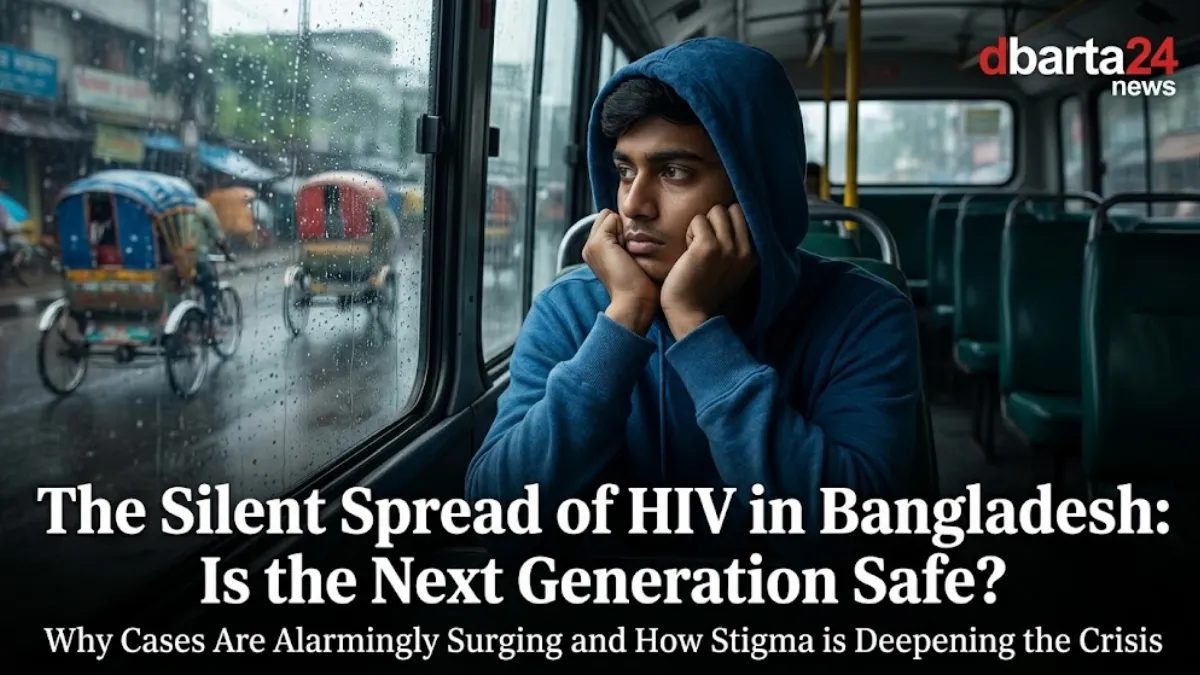
Khairul Alam ; Health Desk – While global health organizations push to eliminate HIV by 2030, Bangladesh faces a quiet but rapidly accelerating crisis at home.
Latest figures reveal a concerning trend: HIV is increasingly infiltrating the younger demographic and moving beyond historically confined boundaries.
Data from the National AIDS and STD Control Programme under the Directorate General of Health Services (DGHS) highlights a sharp year-over-year spike in domestic transmission.
In 2025, Bangladesh recorded 1,891 new HIV infections alongside 219 registered deaths. This marks a significant escalation from 2024, which saw 1,438 new cases, and 2023, which recorded 1,276 cases.
Public health experts estimate that approximately 17,000 people are currently living with HIV across the country.
Shifting Demographics and Regional Hotspots
Historically, HIV programs in Bangladesh focused primarily on targeted high-risk groups, including migrant workers, female sex workers, and people who inject drugs (PWID).
However, newer statistics show that the virus is rapidly spreading among school and college-going students.
Bangladesh HIV Trends (Recent Years)
+------+-------------+--------+
| Year | New Cases   | Deaths |
+------+-------------+--------+
| 2023 | 1,276       | 266    |
| 2024 | 1,438       | 326    |
| 2025 | 1,891       | 219    |
+------+-------------+--------+
The Emerging ‘Red Zones’
-
Sirajganj: Labeled a critical “red zone” due to a massive concentration of cases among people who inject drugs. Over the last five years, the Sirajganj Sadar Hospital ART center identified 255 positive cases. An analysis of these patients revealed that while 187 were active drug users sharing needles, a striking 29 were college and university students.
-
Jashore: In this border district, 40 new cases were detected at the local ART center between January and October 2025. Alarmingly, 25 of these patients—more than half—were youth aged between 17 and 23.
-
Barishal: A similar pattern emerged at the Sher-e-Bangla Medical College Hospital (SBMCH), where 20 new cases were registered over a year. Out of these 20 new patients, 11 were students.
-
Geographic Density: Regionally, Dhaka district recorded the highest volume of new cases in 2025 with 334 infections, followed by Cumilla with 108 cases, and Chittagong and Khulna each registering around 100 cases. Conversely, despite sharing international borders, the three Chittagong Hill Tracts districts maintained the lowest transmission rates in the country.
What is Driving the Spike Among Youth?
Public health specialists and medical researchers point to a dangerous convergence of behavioral and systemic risk factors that leave the younger generation exposed:
-
Shared Injectable Equipment: The reuse of needles and syringes among drug-using youth allows the virus to transmit directly through the bloodstream.
-
Unsafe Sexual Practices: A widespread absence of barrier protection (condoms) and a lack of awareness regarding sexual health leave young people vulnerable during casual encounters.
-
Changing Social Dynamics: Data indicates a substantial rise in transmission via male-to-male sexual contact, with experts noting that men who have sex with men (MSM) account for approximately 40% to 50% of the newly identified infections nationwide.
-
The Culture of Stigma: Severe social taboos surrounding sexual health and HIV prevent individuals from seeking early testing. Many patients actively conceal their status out of fear of social shaming, inadvertently increasing the risk of community transmission.
Expanded Screening Unveils the Reality
While the rising numbers are alarming, health officials note that part of the spike stems from improved infrastructure and increased public outreach.
“The expansion of government and non-government HIV prevention and treatment programs, alongside reduced social fear and stigma associated with the disease, has encouraged more suspected individuals to seek testing,” explained Md. Alauddin Chowdhury, Manager (Data & IT) of the DGHS AIDS/STD Programme. “Ultimately, as testing and screening services scale up, the number of identified cases—particularly among high-risk groups like MSM—is bound to show an upward trend.”
Currently, the DGHS reports that 77% of people living with HIV in Bangladesh are aware of their status.
While this shows progress, it still falls short of the global UNAIDS target, which aims to ensure that 95% of HIV-positive individuals know their status by 2030 to effectively curb the epidemic.
A Call for Systemic Intervention
The transition of HIV from confined risk groups into classrooms and campuses is a public health warning that Bangladesh cannot afford to ignore.
While timely access to Antiretroviral Therapy (ART) allows diagnosed individuals to suppress their viral loads and live healthy lives, treating the infected is only half the battle.
To protect the next generation, the government must transition toward aggressive grassroots awareness.
Public health experts emphasize that scaling up institutional sex education, eliminating the stigma around reproductive health, and deploying targeted harm-reduction programs for substance-abusing youth are critical steps.
Without an immediate, well-funded national action plan that actively engages the public, this silent spread risks evolving into a visible national crisis.