


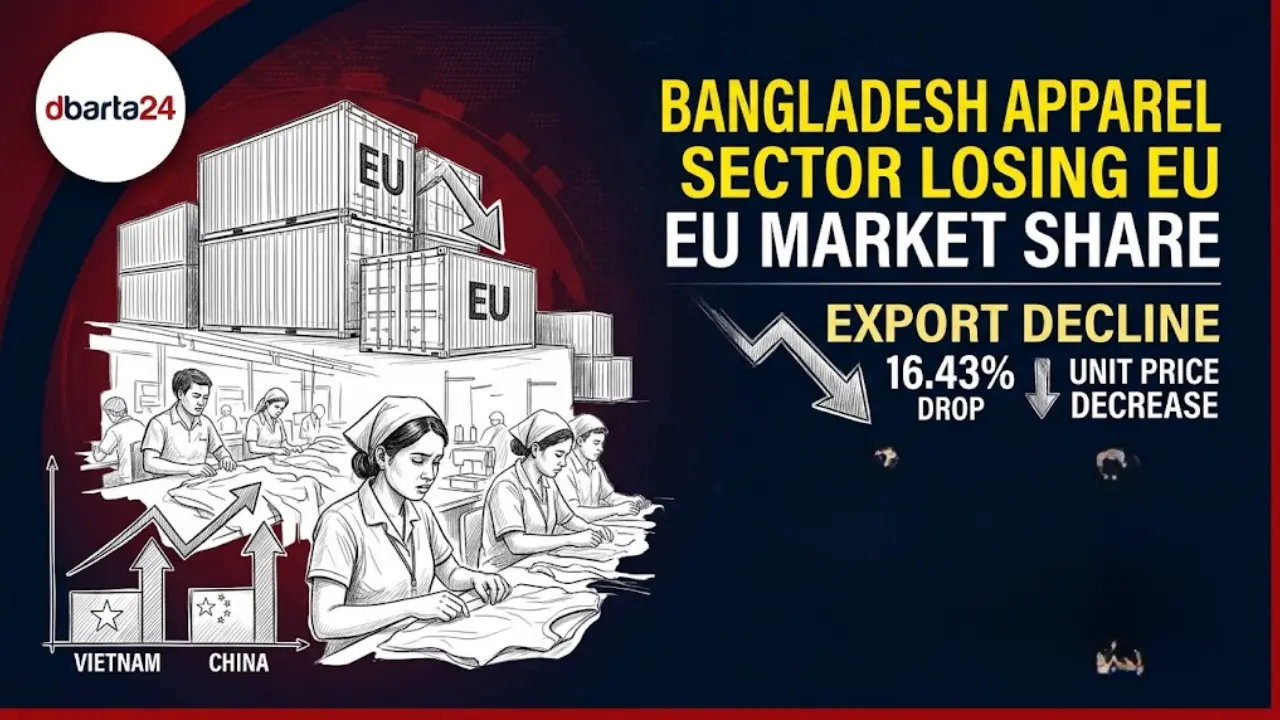
Md. Tareq; Dbarta24 — Following a noticeable slowdown in the US market, Bangladesh’s ready-made garment (RMG) sector is now facing an intensifying crisis in the European Union (EU)—its single largest export destination.
A steep decline in both shipment volumes and average unit prices in the first half of the year has triggered deep concern among industry leaders and trade economists, who warn that the country is rapidly losing ground to regional competitors like Vietnam and China.
According to the latest data from Eurostat, Bangladesh’s garment exports to the 27-member European bloc plunged by 16.43% year-on-year during the January–June period, dropping to €8.64 billion.
This represents a staggering loss of approximately €1.70 billion compared to the €10.34 billion recorded during the same period last year.
Notably, Bangladesh’s export contraction was significantly worse than the global average decline of 9.70% in total EU garment imports.
Falling Unit Prices Compound Export Losses
The crisis in Bangladesh’s RMG sector extends beyond shrinking order volumes to a concerning drop in product pricing.
Eurostat data indicates that the average price per kilogram of Bangladeshi apparel exported to the EU fell by 8.94% during the January–July period.
In comparison, the global average unit price for EU garment imports decreased by only 3.53%.
This disparity highlights a growing vulnerability in Bangladesh’s pricing power. While global market demand has softened, Bangladeshi exporters are taking a disproportionately heavy hit on profit margins.
In sharp contrast, Vietnam—the world’s third-largest apparel exporter—defied the downward trend by recording a 13.43% surge in unit pricing in the EU market over the same period, alongside a modest 0.36% gain in overall export volume to €2.07 billion.
Competitors such as Cambodia and Turkey also registered positive growth in their export unit prices by 5.72% and 1.53%, respectively.
External Trade Shifts and Domestic Bottlenecks
Industry insiders attribute the sharp downturn to a complex mix of global trade dynamics and severe domestic constraints.
The imposition of high tariffs by the United States on Chinese goods has led Chinese manufacturers to redirect a substantial volume of apparel to the European market at aggressive prices, directly undermining Bangladesh’s market share.
Furthermore, Vietnam’s Free Trade Agreement (FTA) with the European Union provides its exporters with preferential tariff access, giving them a distinct competitive edge over Bangladeshi manufacturers who face heightened scrutiny ahead of the country’s upcoming graduation from Least Developed Country (LDC) status.
Mohammad Hatem, President of the Bangladesh Knitwear Manufacturers and Exporters Association (BKMEA), emphasized that multiple systemic challenges are converging simultaneously to depress order volumes:
“The decline in garment export orders from Bangladesh is being driven by a combination of factors: uncertainty surrounding LDC graduation, a severe domestic energy crisis, rising regional competition, and shifts in global buyers’ sourcing strategies.”
Hatem noted that chronic shortages of gas and electricity have disrupted factory operations, hindering timely shipments and damaging Bangladesh’s reputation for supply chain reliability.
As a result, several international fashion brands have begun shifting a portion of their planned orders to alternative manufacturing hubs.
Expert Analysis: Structural Reforms Urgently Needed
Eminent economist Professor Mustafizur Rahman, Distinguished Fellow at the Centre for Policy Dialogue (CPD), cautioned against treating the current slump as a routine market fluctuation.
He described the situation as a cumulative result of external shocks and internal structural weaknesses:
“The shift in international market demand, changing buyer strategies, heightened competition from China and Vietnam, and differential trade privileges have intensified external pressures on Bangladesh. Domestically, these are compounded by the energy crunch, soaring production costs, logistical bottlenecks, financial sector fragility, and broader business climate constraints.”
Professor Rahman warned that once global buyers diversify their supply chains and establish long-term partnerships elsewhere, recovering those lost orders becomes an uphill battle.
“The nature of competition in the global apparel market is evolving rapidly. Unless Bangladesh acts immediately to boost productivity, diversify product offerings, adopt advanced technologies, and strengthen logistics, the country risks systematically losing its market share—not just in Europe, but across other major global destinations as well,” Rahman added.
Short-term cash incentives and temporary subsidies will no longer suffice to stabilize Bangladesh’s flagship export industry.
To safeguard its dominant position in the EU market, Bangladesh must urgently resolve its internal energy bottlenecks, modernize port infrastructure, lower operational costs, and pursue proactive trade diplomacy to secure favorable market access post-LDC graduation.