


Islam Razu , Dhaka – Bangladesh is rapidly losing ground in the European Union (EU), its largest destination for ready-made garments (RMG).
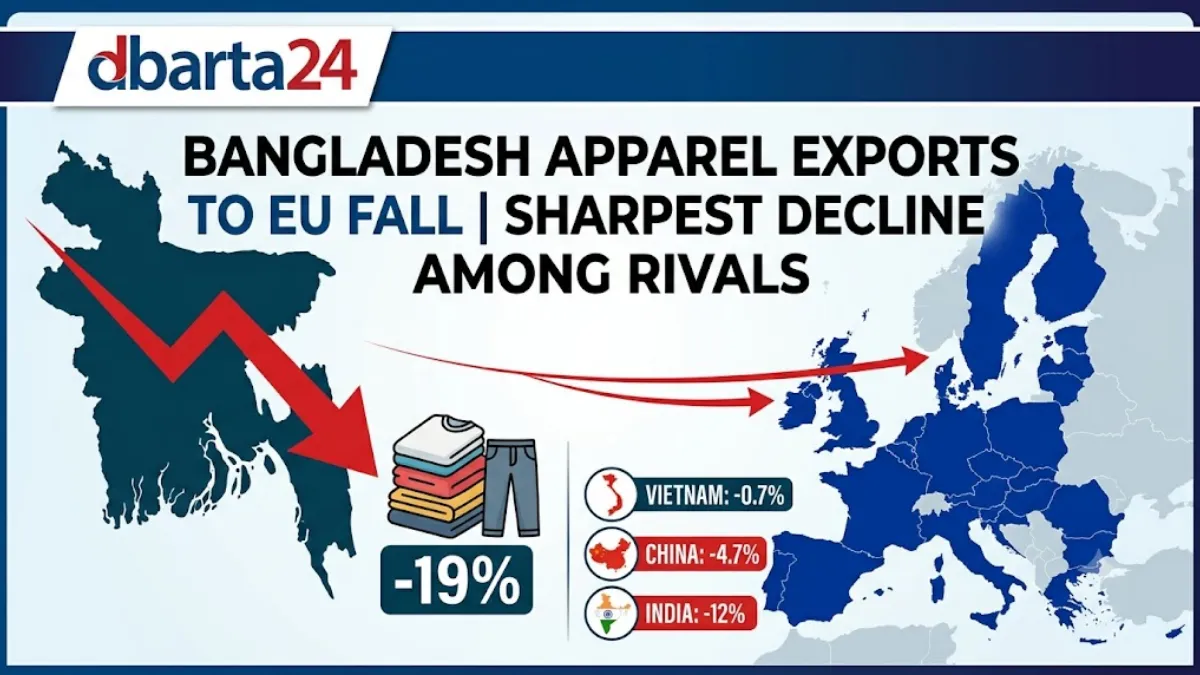
During the first four months of the current calendar year, apparel exports from Bangladesh to the EU plunged by nearly 19.33%, registering the sharpest contraction among all major global garment competitors supplying the trading bloc.
According to the latest updated data from Eurostat, the EU’s statistical office, European buyers imported a total of €27.77 billion worth of apparel from global sources between January and April.
This represents an overall market shrinkage of 10.42% compared to the same period last year.
However, Bangladesh’s export contraction was nearly double the market average. The country shipped garments valued at €6.09 billion during this four-month window, down significantly from the €7.54 billion recorded in the corresponding period last year.
Triple Threat Behind the Export Slump
Industry leaders and exporters attribute this sudden downturn to a combination of geopolitical shifts, intense market competition, and eroding domestic policy support.
Following the implementation of retaliatory tariffs on Chinese goods by the United States last year, Chinese apparel manufacturers aggressively shifted their focus toward capturing the European market.
Backed by extensive state subsidies and financial incentives, Chinese exporters began undercutting prices to secure bulk orders.
Concurrently, the Free Trade Agreement (FTA) between India and the EU has encouraged European buyers to divert substantial ordering volumes to neighboring India.
A prevailing drop in consumer demand within the EU market, triggered heavily by broader economic anxieties and international conflicts, has further squeezed order inflows.
Global Competitors Navigate the Crisis
While China retains its dominance in the EU market with €7.95 billion in exports during Jan-April, its export value contracted by only 4.70%—faring significantly better than Bangladesh.
In terms of volume, Bangladesh actually shipped more garments by weight (44 million kg) than China (41 million kg), but suffered heavily on profit margins due to depressed pricing.
Bangladesh’s average garment export price dropped by 10.5% to €13.96 per kg, whereas competing nations like Turkey, Vietnam, and Cambodia managed to increase their per-kilogram export values.
Among the top ten apparel exporters to the EU, Vietnam emerged in the most secure position, seeing a negligible export decline of just 0.70% to reach €1.37 billion.
Conversely, other regional players faced varying degrees of contraction: Turkey dropped by 16.5%, India by 12%, Pakistan by 18%, and Indonesia by 18%.
Industry Leadership Voices Alarm
Speaking on the development, Md. Shihab Uddoja Chowdhury, Vice President of the Bangladesh Garment Manufacturers and Exporters Association (BGMEA), outlined the core vulnerabilities:
“Apparel exports to the EU are declining due to three primary reasons: a drop in consumer-level demand in the EU market, China’s aggressive marketing and price reductions to capture order volumes, and the diversion of buyer orders to India following their FTA. We expect this shift to India to intensify further within the next year. We have already formally briefed high-level government authorities regarding these challenges.”
Industry veterans also point toward a stark contrast in domestic policy responses. Fazlul Hoque, former President of the Bangladesh Knitwear Manufacturers and Exporters Association (BKMEA), noted that external competition was worsened by internal financial bottlenecks:
“When China launched its aggressive marketing in the EU, their state stepped in to support them. In contrast, our government scaled back existing facilities and policy support. Due to the fragile condition of local banks, many factories failed to receive the necessary financial backing, forcing several units to suspend operations or halt exports entirely. Rising domestic costs of doing business have left our entrepreneurs with zero room to counter the low price points offered by Chinese rivals.”
According to data from the Export Promotion Bureau (EPB), Bangladesh exported $35.31 billion worth of garments globally during the first 11 months of the fiscal year, with the EU market absorbing roughly 49% ($17.36 billion) of that volume.
As overall apparel shipments have dipped by roughly 5% over this period, the severe drop in Eurostat’s early-year reporting sounds a major alarm for local policymakers.
Without urgent intervention to ease manufacturing costs, stabilize the banking sector’s trade support, and match competitor diplomacy, Bangladesh risks permanent market-share erosion in its most vital economic corridor.