


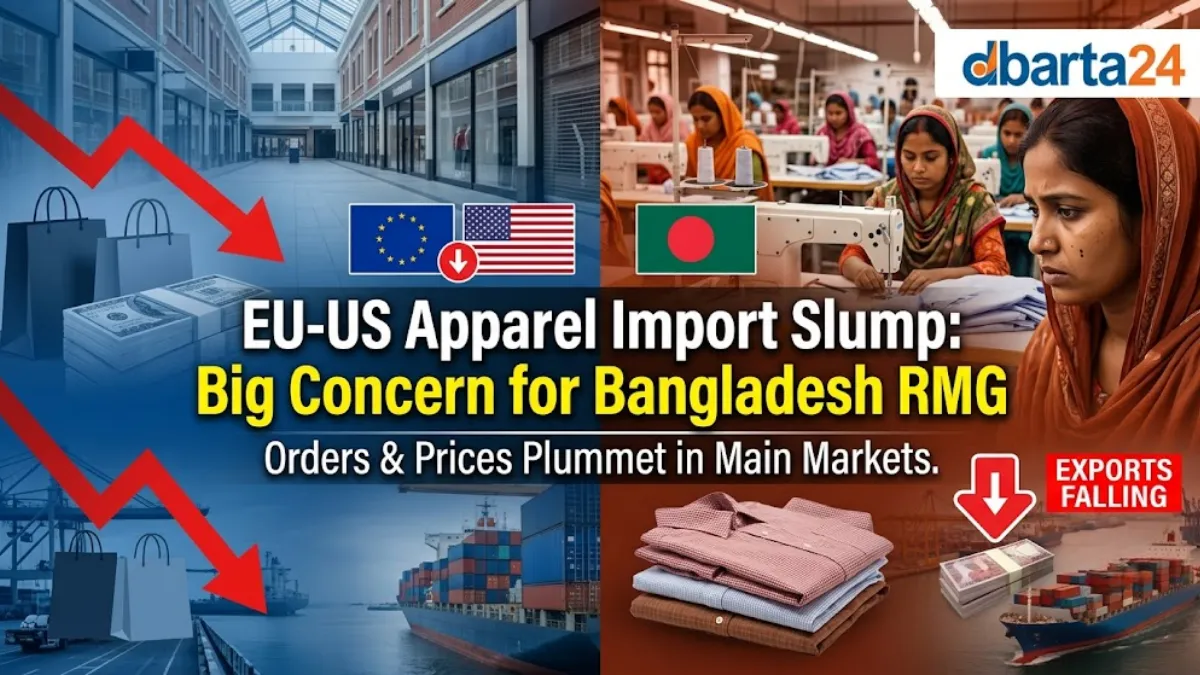
Muhammad Tareq ; Dhaka — A sharp decline in apparel imports by the European Union (EU) and the United States during the first four months of 2026 has triggered fresh anxieties for Bangladesh’s Ready-Made Garment (RMG) sector.
As the country’s primary source of foreign exchange alongside remittances, the export sector is facing a severe double whammy of shrinking order volumes and falling unit prices in its two largest destinations.
Since the EU and US account for nearly 70% of Bangladesh’s total export earnings, economists and industry leaders warn that this lingering demand slump could severely strain the country’s foreign exchange reserves, industrial output, and employment.
The Slump in Figures: EU and US Markets
Data from Eurostat and the US Department of Commerce’s Office of Textiles and Apparel (OTEXA) paint a grim picture for the January–April 2026 period:
-
The EU Market: The EU’s global garment imports fell by 10.42% to $27.77 billion. However, Bangladesh’s exports to the bloc plummeted by a staggering 19.33%, dropping to $6.08 billion from $7.54 billion in the same period last year. In comparison, China’s exports fell by 4.70% and India’s by 12.10%.
-
The US Market: Total US clothing imports dropped by 12% to just over $23 billion. Bangladesh, the second-largest supplier to the US, saw its exports shrink by 11.24% to $2.64 billion. Conversely, Vietnam bucked the trend by registering a 1.31% growth, exporting $5.15 billion worth of apparel to the US.
The Price Compression Shock
Compounding the crisis is a steep decline in the average price offered to Bangladeshi manufacturers. In the EU, while the average import price dipped by 5.22%, the price for Bangladeshi apparel plunged by 10.45%.
Meanwhile, Vietnam secured a 1.49% price growth in the EU and a 2.69% growth in the US, highlighting its superior competitive edge.
Underlying Drivers and Domestic Structural Bottlenecks
Global economic headwinds—primarily high inflation, squeezed consumer spending in Western economies, and high retail inventory leftovers—are driving the import contraction.
However, local exporters are dealing with a parallel domestic crisis. The RMG industry is currently crippled by soaring production costs, severe energy and gas shortages, high bank interest rates, local currency volatility, and supply chain inefficiencies. The simultaneous drop in order volumes and export prices is rapidly eroding factory profit margins.
Insights from Industry Leaders and Economists
Industry stakeholders emphasize that this downturn should serve as an urgent structural wake-up call rather than a temporary hitch, especially with Bangladesh’s upcoming graduation from the Least Developed Countries (LDC) status.
“The decline in import growth in the US and European markets is an important warning sign for Bangladesh’s RMG sector… When global demand drops, risks of reduced orders, price pressure, and intense competition intensify.”
— Mahmud Hasan Khan Babu, President, BGMEA
The BGMEA chief stressed the need for shifting toward high-value products, technological integration, automation, and ensuring uninterrupted gas and electricity supply alongside policy support from the government to reduce the cost of doing business.
Prof. Mustafizur Rahman, Distinguished Fellow at the Centre for Policy Dialogue (CPD), pointed out that volume growth alone will no longer sustain the industry.
“If we want to lead the RMG sector toward sustainable growth in the coming decade, we must increase both the quality and diversity of our exports. Beyond conventional garments, we need to focus more on technical textiles, sportswear, outerwear, and high-value fashion products.”
— Prof. Mustafizur Rahman, Distinguished Fellow, CPD
He also advised reducing over-dependence on the EU and US by diversifying into markets like Japan, South Korea, Australia, India, and Latin America, while expanding man-made fiber production locally to cut import reliance.
Dr. Zahid Hussain, former Lead Economist of the World Bank’s Dhaka office, warned of the long-term stakes:
“Global apparel competition is no longer limited to supplying goods at low prices. Productivity, rapid supply chains, technology, green production, and high-value product capabilities will be the key determinants… If utilized positively through policy reforms, market diversification, and modernization, this challenge can turn into future strength.”
— Dr. Zahid Hussain, Former Lead Economist, World Bank (Dhaka)
With over 4 million workers—predominantly women—relying on the garment sector, the current global import contraction exposes the vulnerability of Bangladesh’s export-reliant economy.
As trade preferences shift with the post-LDC transition, the government and private sector must collaborate immediately. Moving away from low-cost dependency toward product diversification, green logistics, and energy security is no longer optional; it is survival.