
















Bangladesh Bank Set to Oust Directors of Capital-Deficit Banks as Non-Performing Loans Hit Record High
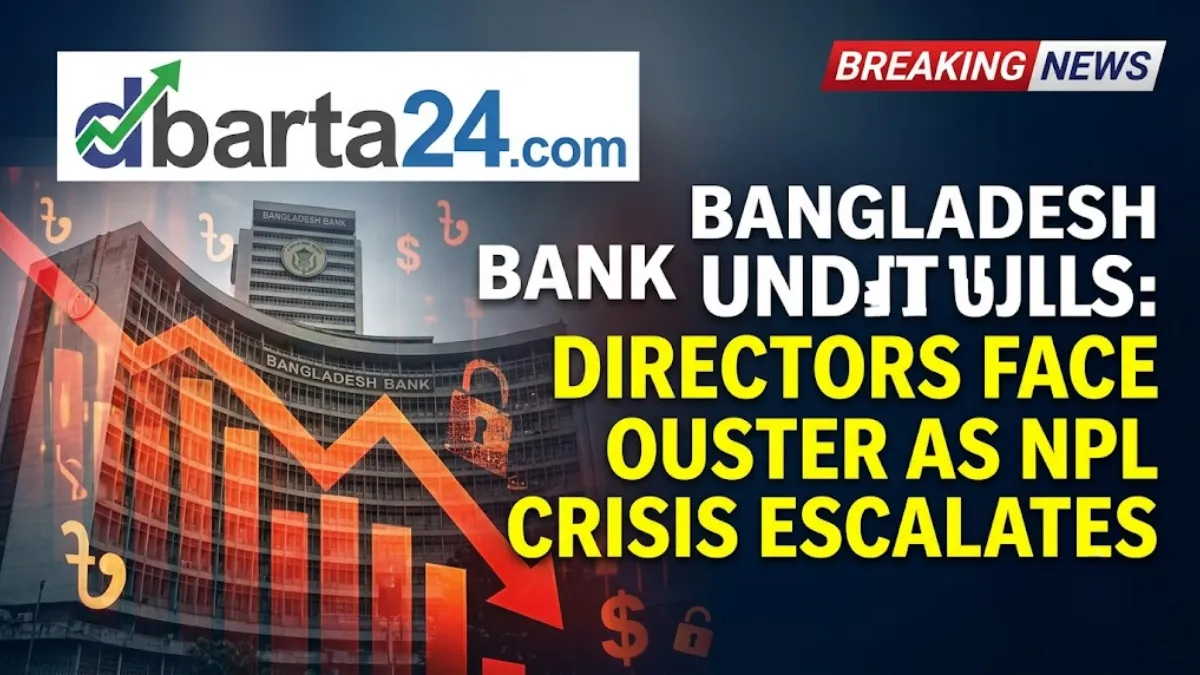
Dbarta24 Business Report— Bangladesh Bank has rolled out a sweeping, multi-phase roadmap to tackle the country’s escalating banking crisis, warning that bank directors will lose their board seats and ownership stakes if they fail to meet minimum capital requirements caused by rampant non-performing loans (NPLs).
With Bangladesh currently recording the highest NPL ratio globally, the central bank has set an ambitious target to slash defaulted loans from the existing 32.26% down to 20% by the end of this year, and further down to 10% by next year.
Under the newly outlined strategy, spanning 21 action plans across short-, medium-, and long-term phases, Bangladesh Bank Governor Md. Mostakur Rahman emphasized that lenient debt-rescheduling policies are officially over. Moving forward, debt recovery will strictly adhere to the central bank’s “Exit Policy” issued on June 29, which offers temporary interest waivers to encourage default clearance through December. However, starting next year, regulatory leniency will give way to aggressive legal and structural enforcement.
Strict Enforcement and Loss of Ownership
To restore stability to the fragile financial sector, the central bank is introducing stringent measures for non-compliant institutions and borrowers:
-
Board Removal: Banks with severe capital deficits will be given a strict timeline to cover shortfalls. Directors who fail to maintain the required capital reserves will be stripped of their ownership and disqualified from holding directorships in any bank for five years.
-
Resolution and Mergers: Capital-starved banks that remain non-compliant will face central bank intervention, including forced acquisition, bank resolution, mergers, or liquidation.
-
Public Shaming of Defaulters: The names and photographs of willful defaulters who ignore the flexible exit policy will be displayed publicly at major international airports, as well as outside bank headquarters and branches.
“Reducing non-performing loans is Bangladesh Bank’s absolute top priority,” said Arif Hossain Khan, Executive Director and Spokesperson of Bangladesh Bank. “We have initiated a flexible policy to facilitate recovery first. However, if defaulters do not settle their dues, they will face severe legal consequences in the subsequent phases.”
Distressed Asset Management and Legal Reforms
According to central bank data, despite official figures reporting default loans at 32.26%, the volume of high-risk distressed assets has surged to 10,87,590 crore BDT—representing 59.73% of all total banking loans.
Driven by huge capital deficits across 20 banks totaling 2,78,000 crore BDT, the banking sector’s overall capital adequacy ratio dropped into negative territory at -2.64%, leaving only 17 out of 52 domestic banks profitable last year.
To clear these bad debts, the central bank is drafting the Distressed Asset Management Act. Under this framework, specialized asset management companies will buy collateralized properties of defaulted loans directly with cash.
Syed Mahbubur Rahman, Managing Director of Mutual Trust Bank, supported the initial exit relief but stressed the importance of accurate asset valuation.
“It is far better to settle an account today at a slight discount than to drag out defaulted loans for a decade,” Rahman said. “However, the key challenge for asset management companies will be determining the true market value of collateralized assets, as many loans were historically backed by inflated or fraudulent collateral.”
In addition to asset management companies, the central bank plans to amend the Money Loan Court Act (Artha Rin Adalat) to mandate case resolution within six months.
Furthermore, to prevent defaulters from tying up recovery proceedings through writ petitions, new regulations will require borrowers to deposit a significant portion of their outstanding debt prior to filing a writ in court.
Summary of Strategic Action Plan
| Phase | Key Initiatives |
| Short-Term | Strict application of the Exit Policy, implementation of Prompt Corrective Action (PCA), quarterly progress reporting to the Governor by high-NPL banks, and mandatory discussions on the top 20 defaulters during bankers’ meetings. |
| Medium-Term | Public release of defaulter lists, incentive structures for good borrowers, deployment of independent valuation agencies, early warning systems (EWS), and special performance bonuses for recovery officers. |
| Long-Term | Legal reforms in Money Loan Courts, requiring substantial deposits for court writ filings, setting overall group lending limits across the entire banking sector, and requiring corporate loans over 1,000 crore BDT to be raised via bond markets. |
SEO & Metadata Summary
-
SEO Title:
-
SEO Description:
-
Focus Keyphrase:
-
Tags:
-
ALT Text for Main Image: