


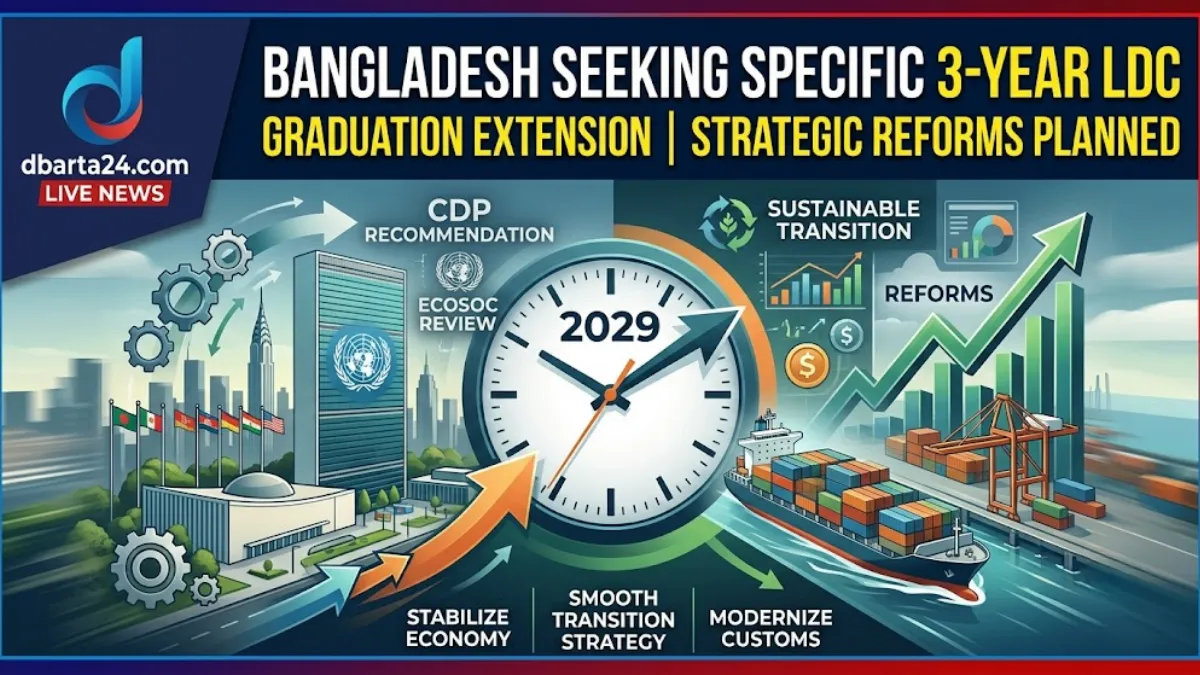
Special Correspondent — Bangladesh has formally requested a concrete recommendation from the United Nations Economic and Social Council (ECOSOC) to extend its Least Developed Country (LDC) graduation preparation period by three years.
The interim period is aimed at helping the nation navigate recent economic shocks, stabilize key growth indicators, and carry out comprehensive structural reforms through a newly drafted five-year strategic framework.
The request is undergoing review at a crucial two-day ECOSOC meeting held at the UN Headquarters in New York. ECOSOC’s eventual recommendation will form the basis for the final decision expected at the UN General Assembly session this coming September, according to sources from the Ministry of Finance and Ministry of Commerce.
Diplomatic Push Following CDP Backing
On February 18, Bangladesh submitted a formal application to the UN Committee for Development Policy (CDP) to push back its LDC graduation deadline to November 24, 2029.
Prime Minister Tarique Rahman subsequently addressed a letter to the UN Secretary-General on April 6, seeking personal support for the extension.
While the CDP endorsed Bangladesh’s request for a delay in June, it stopped short of recommending a specific timeframe.
To ensure ECOSOC recommends the requested three-year window, the Bangladesh government intensified diplomatic engagement:
-
Ministerial Delegation: Commerce Minister Khondokar Abdul Muktadir led a delegation to meet ECOSOC President and Permanent Representative of Nepal, Ambassador Lok Bahadur Thapa, alongside ECOSOC Vice President and Permanent Representative of Algeria.
-
Strategic Roadmap: The delegation presented a transition roadmap developed by the Economic Relations Division (ERD) of the Ministry of Finance.
-
Diplomatic Envoys: High-level discussions were conducted with representatives of UN member states, diplomatic missions in Dhaka on July 2, and during a preliminary bilateral meeting in Kathmandu on July 9.
Economic Context & Rationalization
In discussions with international partners, government officials highlighted that domestic and global economic shocks over recent years severely hindered the planned utilization of the original five-year preparation phase.
UN principles stipulate that LDC graduation must not jeopardize a nation’s existing development trajectory. However, socio-economic disruptions over the last four years have disrupted progress.
“The extension request is not a step backward from development, but a deliberate move to ensure a smooth, well-planned, and sustainable transition,” the government noted in its submission, pointing to a fragile economic legacy, sluggish GDP growth, subdued private investment, and slower export and revenue collections that require time to rectify.
Expert Analysis and Recommendations
Distinguished economists and trade specialists emphasize the critical importance of keeping diplomatic momentum alive while accelerating internal reforms:
“ECOSOC will evaluate the CDP’s endorsement alongside member states’ views and overall political realities before the final General Assembly vote in September. Continued diplomatic outreach is vital. The government must now swiftly execute its five-year ‘Smooth Transition Strategy’ and push forward mandatory economic reforms.”
— Prof. Mustafizur Rahman, Distinguished Fellow, Centre for Policy Dialogue (CPD)
“The duration ECOSOC recommends will define the government’s roadmap for post-LDC readiness. To remain competitive globally after losing LDC trade preferences, Bangladesh has no alternative to deep reforms—particularly in modernizing customs procedures to process import-export clearances within a single day.”
— Dr. Mostafa Abid Khan, Trade Specialist & Former Member, Bangladesh Trade and Tariff Commission
The decision of the UN General Assembly this September will establish Bangladesh’s final timeline for exiting LDC status.
Officials and industry leaders remain focused on utilizing the requested extra preparation window to rebuild economic resilience, streamline trade logistics, and prepare the nation for post-LDC market dynamics.