


Md. Tareq; Dbarat24 – Bangladesh’s readymade garment (RMG) sector is facing a severe headwind in its most crucial destination, with export volumes shrinking across 15 European Union (EU) nations during the recently concluded 2025-26 fiscal year.
The downturn in these major traditional strongholds has raised alarms across the industry, given that the 27-nation bloc accounts for nearly half of Bangladesh’s total apparel export earnings.
While minor growth was recorded in a few smaller destinations, it did little to offset the massive deficits left by the country’s top European consumers.
Major Markets Face Sharp Declines
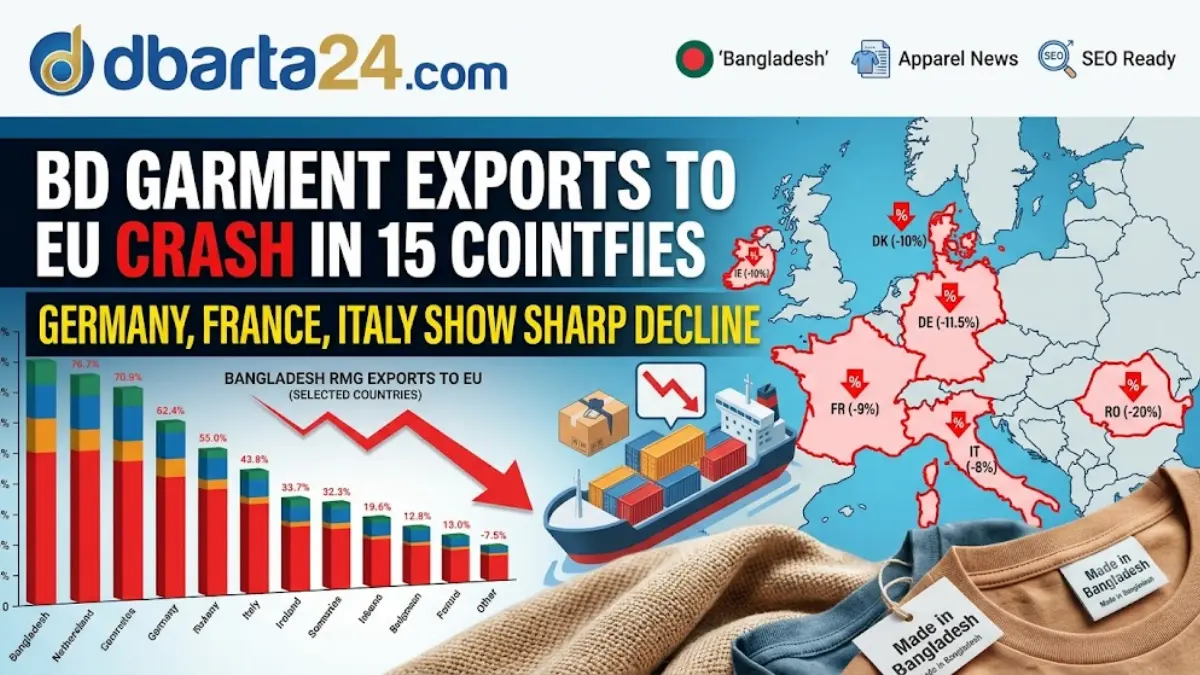
Germany, historically Bangladesh’s second-largest single-country market globally after the United States, recorded an 11.5% drop in apparel intake.
According to data compiled by the Export Promotion Bureau (EPB), BGMEA, and BKMEA, shipments to Germany plummeted to $4.38 billion from $4.95 billion in the previous fiscal year (2024-25).
The knitwear segment bore the brunt of this slowdown, dropping by nearly 13%, while woven garments fell by roughly 10%.
The story remains similarly bleak across other primary European hubs:
-
France: Exports fell by 9% to just under $1.97 billion (down from $2.16 billion).
-
Italy: The fourth-largest market saw an 8% dip, with earnings decreasing from $1.54 billion to $1.42 billion.
-
Denmark & Ireland: Both markets saw double-digit contractions of 10%.
-
Romania: Registered the steepest percentage crash, with shipments plummeting 20% to $180 million.
Other nations marking negative growth include Belgium, the Czech Republic, Portugal, Slovakia, Greece, Croatia, Finland, Luxembourg, and Malta.
Concurrently, the EU’s share in Bangladesh’s total RMG export portfolio slipped below the psychological fifty-percent threshold, dropping to 49.25% from 50.10% the previous year.
Total apparel exports to the bloc settled at $19.06 billion, indicating an overall 3.31% year-on-year decline.
Domestic Hurdles and Global Pressures
Industry leaders attribute this contraction to a mix of domestic operational inefficiencies and shifting geopolitical dynamics.
The knitwear sector, which relies heavily on localized supply chains, was hit hardest due to its high domestic value addition.
Fazlee Shamim Ehsan, Executive President of the Bangladesh Knitwear Manufacturers and Exporters Association (BKMEA), explained the structural vulnerability:
“Local value addition in knitwear is much higher than in woven garments—averaging around 90%. Because the local production process is deeper, any domestic crisis hits the knitwear sector first. Whether it is the gas and electricity crisis, high bank loan interest rates, or labor unrest, the blow lands hardest on knit apparel.”
He further noted that global trade shifts have forced fierce competitors like China and India to pivot aggressively toward Europe to dodge tariffs elsewhere.
“Additional tariffs imposed by US President Donald Trump restricted global export avenues. To bypass these US tariffs, competitor nations like China and India intensified their focus on the EU market. This influx has directly squeezed Bangladesh’s market share. Compounding this, our domestic energy shortages, inflated utility tariffs, and rising labor wages have significantly driven up production costs, eroding Bangladesh’s competitive edge,” Ehsan added.
Pockets of Resiliency
Despite the widespread slowdown, Spain offered a notable silver lining. As Bangladesh’s second-largest market within the EU, Spain registered a healthy 6% growth, with export values rising to $3.60 billion up from $3.40 billion.
Minor gains were also recorded in the Netherlands, Sweden, Slovenia, Poland, Lithuania, Latvia, Hungary, Cyprus, and Bulgaria.
The Path Forward
The contraction in 15 vital European economies serves as a stark wake-up call for Bangladesh’s primary export sector.
Industry insiders believe that unless immediate policy interventions are staged to stabilize the domestic energy supply, curb surging overhead costs, and resolve financing frictions, Bangladesh risks ceding more ground to regional competitors in the highly competitive Western markets.