


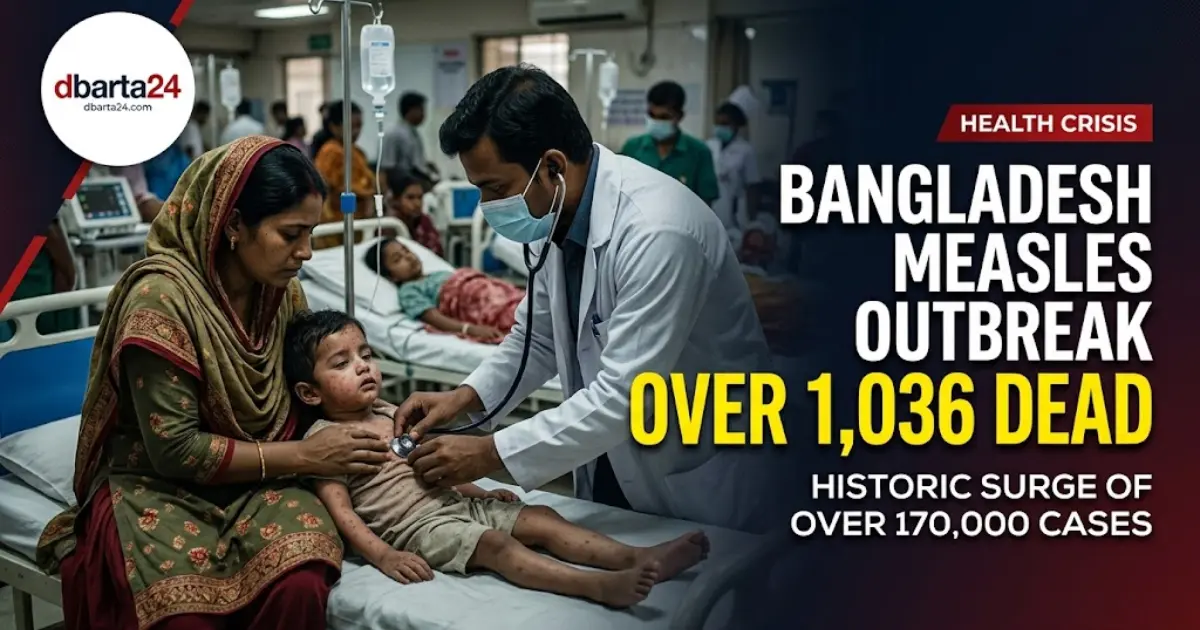
Dbarta24 Report — Bangladesh is grappling with the worst measles crisis in its history, with the total number of fatalities reaching 1,036 following six additional deaths reported in the last 24 hours.
Data released today by the Directorate General of Health Services (DGHS) highlights an alarming surge in infections that has severely disrupted national public health targets.
According to the official DGHS report covering the 24-hour period ending at 8:00 AM Tuesday, all six recent fatalities were caused by measles-like symptoms. Out of these, four deaths occurred in the Dhaka Division, while one death each was recorded in the Sylhet and Chattogram Divisions.
Since the outbreak began escalating on March 15, the country has recorded 100 confirmed measles deaths alongside 936 deaths linked to measles symptoms.
Health experts note that during major outbreaks, all deaths displaying classical symptoms are clinically treated as measles fatalities. Children remain the most vulnerable demographic, though age-specific breakdowns are currently unavailable in official tracking reports.
The disease trajectory continues to show high transmission rates nationwide:
-
24-Hour Suspected Cases: 1,239 new patients exhibiting symptoms
-
Total Suspected Cases (Since March 15): 173,959
-
24-Hour Confirmed Cases: 77 new laboratory-confirmed cases
-
Total Confirmed Cases (Since March 15): 20,201
-
Hospital Admissions: 153,279 total hospitalized patients, with 147,386 successfully discharged
This current epidemic marks a devastating setback for Bangladesh’s immunisation targets. Over the past eight years, annual measles cases rarely exceeded 400 nationwide, with zero recorded fatalities.
The country had set a target to eliminate measles by 2025 and was on track to receive official measles eradication certification in 2026.
Public health experts attribute the sudden resurgence to severe gaps in routine childhood vaccination programs during the 2025 interim administration. Despite initial signs of transmission early this year, response measures were delayed.
Although a mass vaccination drive was conducted between April and May, experts estimate that nearly 4 million children missed their doses, leaving significant immunity gaps that allowed the virus to spread rapidly.