


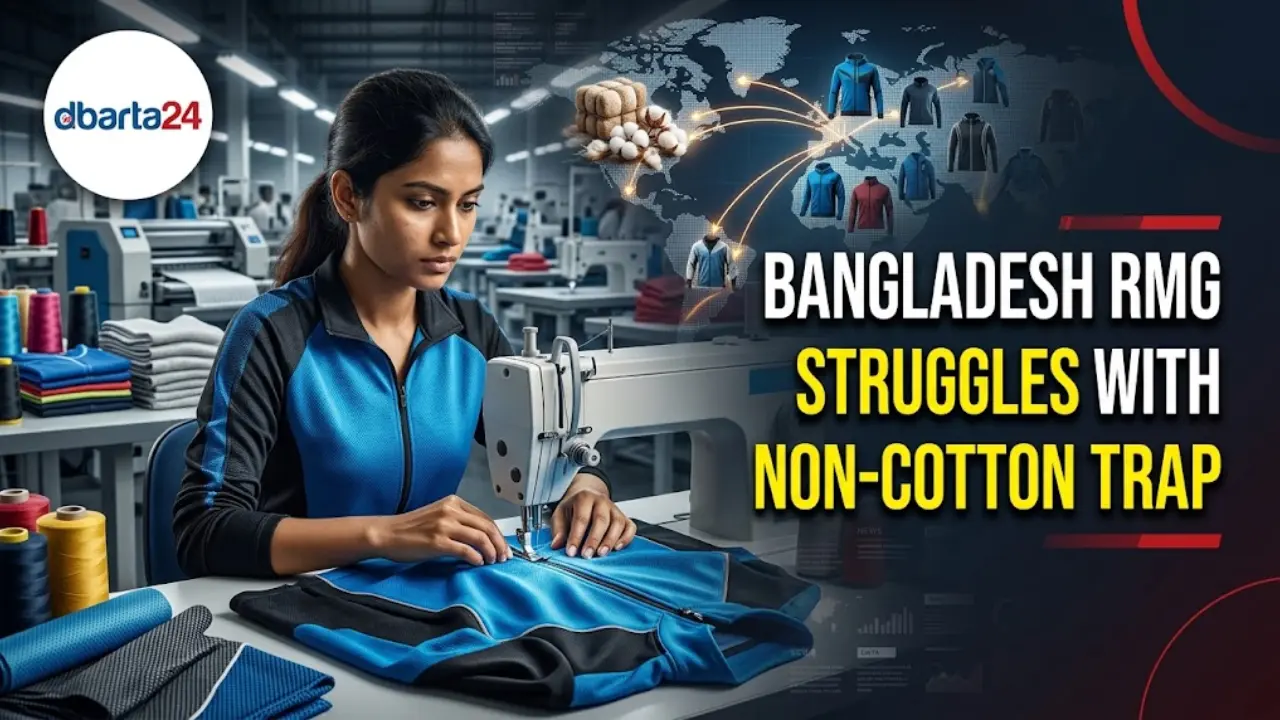
Khairul Alam; Dbarta24 – The global apparel market is undergoing a structural transformation, rapidly shifting away from traditional cotton-based garments toward synthetic and man-made fiber (MMF) clothing.
Driven by rising international demand for activewear, sportswear, technical textiles, outerwear, and high-value functional apparel, non-cotton products now dominate world trade.
However, Bangladesh—the world’s second-largest garment exporter—is failing to keep pace, leaving its export basket overwhelmingly reliant on cotton.
According to an analysis by Bangladesh Apparel Voice (BAV) based on data from the Export Promotion Bureau (EPB) and the International Trade Centre (ITC), the gap between Bangladesh and global market trends has widened over the past five years (2021–2025).
Global vs. Bangladesh Apparel Export Composition (2021 vs. 2025)
┌────────────────────────────────────────────────────────────────────────┐
│ Global Apparel Market (2025)                                           │
│ [ Non-Cotton: 58.4% ] [ Cotton: 41.6% ]                                │
├────────────────────────────────────────────────────────────────────────┤
│ Bangladesh Apparel Exports (2025)                                      │
│ [ Cotton: 72.7% ] [ Non-Cotton: 27.3% ]                                │
└────────────────────────────────────────────────────────────────────────┘
The Widening Market Gap
While the rest of the world accelerates toward non-cotton apparel, Bangladesh’s export portfolio remains virtually unchanged:
-
Global Trends: Between 2021 and 2025, the share of cotton garments in global apparel exports fell from 44.9% to 41.6%. Conversely, the share of non-cotton garments grew from 55.1% to 58.4%.
-
Bangladesh’s Stagnation: In 2021, cotton-based garments accounted for 73.2% of Bangladesh’s apparel exports, while non-cotton stood at 26.8%. By 2025, cotton still held 72.7%, while non-cotton merely reached 27.3%—a fractional increase of just 0.5 percentage points in five years.
-
Expanding Disparity: In 2021, the gap between global non-cotton market share and Bangladesh’s share was 28.3 percentage points. By 2025, that gap expanded to 31.1 percentage points, underscoring that Bangladesh is losing ground relative to global shifts.
Between 2021 and 2025, Bangladesh’s non-cotton share hit a low of 25.6% in 2023 before making a minor recovery to 27.3% in 2025, failing to break past the 28% mark throughout the entire five-year period.
Competitors Stepping Ahead
Competing Asian garment-exporting nations have adapted far more aggressively to global demand patterns. Synthetic and blended fiber garments account for nearly 49% of total apparel exports from both China and Vietnam.
Meanwhile, regional peers like Cambodia and Indonesia have raised their non-cotton export shares into the mid-40% range.
While Bangladesh possesses massive production capacity, competitive labor costs, and decades of manufacturing experience, its growth in high-value non-cotton items remains constrained by supply chain gaps in raw synthetic materials, specialized machinery, technical expertise, and processing infrastructure.
“Bangladesh’s apparel sector still stands largely on cotton-based products, whereas global market demand is changing rapidly. Many high-value new products rely on synthetic and specialized fibers outside of cotton. Competing on low prices alone may work today, but surviving in tomorrow’s market requires building advanced manufacturing capabilities and product diversity.”— Mohiuddin Rubel, Founder and CEO of Bangladesh Apparel VoiceStrategic Opportunities for Growth
Transitioning toward synthetic and functional garments offers Bangladesh significant opportunity for higher value addition.
Non-cotton apparel—including waterproof outerwear, activewear, thermal protective clothing, and specialized workwear—commands higher profit margins than basic cotton t-shirts and trousers.
To capture future market share, industry stakeholders stress the need for targeted investments in local synthetic raw material production, specialized yarn spinning, advanced dyeing and finishing units, testing laboratories, and workforce upskilling.
Furthermore, establishing a foothold in recycled and sustainable synthetic fibers will be critical as global fashion brands increasingly enforce environmental compliance standards.
Low-cost labor has historically driven Bangladesh’s apparel success, but future market leadership will depend on technological adaptation, raw material diversification, and higher-value production capabilities