


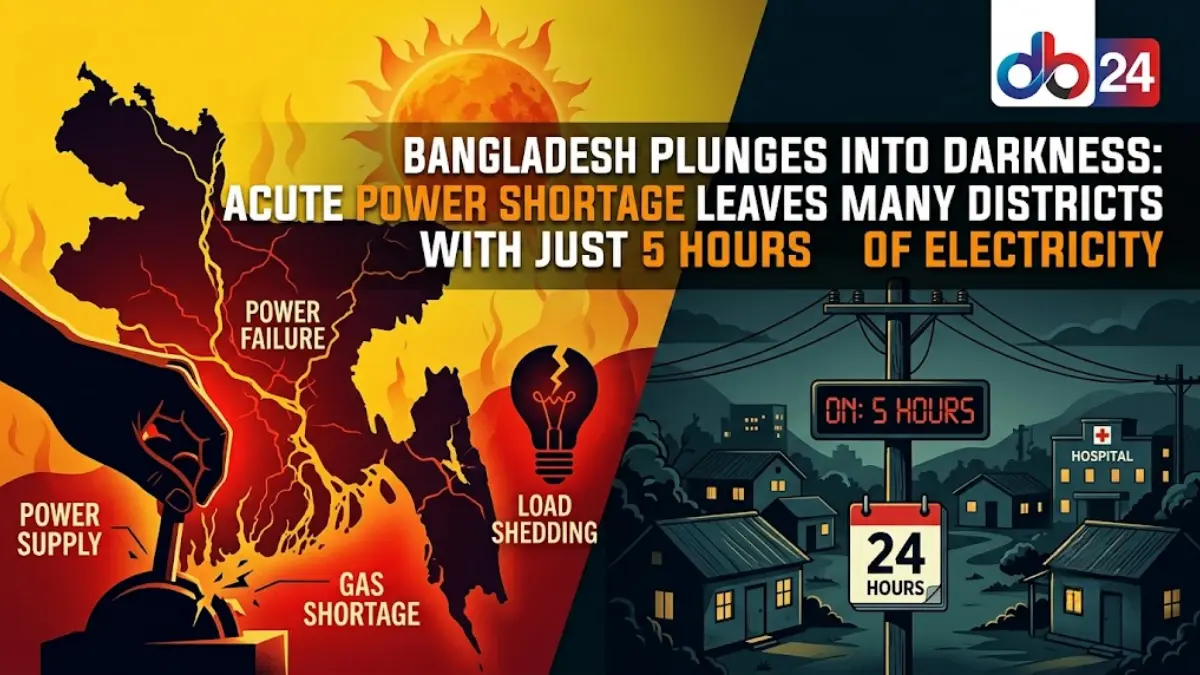
Md. Islam Uddin; Dbarta24 — A severe power crisis coupled with intense heatwave conditions has thrown life across Bangladesh into extreme disarray.
Massive electricity deficits have forced distribution companies to enforce relentless load shedding, leaving vast swathes of the country without power for 10 to 12 hours a day—and in the worst-hit regions, residents receive barely five hours of electricity in a 24-hour cycle.
Reports gathered from at least eight districts and 15 upazilas paint a grim picture of a national grid struggling to cope with skyrocketing demand amid a critical shortage of fuel supplies.
Severe Gas Shortage Triggers Production Collapse
At the heart of the ongoing crisis lies a drastic reduction in natural gas supply to power plants across the country. According to a senior official from the Bangladesh Power Development Board (BPDB), gas allocations for electricity generation have plummeted from 1 billion cubic feet (bcf) to roughly 700 million cubic feet (mmcf).
“Before the recent severe gas crisis, up to 100 million cubic feet of gas was supplied for power generation. Now it has dropped to 70 million. Petrobangla supplied 68 million cubic feet of gas to the power sector recently, making it impossible to produce electricity according to demand,” a BPDB Chief Engineer confirmed.
Data from the Power Grid Company of Bangladesh (PGCB) underscores the deficit. On Sunday evening, peak demand hovered at 16,573 MW against a load shedding margin of 1,821 MW.
Earlier that afternoon, grid deficit reached 2,634 MW against a total demand of 16,084 MW. During late-night hours, deficits exceeded 3,000 MW, forcing widespread blackouts when residents needed cooling the most.
Rural Regions Hit Hardest: Protests Erupt
The crisis has severely disproportionately affected rural and sub-urban areas:
-
Tahirpur, Sunamganj: Positioned at the epicenter of the shortfall, Tahirpur receives a mere 3 MW against a total requirement of 9 MW. Residents endure alternate hourly blackouts during the day and extended cuts at night, averaging just five hours of grid supply daily.
-
Saturia, Manikganj: Receiving only 4 MW against a 14 MW demand, the area endures 20 to 25 disruptions daily. Outraged local residents staged protests outside the local Rural Electrification Board (REB) substation to express their frustration.
-
Kuakata & Abhaynagar: Popular tourist destination Kuakata reported up to 16 blackouts a day, while Abhaynagar in Jashore faced up to 15 outages in a single 24-hour window.
Economy, Healthcare, and Education Reeling
The recurring disruptions are inflicting severe damage across vital economic and public sectors:
-
Industrial Strain: In industrial hubs like Araihazar in Narayanganj, factories operate at a fraction of their capacity. “Power supply is absent nearly half the day. Frequent trips force machinery to restart continuously, multiplying production costs,” local factory owners noted.
-
Small Businesses & Transport: Battery-powered auto-rickshaw drivers report an inability to charge their vehicles, slashing daily earnings in half. Local sawmills, rice mills, and digital service centers face prolonged operational halts.
-
Healthcare Vulnerabilities: Hospitals and sub-district health complexes are facing severe operational bottlenecks. Facilities in Tahirpur and Nalchhiti report broken or non-existent generators, leaving patients—particularly elderly individuals and infants—suffering in unyielding heat.
-
Students Under Stress: Candidates preparing for crucial examinations are forced to study under candlelight or portable solar lamps amid frequent evening blackouts.
Grid Officials Foresee Continued Shortfalls
Distribution agencies maintain that their hands are tied due to severe shortfalls from the national grid transmission system.
“We are receiving nearly 60 MW less power from the national grid compared to our local demand. Under these circumstances, implementing load shedding is our only operational resort,” stated Muhammad Sohrab Ali, Assistant General Manager at the Munshiganj Palli Bidyut Samiti.
With power distributors receiving less than half of their allocated quota in regions such as Nalchhiti, Harinakundu, and Lalpur, normal grid operations are unlikely to resume until gas allocations to key thermal power facilities stabilize.