


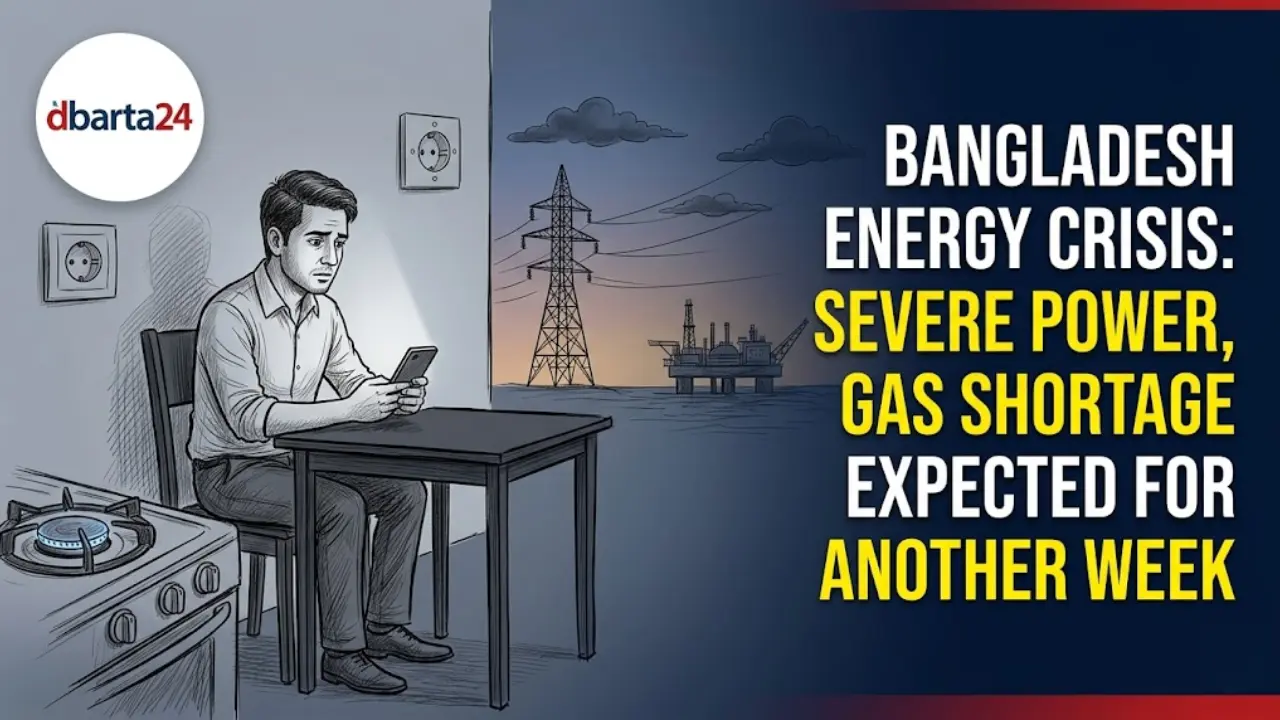
Md. Tareq; Dbarta24 — A severe power and natural gas supply disruption continues to cripple daily life, industrial output, and commercial activities across Bangladesh.
Energy sector officials estimate that the current crisis—driven by bad weather, technical glitches at offshore Liquefied Natural Gas (LNG) terminals, and fuel supply constraints—will persist for at least another week.
National grid data reveals a mounting deficit exceeding 3,000 megawatts (MW) during peak hours. Rural regions bear the heaviest burden, with many districts receiving only 5 to 7 hours of electricity a day. The growing strain has forced rolling blackouts into major urban centers, including the capital city, Dhaka.
Supply Chains Severed by Bad Weather and Glitches
The root of the current disruption lies in a dramatic drop in gas production. Adverse weather conditions off the coast of Maheshkhali have prevented incoming LNG tankers from offloading cargo.
-
Summit LNG Terminal: Daily output dropped to approximately 200 million cubic feet (mmcfd) due to cargo offloading delays.
-
Excelerate Energy Terminal: Operational capacity fell to 200–220 mmcfd—down from its standard 550–600 mmcfd output—following a boiler system failure.
Combined LNG supply to the national grid has plummeted to roughly 410 mmcfd. Petrobangla reported that total gas allocated to power generation sank below 700 mmcfd before hovering around 750–800 mmcfd, well short of the 2,200 mmcfd required for full capacity.
Consequently, gas-based power generation nationwide has dropped to 3,000–4,000 MW against an installed capacity of 12,472 MW.
Coal-fired plants face similar supply constraints due to offloading delays. Output at the Norinco plant dropped by 300 MW, while the Payra plant reported a reduction of 500–600 MW.
Cross-border power imports from India’s Adani Power facility also declined by 400–500 MW due to grid constraints and coal availability issues.
Domino Effect on Homes, Industry, and Transport
The gas deficit has triggered a chain reaction throughout the economy:
-
Domestic Pressure: Residential piped gas shortages have led to a surge in electric stove usage, placing additional demand on an already overstretched power grid.
-
Industrial Impact: Industrial units, unable to generate captive power via gas, have shifted their energy reliance back to the national grid.
-
Transport Disruptions: Low pipeline pressure has forced dozens of Compressed Natural Gas (CNG) stations to shut down or operate under restricted hours, creating long queues in Dhaka and surrounding districts.
Rural Outages Drive Public Unrest
Rural electricity distributors (Pallibidyut Samitis) serve nearly 80% of the nation’s 52 million consumers. These rural associations are receiving allocations 40% to 45% below their average demand of 8,000 to 9,000 MW.
Extended blackouts lasting up to 20 hours in parts of Rangpur, Gopalganj, Tangail, and Netrokona have sparked public outrage. Vandalism, office sieges, and physical assaults on utility staff have been reported in several districts.
In response, the Bangladesh Palli Bidyut Association sent an urgent letter to the Inspector General of Police (IGP) requesting law enforcement security for 80 rural utility offices, substations, and key installations.
Government Imposes Conservation Measures
To curb peak-hour consumption, the Power Division issued new operational guidelines. Effective August 12, all shopping malls, markets, and retail shops must close by 8:00 PM—one hour earlier than previous regulations.
Illuminated commercial billboards must be turned off by 7:00 PM, and decorative lighting remains strictly prohibited.
Addressing reporters at the Secretariat, State Minister for Power, Energy, and Mineral Resources Anindy Islam Amit emphasized that the government is exploring short-term imports to bridge the gap.
“We are working on all possible alternatives to increase gas and LNG supply, including attempts to procure at least one spot cargo from Malaysia,” said State Minister Anindy Islam Amit. “Previous administrations relied on temporary fixes rather than long-term policy solutions, leaving us vulnerable to the crisis we face today. However, we are taking strategic steps to bring relief as quickly as possible.”The Road Ahead
Energy policy experts caution that short-term measures will not prevent future shortfalls.
Professor M. Tamim, a prominent energy consultant, noted that resolving the country’s energy vulnerability requires balancing local gas exploration, maximizing the efficiency of coal-fired units, rapidly scaling up solar infrastructure, and securing long-term supply contracts with international partners.
For now, residents and business operators across the country must prepare for at least seven more days of restricted power and gas supply while technical repairs and fuel offloading operations continue.