


Md. Tareq; Dbarta24 – A severe power crisis has gripped Bangladesh as electricity shortages reached an all-time high, triggering widespread disruptions to daily life, agriculture, healthcare, and industrial output across the nation.
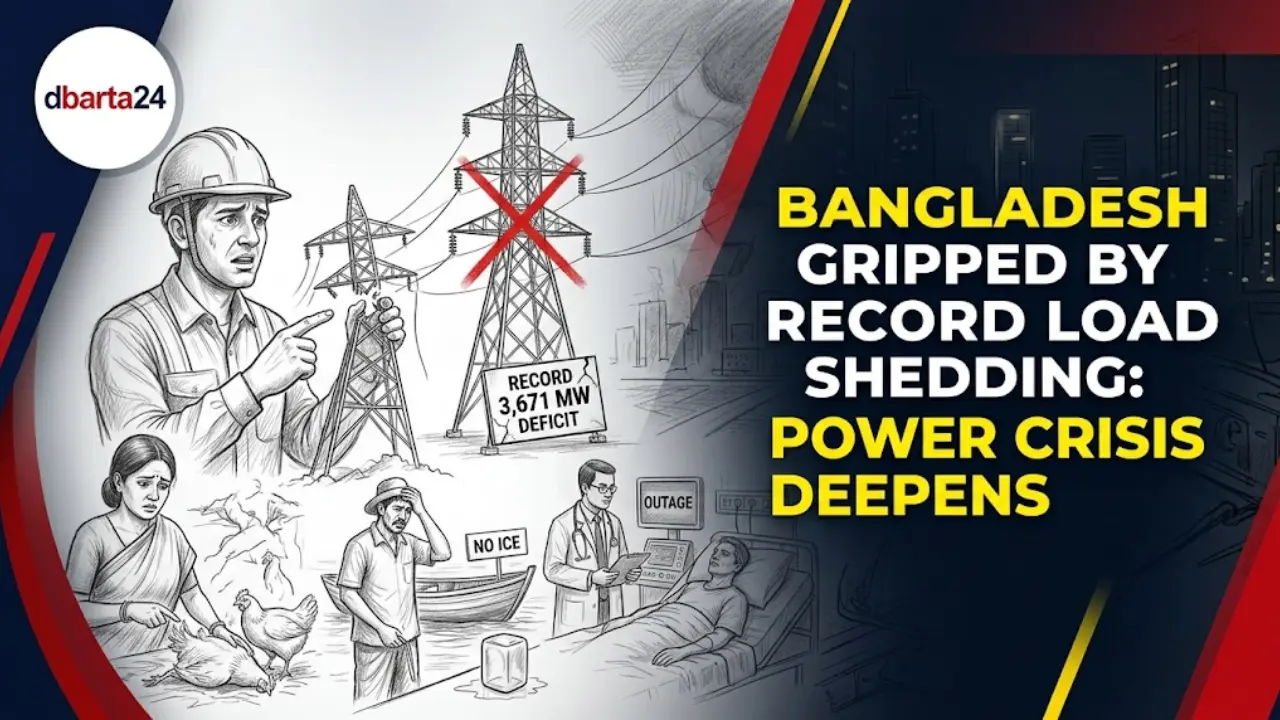
Official data from state-run power companies revealed that national load shedding spiked to a historic peak of 3,671 megawatts (MW) on Sunday afternoon against a total demand of 16,051 MW.
Internal sources within distribution companies suggest the actual deficit surpassed 4,000 MW at its worst points, far exceeding previous historic highs recorded in recent years.
Unscheduled Outages Paralyze Daily Life
Residents across urban and rural zones report enduring unscheduled power cuts ranging between 12 and 16 hours daily. Regions including Rangpur, Sylhet, Rajshahi, Mymensingh, and Barishal remain among the hardest hit.
The relentless blackouts are causing severe ripple effects across key economic sectors:
-
Poultry Industry: In Abhaynagar, Jessore, an eight-hour power outage caused over 400 chickens to suffocate and die due to extreme heat, leaving smallholders facing devastating financial losses.
-
Fisheries & Maritime Operations: At the Alipur-Mahipur fishing harbor in Patuakhali, severe power cuts disrupted ice production during the peak Hilsa season. With ice prices doubling from BDT 150 to BDT 300 per block, hundreds of fishing trawlers remain grounded at dockyards.
-
Agriculture & Irrigation: Rural farming communities in Rajshahi and Kurigram report disrupted irrigation schedules, raising concerns over crop yields.
-
Healthcare & Commerce: Hospitals, clinics, and small-scale industrial units in Rangpur and Sunamganj face continuous operational delays as fuel costs for generators surge.
Trilemma of Supply Disruptions: Gas, Technical Faults, and Imports
Industry insiders attribute the unprecedented deficit to three primary compounding factors: a primary fuel crunch, mechanical failures, and decreased cross-border imports.
-
Gas Supply Deficit: Gas-based power plants, which typically generate between 5,000 and 6,000 MW daily, are currently delivering roughly 3,500 MW due to reduced feedstock. Gas allocation to power generation dropped from 1,000 million cubic feet per day (mmcfd) to approximately 680 mmcfd.
-
Plant Shutdowns: A technical breakdown forced the temporary shutdown of one unit at the Payra Thermal Power Plant, capping its output to just 500–550 MW.
-
Cross-Border Supply Reductions: Electricity imports from Adani Power’s Jharkhand facility in India have also seen significant reductions, compounding the national grid’s vulnerability.
Fuel Infrastructure Under Strain
The underlying gas crisis stems largely from sustained technical bottlenecks at the Maheshkhali Liquefied Natural Gas (LNG) terminal following a fire incident on July 21.
Prior to the incident, daily supply to the national grid averaged 2,650 mmcfd. While current supply has partially recovered to around 2,350 mmcfd, it still falls drastically short of the national requirement of 3,800 mmcfd.
Officials anticipate that bringing the secondary boiler back online at the LNG facility will inject an additional 300 mmcfd into the grid, though a complete resolution to the power deficit remains dependent on broader fuel availability and infrastructure recovery.
Addressing the severe disruption in Narayanganj’s Bandar area, local parliamentarian Advocate Abul Kalam highlighted that residents face power cuts three to four times per hour.
He urged authority officials to implement a predictable, scheduled rationing plan if load shedding remains unavoidable during the ongoing fuel shortage.
With summer temperatures remaining high, energy authorities face mounting pressure to stabilize fuel imports and restore damaged generation infrastructure.
Until gas supplies fully recover and key facilities return to capacity, consumers and business sectors across Bangladesh will likely face continued power rationing.