


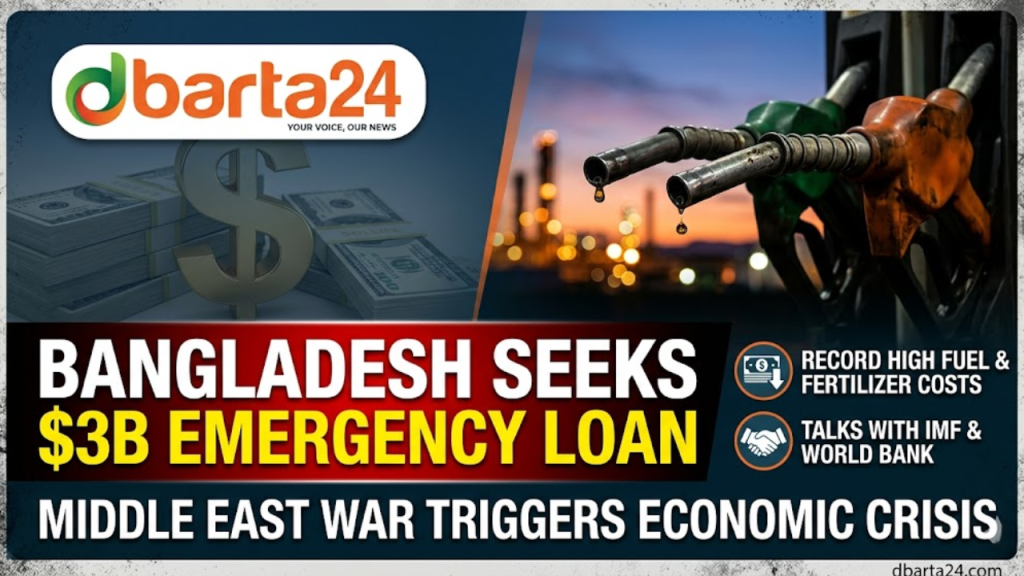
Khairul Alam; Dhaka: The current economic trajectory of Bangladesh has reached a state of fiscal precariousness, driven primarily by external geopolitical volatility that has disrupted global energy and agricultural supply chains.
As the nation navigates the fallout of Middle East regional instability, the government has identified a $3 billion emergency loan as a non-negotiable strategic necessity.
THE $3 BILLION EMERGENCY LOAN: A STRATEGIC COUNTER-CYCLICAL INTERVENTION
This capital infusion is required to maintain macroeconomic stability and ensure the continued procurement of essential commodities amidst unprecedented price surges in global markets.
The Current Crisis
The fundamental driver for this $3 billion budget support request is the sharp escalation in the cost of fuel oil, liquefied natural gas (LNG), and fertilizer. These inflationary pressures, catalyzed by regional conflict, have exacerbated the balance of payments pressure, forcing the administration to seek immediate external aid to bridge the widening fiscal deficit.
Breakdown of Immediate Financial Pressures
- Import Cost Requirements: Approximately $3 billion is essential to sustain the import of energy and agricultural inputs over a concentrated four-month window.
- Subsidy Shortfall: The government faces a staggering 38,542 crore BDT deficit in the subsidy budget required to insulate domestic consumers.
- Operational Timeline: The credit facility is specifically targeted to cover the high-demand period from March to June.
The “So What?” Layer: Fiscal Impact Analysis
The exponential rise in global commodity prices—specifically diesel (+250%), LNG (+100%), and fertilizer (+50%)—has effectively neutralized previous budgetary assumptions. This “price squeeze” necessitates a counter-cyclical fiscal intervention; without these funds, the government would be forced to choose between a catastrophic depletion of foreign currency liquidity or the imposition of domestic price hikes that could trigger social instability. While these immediate costs are staggering, they are symptoms of a deeper geopolitical reconfiguration—specifically the strategic disruption surrounding the Hormuz Strait.
GEOPOLITICAL TRIGGERS AND DOMESTIC IMPACT
The vulnerability of the Bangladesh economy is inextricably linked to the maritime security of the Hormuz Strait. As a primary artery for global energy, its closure has catalyzed a systemic disruption of supply chains, undoing the tentative gains in reserve stabilization achieved in early 2024.
Chronology of Conflict and Governance
The timeline of the current crisis reflects a rapid transition from domestic political shifts to global economic shocks:
- August 5: Fall of the Awami League government.
- February 18: Formation of the current BNP-led government.
- February 28: Military escalations between the US/Israel and Iran led to the closure of the Hormuz Strait.
- April 8: A ceasefire was initiated; however, the Hormuz Strait remains closed, maintaining extreme volatility in energy pricing.
Economic Fallout Analysis: Comparative Crisis Metrics
The following table contrasts the structural impact of the 2022 Russia-Ukraine shock against the current Middle East crisis:
| Economic Indicator | 2022 Crisis (Russia-Ukraine) | Current Crisis (Middle East War) |
| Poverty Rate | 18.7% | Increased to approximately 28% |
| Currency Value | 86 BDT per USD | 120+ BDT per USD |
| Foreign Reserves | Dropped from 48B to <20B | Fluctuated from $35B (Feb) to $29B (March – BPM6) |
The “So What?” Layer: The Poverty-Subsidy Vicious Cycle
The correlation between global energy markets and domestic household security is direct and devastating. The 9% increase in the poverty rate creates a “vicious cycle”: rising fuel and fertilizer costs demand higher subsidies to prevent social unrest, yet these very subsidies balloon the budget deficit, further weakening the BDT and necessitating more external debt. This feedback loop threatens to erode the nation’s long-term credit rating unless structural equilibrium is restored. This fiscal burden is now the defining challenge for the current administration’s economic policy.
THE SUBSIDY BURDEN AND FISCAL STRAIN
Strategic government subsidies function as a vital macroeconomic buffer, designed to prevent the “abnormal” price shocks that would otherwise destabilize the domestic production of food and electricity. However, the current global price environment has pushed the national treasury toward a point of fiscal exhaustion.
The Subsidy Gap
The fiscal strain is quantified by a massive disparity in the current budget: the national allocation of 59,000 crore BDT for subsidies is eclipsed by an actual requirement of 97,542 crore BDT. This leaves a 38,542 crore BDT funding gap that the government must resolve to maintain domestic price ceilings.
Import Cost Projections: Comparative Analysis
The financial requirement for essential imports has shifted dramatically compared to historical benchmarks for the March–June window:
- Previous Year Actuals (Historical Window): $301 million.
- Current Year Projection (Current Window): $558 million.
The “So What?” Layer: Risks of Price Management
To mitigate immediate shocks, the government refrained from fuel price hikes through April. On April 9, the administration established the “Electricity Price Adjustment Committee,” led by the Finance Minister.
While intended to provide a mechanism for orderly adjustments, the strategic risk remains: if this committee fails to balance IMF demands for subsidy removal with the realities of domestic purchasing power, the resulting inflation could trigger a secondary wave of poverty.
This delicate balancing act now moves to the international stage as diplomatic efforts intensify.
GLOBAL DIPLOMACY AND FINANCIAL REFORMS
The World Bank and IMF Spring Meetings in Washington represent a critical juncture for the stabilization of Bangladesh’s foreign exchange market. These high-level negotiations will determine the terms of the budget support needed to manage the nation’s $113.51 billion total external debt.
Stakeholder Perspectives
- Finance Minister Amir Khosru Mahmud Chowdhury: Leading the delegation to advocate for emergency liquidity and highlight the external nature of the current shock.
- Governor Ahsan H. Mansur: Focuses on maintaining the stabilization of reserves, which utilized interest rate hikes to reach $35 billion in February before the current Middle East escalation.
- Economist Zahid Hussain: Notes that while budget support is a standard global response, development partners will demand transparency regarding why domestic prices haven’t been synchronized with international market rates.
The Reform Challenge
Multilateral partners (World Bank, IMF, ADB, AIIB) are likely to attach structural conditionalities to any new capital, including:
- Aggressive revenue mobilization and tax-to-GDP ratio improvements.
- The transition from universal subsidies to “targeted subsidies” specifically for the most vulnerable populations.
- Demonstrable progress on previously stalled structural reforms in the banking sector.
The “So What?” Layer: Negotiation of Fiscal Sovereignty
The primary tension exists between the IMF’s preference for total subsidy elimination and the government’s insistence on “short-term, targeted” interventions.
The outcome of these negotiations will dictate the country’s long-term fiscal health and its ability to absorb future shocks without defaulting on its massive external obligations.
As the government pursues this equilibrium, the continued closure of the Hormuz Strait remains the ultimate variable of uncertainty in the path toward economic recovery.