


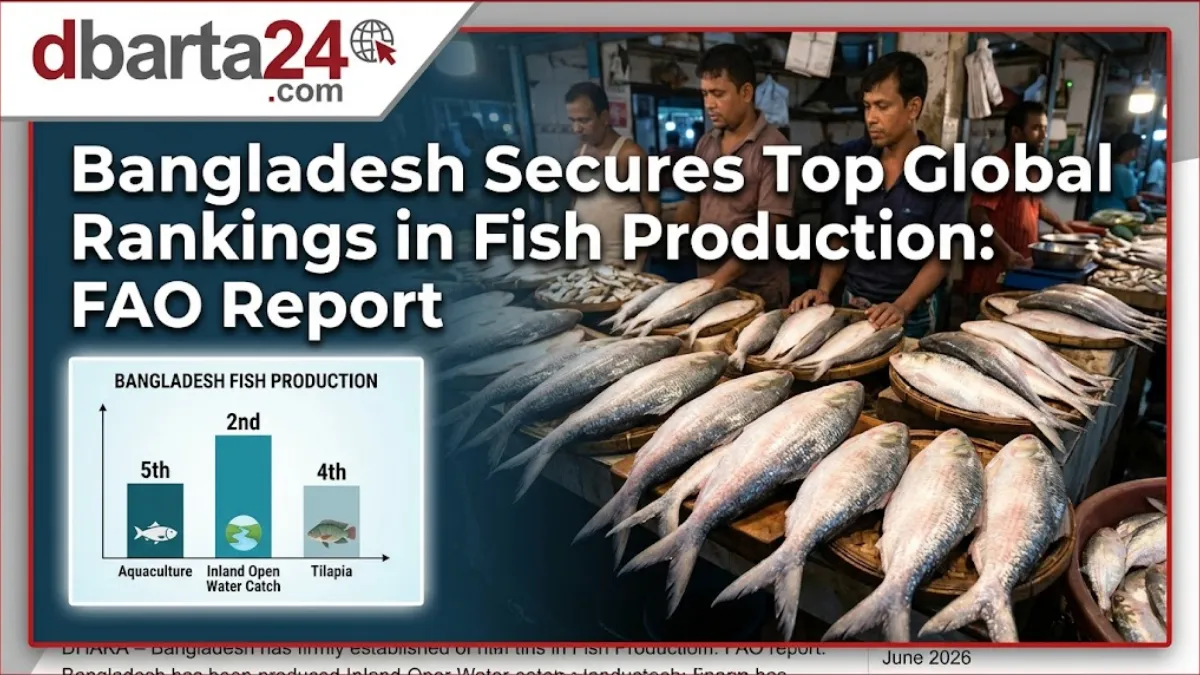
Khairul Alam , Dhaka – Bangladesh has firmly established itself as a global powerhouse in fish production, maintaining its position among the world’s top five aquaculture producers and ranking second only to India in fish harvesting from inland open waters, according to a landmark report by the Food and Agriculture Organization (FAO).
The FAO’s newly released “The State of World Fisheries and Aquaculture 2026” report, based on 2024 data, underscores Bangladesh’s critical and growing role in the global shift towards Asia for freshwater fish production.
Global Standing and Core Statistics
The report confirms that Bangladesh has held onto its vital fifth-place ranking globally for the production of aquatic animals through aquaculture (fish farming). Leading the charge are China, Indonesia, India, and Vietnam.
Furthermore, the nation ranks second globally in capturing aquatic animals from inland open waters (rivers and havels), a position where it is preceded only by neighboring India.
In 2024, Bangladesh produced a remarkable 2,978,000 tons of fish via aquaculture. In the realm of inland open water capture, Bangladesh harvested 1,412,000 tons, accounting for 11.5% of the total global catch.
Economic Ripple Effects
This robust growth in fisheries has become a cornerstone of the national economy. Data from the Department of Fisheries indicates that the fisheries sector contributes 2.53% to Bangladesh’s Gross Domestic Product (GDP).
Furthermore, the sector recorded a GDP growth rate of 2.81% in the 2023-24 fiscal year.
The report highlights a paradox in international trade. While Bangladesh is a net exporter of aquatic products in terms of monetary value, exporting goods worth 61,450 million BDT in the 2023-24 fiscal year, it remains a net importer when measured by essential nutritional components, specifically protein and fat.
This signifies that while high-value aquatic exports boost foreign exchange, the country must rely on imports to fill certain nutritional gaps for its population.
Sector Strengths and Strategic Progress
The progress in aquaculture stems from substantial investment—from the government, private sector, individual entrepreneurs, and international research organizations—and an organized structure of the Department of Fisheries at the upazila and district levels, a model that is unparalleled in many countries.
Notably, the report recognized one specific leap: in shrimp production, Bangladesh moved up one spot from fourteenth to thirteenth place.
In terms of species-specific leadership, Bangladesh holds the world’s top rank for Hilsha harvesting and ranks fourth globally (and third in Asia) for Tilapia production.
“A ‘revolution’ has occurred in aquaculture in Bangladesh. However, there are significant hurdles such as the lack of insurance facilities for farmers, the quality and supply of improved fry (fish fingerlings), the availability of good quality fish feed at affordable prices, and the need for better market management structures.”
— Molla Shamsur Rahman Shahin, President, Fish Farm Owners Association of Bangladesh (FOAB)
Looking to the Future: The Growth Mantra
The FAO projects that aquatic food demand will rise alongside the growing global population, making aquaculture the primary driver for meeting this demand.
Total global production of aquatic animals hit a record 235 million tons in 2024, and aquaculture’s contribution has surpassed capture fisheries since 2021. This growth is projected to continue, with global production expected to reach 214 million tons by 2034.
However, the path forward requires addressing challenges. While acknowledging the clear revolution in aquaculture, industry leaders emphasize the critical lack of policy support in key areas.
“There are significant hurdles such as the lack of insurance facilities for farmers, the quality and supply of improved fry (fish fingerlings), the availability of good quality fish feed at affordable prices, and the need for better market management structures,” said Molla Shamsur Rahman Shahin, President of FOAB.
Scientific Scrutiny and Future Prospects
While acknowledging the clear revolution in aquaculture, some researchers and academics express skepticism regarding the methodology and reliability of the data for inland open water capture, arguing that while Hilsha catch data is solid, the capture data for other species might be open to question.
“Any matter can be doubted, there is a scope for that,” responded Md. Khaled Kanak, Director General of the Department of Fisheries. He emphasized that the introduction of new technologies, the continuous supply of fingerlings from 126 government centers, and the strategic actions taken by upazila-level fisheries offices are responsible for the accelerated production.
As Bangladesh sails toward becoming a leading blue economy, the success of its fisheries sector—supporting the direct and indirect livelihoods of over 20 million people, or 12% of the population—remains pivotal.
The future rests on navigating the delicate balance between increasing production, ensuring environmental sustainability, and optimizing resource management to secure national food and nutrition security.