


Khairul Alam; Dbarta24 — The Bay of Bengal stands as one of the primary pillars of Bangladesh’s national economy, food security, and emerging Blue Economy. Spanning approximately 118,813 square kilometers of maritime territory and an Exclusive Economic Zone (EEZ) extending 200 nautical miles, these waters represent far more than a simple fish reservoir.
They constitute a vital sanctuary of biodiversity, the chief livelihood source for coastal communities, and a significant driver of foreign exchange earnings.
However, maritime experts and policy observers warn that without scientifically grounded management, structured planning, and rigorous conservation, this immensely promising marine resource could drift toward a severe crisis.
Ecological Zoning and Marine Zonation
The marine waters of the Bay of Bengal are categorized into four distinct zones based on riverine siltation, salinity levels, currents, depth, and seabed characteristics:
-
Estuarine zones
-
Clear coastal waters
-
Coral and rocky areas
-
Open deep-sea waters
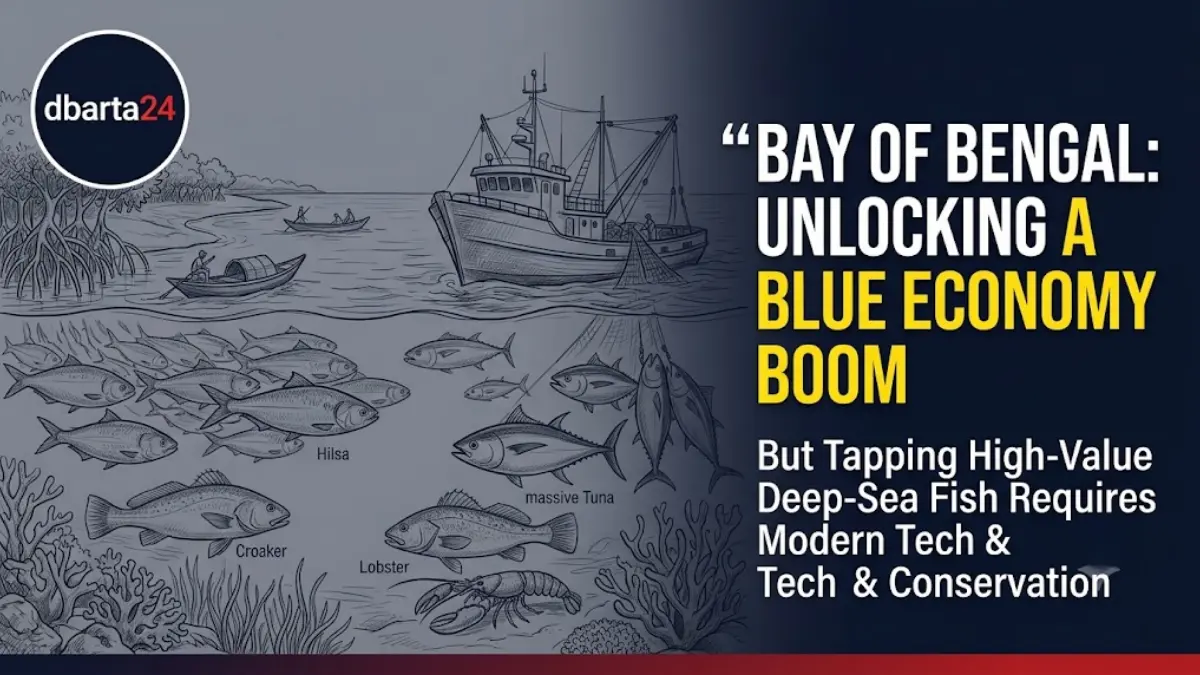
Each zone exhibits unique environmental characteristics, supporting varied species distributions and productivity levels. Structurally, marine fisheries are divided into three depth-based categories: Pelagic species (such as Tuna, Mackerel, Sardines, and Hilsa) that inhabit open waters; Mesopelagic/Mid-water species (including lanternfish and mid-water shrimp); and Demersal species (such as Croaker, Grouper, Snapper, Ribbonfish, Lobster, and Crab) dwelling near the ocean floor. From a commercial standpoint, pelagic and demersal resources carry the highest economic value.
Bangladesh’s primary marine harvesting grounds include Swatch of No Ground, Middle Ground, South Patches, and South of South Patches.
Operational regulations designate coastal waters up to a depth of 40 meters for traditional non-mechanized and small motorized boats, depths between 40 and 200 meters for commercial trawlers, and waters beyond 200 meters for deep-sea long-liner trawlers.
According to data for the 2024–2025 fiscal year, approximately 25,718 mechanized and non-mechanized boats alongside 232 licensed industrial trawlers operated in coastal and deep-sea zones.
However, the heavy reliance on destructive gear—particularly gillnets and set bag nets—continues to pose significant threats to marine fauna.
Shift in Marine Contribution and Growth Deceleration
Over the past decade and a half, Bangladesh achieved significant growth in total fish production, rising from nearly 2.9 million tonnes in FY 2008–09 to 5.11 million tonnes in FY 2024–25. Despite this overall expansion, the relative contribution of marine fisheries has steadily declined.
In FY 2008–09, marine harvests yielded approximately 0.52 million tonnes, accounting for 17.84 percent of total national output. By FY 2024–25, marine catch increased marginally to 0.57 million tonnes, but its share plummeted to just 11.12 percent of total production.
Concurrently, the overall annual growth rate of national fish production slowed markedly—dropping from an average of 5.6 percent in the post-2009 period to just 1.9 percent in FY 2024–25.
Multidimensional Challenges: Overfishing, Climate, and Data Gaps
The marine fisheries sector faces a array of structural and environmental pressures:
-
Overexploitation & Illegal Fishing: Overfishing in shallow coastal zones, catching juvenile and egg-bearing fish, illegal, unreported, and unregulated (IUU) fishing, and the deployment of destructive nets exert heavy strain on stocks.
-
Climate Change Impacts: Rising sea surface temperatures, frequent cyclones, storm surges, and coastal habitat degradation alter fish spawning grounds and migration routes.
-
Marine Pollution: Plastic waste, industrial effluents, oil spills, and river-borne contaminants harm critical coral, seagrass, and mangrove ecosystems.
-
Data Deficits: Lack of reliable scientific data regarding stock assessments, reproductive capacities, and Maximum Sustainable Yield (MSY) limits complicates evidence-based management.
-
Deep-Sea Capacity Deficits: High-value pelagic resources like Tuna, Skipjack, and Billfish in international deep waters remain largely underutilized due to a shortage of modern vessel fleets, skilled manpower, cold-chain infrastructure, and deep-sea port facilities.
Pathways to Sustainable Management
Realizing the untapped opportunities of the Blue Economy—including seaweed cultivation, marine aquaculture, marine biotechnology, and value-added processing—requires immediate policy alignment. Key recommendations for long-term sustainability include:
-
Establishing regular scientific stock assessments to formulate data-driven catch policies.
-
Strengthening modern maritime surveillance and enforcing strict anti-IUU fishing laws.
-
Expanding and actively managing Marine Protected Areas (MPAs) to safeguard spawning habitats.
-
Modernizing deep-sea fishing fleets and technical infrastructure.
-
Advancing climate-adaptive research and strengthening the resilience of coastal fishing communities.
Balancing marine resource exploitation with rigorous ecological conservation remains essential for ensuring that the Bay of Bengal continues to power Bangladesh’s long-term economic development and food security.