


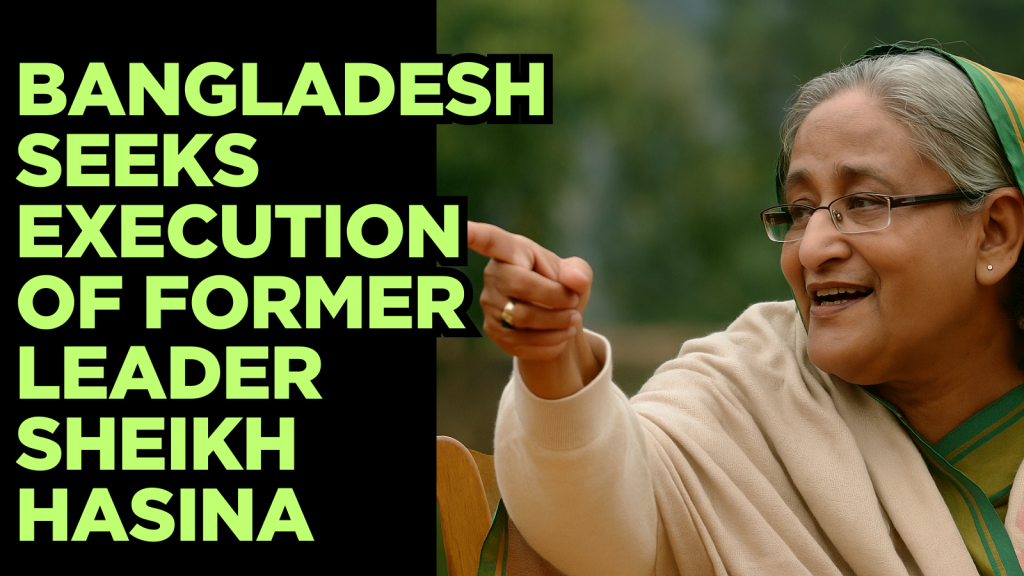
News Explainer , Bangladesh Politics : Once known as a secular leader and daughter of a revolutionary, Sheikh Hasina’s political journey saw her rise to the top of Bangladesh’s politics, only to suffer an extraordinary fall from power and be forced into voluntary exile in India.
She has been sentenced to death in absentia in Bangladesh. Her execution could proceed if New Delhi decides to extradite her.
The former leader, who was ousted following a violent crackdown on student protests in 2024, has been convicted of crimes against humanity for her role in the crackdown that led to her government’s downfall. After 15 years of increasingly authoritarian rule, she fled to India in August last year, taking refuge in the capital of one of her closest allies.
She is now at the center of a tense standoff between the two nations. Dhaka is demanding her extradition to face justice for her crimes, which she vehemently denies committing.
“She had to flee the country to escape the public rage,” says Bangladeshi political scientist Mobashar Hasan. “She is hiding in India, and the death sentence has been issued against her. This is truly an exceptional story.”
A Violent Past
Sheikh Hasina’s path in politics is a Shakespearean tale of tragedy, exile, and power, deeply intertwined with her nation’s history. The eldest daughter of Bangladesh’s charismatic ‘Father of the Nation,’ Sheikh Mujibur Rahman, she entered politics early. But a bloody night in August 1975 truly defined her.
In a brutal military coup, army officers assassinated her father, mother, and three brothers at their Dhaka residence. Sheikh Hasina and her sister survived because they were visiting West Germany.
The chaos led to the rise of General Ziaur Rahman, husband of her future rival Khaleda Zia. His government passed a law that protected Sheikh Mujibur Rahman’s killers for decades.
Hasina’s life changed forever that night, forcing her into six years of exile in India, a time that instilled in her a deep respect for the Indian state.
Upon her return to Bangladesh in 1981, she took the helm of her father’s party, the Awami League. Her return marked the beginning of the “Battle of the Begums“—a destructive, deeply personal rivalry with Khaleda Zia that consumed Bangladesh for the next 30 years.
Rise and Fall
Hasina eventually led her party to an electoral victory in 1996, becoming Prime Minister for the first time. Her initial act was to announce the trials for those involved in the 1975 coup and her family’s murders—a quest for justice.
After one term, she lost to Khaleda Zia. But when she returned to power in 2008, she was seen as a changed leader: more determined, less trusting, and committed to permanently securing her position.
Over the next 15 years, she ruled Bangladesh with increasing severity, ushering in an era of strong economic growth. Simultaneously, she provided crucial support to India, strengthening New Delhi’s hand through economic and security pacts that countered Pakistan and China.
However, this development came at a high cost. Rights groups warned her government was moving toward a one-party system. Critics voiced concerns over political violence, voter intimidation, and harassment of the media and opposition. Hasina’s image was tainted by aggressive repression. “She spilled a lot of blood to stay in power,” noted Mobashar Hasan.
Her control seemed unbreakable, but the youth-led uprising last year was different. Starting over demands for civil service quota reform, the student protests quickly escalated into a nationwide movement demanding her resignation. The government’s brutal crackdown resulted in the deaths of approximately 1,400 people, according to the UN Human Rights Office.
The bloodshed failed to quell the movement; instead, it fueled public outrage into an unstoppable force that finally overthrew her government.
The Death Sentence
Sheikh Hasina’s life as a political refugee in New Delhi brings her story full circle, back to the state of exile she endured half a century ago.
She was tried in absentia by Bangladesh’s International Crimes Tribunal (ICT)—an entity she helped establish—and sentenced to death. The charges centered on her alleged instigation of the killing of protesters, ordering their hanging, and authorizing the use of lethal weapons, drones, and helicopters to suppress the demonstrations.
The court found her instruction to kill student protesters was “absolutely clear.” The verdict was met with applause and tears in the courtroom.
India’s Decision
For over a decade, Sheikh Hasina was India’s most steadfast regional ally. Her government helped suppress anti-India insurgent groups that used Bangladeshi territory as a safe haven. Now, her downfall has created significant security concerns in New Delhi about a potential resurgence of extremist groups.
Anil Trigunayat, a former Indian diplomat who served in Bangladesh, expressed strong doubt that New Delhi would send Hasina back to face imprisonment or the death penalty.
The former leader rejects the charges as politically motivated. This gives India a potential basis to classify the accusations as such. India’s extradition law and its treaty with Bangladesh include an exception for “political offenses,” allowing a country to reject an extradition request if the crime is deemed political.
Trigunayat states, “India would have to look at it as a political crime, not a crime against humanity, which she has been charged with.” He also noted that Hasina has not exhausted all her legal remedies, with options for appeal to the Supreme Court of Bangladesh and potentially the International Criminal Court in The Hague. “As all remedies are not exhausted, India will not be in a hurry to send her,” he said.
Bangladesh’s Foreign Ministry called on India to hand her over “without delay” on the day of the verdict, citing it as India’s duty under the bilateral extradition treaty.
The death sentence has created a tense atmosphere for Bangladesh’s national election, expected in February. The Awami League is now banned, and the interim government led by Muhammad Yunus faces the immense challenge of guiding a deeply fractured nation.