


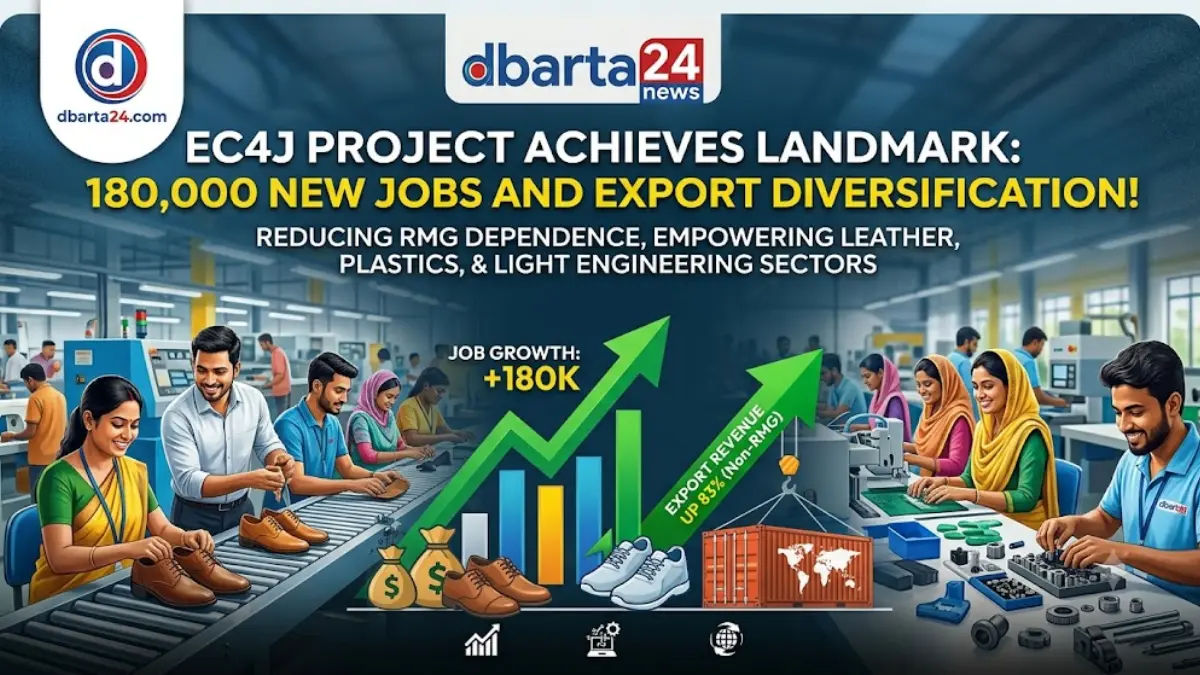
Muyabia Labony; Dbarta24 — In a major breakthrough for Bangladesh’s trade expansion and economic resilience, the Ministry of Commerce’s Export Competitiveness for Jobs (EC4J) project has emerged as a cornerstone initiative in reducing the nation’s heavy reliance on the Readymade Garments (RMG) sector.
By fostering competitiveness across four high-potential manufacturing industries, the initiative has successfully generated nearly 180,000 decent jobs—tripling its original target—while expanding Bangladesh’s footprint in global value chains.
Launched in July 2017 with financial backing from the World Bank’s International Development Association (IDA), the EC4J project was designed to address a critical economic vulnerability: with over 80% of national export revenue tied strictly to RMG, diversifying the export portfolio was declared a national priority ahead of Bangladesh’s graduation from Least Developed Country (LDC) status.
The project targeted four strategic non-RMG sectors—leather and leather goods, footwear, plastics, and light engineering—upgrading them to international standards and equipping them to enter new global markets.
Exceeding Targets and Mobilizing Private Capital
Reflecting on the program’s outcomes, Project Director and Joint Secretary of the Ministry of Commerce, Sheikh Mohammad Abdur Rahman, confirmed that the project exceeded nearly all key performance indicators, building a sustainable foundation for long-term competitiveness.
“The objective of the project was not merely to boost exports, but to empower Bangladeshi industries to compete globally and create quality employment,” said Abdur Rahman. “The results demonstrate that providing targeted support to export-oriented enterprises can significantly accelerate industrial transformation.”
A central component of this success was the Export Readiness Fund (ERF), a matching grant facility that provided financial and technical support to 570 enterprises, including women-led businesses.
This support enabled firms to meet global Environmental, Social, and Quality (ESQ) standards, modernize production lines, and earn 260 international compliance certifications. Additionally, the ERF successfully catalyzed over $18 million in private sector co-investment, augmenting public funds.
+-------------------------------------------------------------------------+
|                  EC4J PROJECT KEY METRICS & ACHIEVEMENTS                |
+------------------------------------+-------------------+----------------+
| Metric                             | Project Baseline  | Achieved Level |
+------------------------------------+-------------------+----------------+
| New Decent Jobs Created            | 60,000 (Target)   | ~180,000       |
| Beneficiary Sales Growth           | 15.4% (Target)    | 59.0%          |
| Active Exporters Among Beneficiaries| 59.0%             | 95.0%          |
| Average Export Revenue Increase    | —                 | 192.0%         |
| Non-RMG Sector Export Growth (2016-23)| —              | ~83.0%         |
| Private Co-Investment Mobilized    | —                 | $18+ Million   |
+------------------------------------+-------------------+----------------+
(Data Source: World Bank / Ministry of Commerce)
Heavy Investments in Industrial Infrastructure
Beyond direct financial incentives, the EC4J project directed substantial resources toward technical capacity building and institutional infrastructure:
-
BIPET Established: The Bangladesh Institute of Plastics Engineering and Technology (BIPET) is now fully operational, offering industry-focused technical training.
-
Centers of Excellence Completed: Construction is complete for the Center of Excellence for Engineering and Technology (CEET) at the Bangladesh Hi-Tech City in Kaliakair, as well as the Design and Technology Center for Leather Goods and Footwear (DTCLF) in Kashimpur, Gazipur.
-
Strategic Land Acquisition: Site development and land acquisition have been finalized for two upcoming institutes—the Institute of General Engineering and Technology (IGET) at the BSCIC Chemical Industrial Park in Munshiganj, and the International Institute of General Engineering and Technology (IIGET) at the National Special Economic Zone (NSEZ) in Mirsarai, Chattogram.
According to project management, these specialized hubs will provide essential product development, testing facilities, and technical labor to power Bangladesh’s high-value export industries for years to come.
Transparent Governance Drives Global Validation
World Bank evaluations highlight the project’s unique grant management system as a key factor in its success.
Managed by an independent, internationally recruited third party, grant disbursements were linked directly to verified implementation milestones, ensuring absolute accountability and building trust with private investors.
Through specialized training in skills development, workplace safety, and compliance, the project directly benefited over 107,000 individuals—38% of whom are women.
With non-RMG exports within the project’s target sectors surging by roughly 83% between 2016 and 2023, the World Bank cited the EC4J initiative as a model benchmark for public-private partnerships in developing economies.