


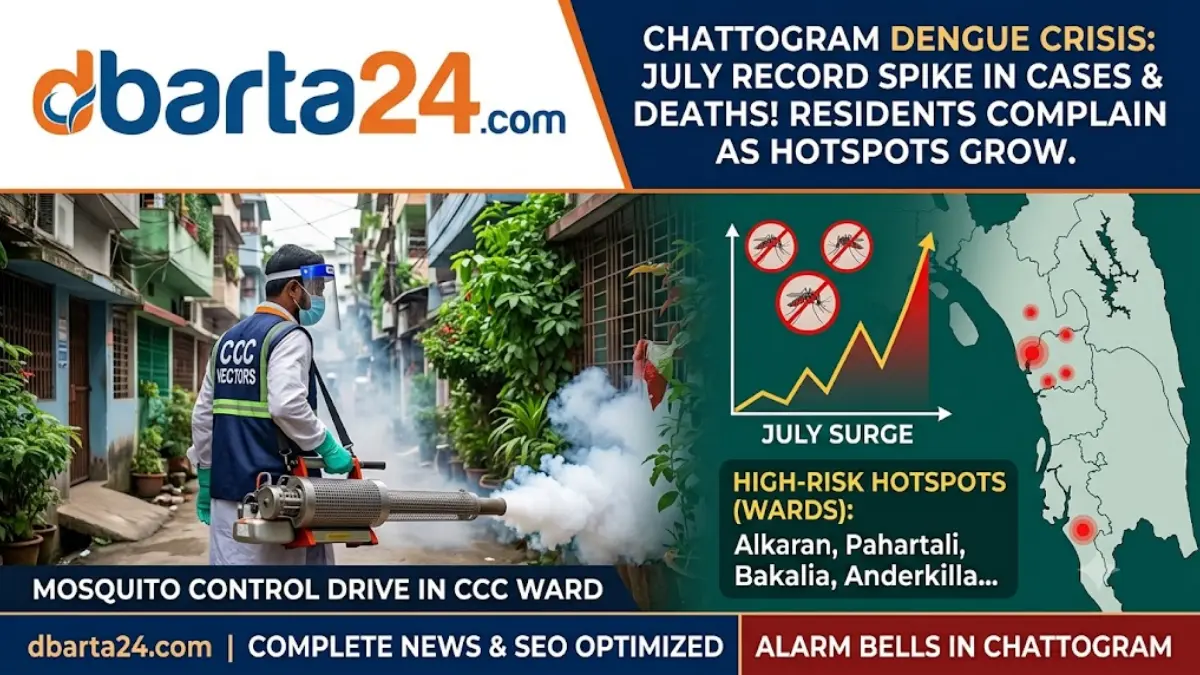
Shamchul Rahman; Dbarta24 Correspondent — Chattogram is facing its most severe Dengue outbreak of the year, with the month of July recording a staggering spike in both hospitalizations and fatalities.
Official data reveals that out of 834 total Dengue cases recorded between January and July 31, nearly two-thirds—536 cases—were reported in July alone.
The month also accounted for two of the three Dengue-related deaths recorded in the district this year, sparking widespread concern across urban and rural communities.
July Spike Triggers Health Warning
According to statistics from the Chattogram District Civil Surgeon’s Office, infection numbers remained relatively subdued during the first half of the year before surging alongside the monsoon rains in July.
A demographic breakdown of the 834 infected patients shows that 338 reside within Chattogram city, 341 belong to surrounding upazilas, and 155 hail from neighboring districts.
Sitakunda emerged as the most affected upazila, registering 83 cases. Gender-wise data indicates that infected patients include 480 men, 216 women, and 138 children.
“July witnessed the highest surge in both Dengue cases and casualties this year,” stated Dr. Jahangir Alam, Civil Surgeon of Chattogram. “Since Dengue spreads through Aedes mosquito bites, staying protected from mosquitoes is crucial. We have officially urged the City Corporation to intensify vector control drives. Currently, 103 patients are undergoing treatment across various hospitals.”
Resident Grievances Over Vector Control Drives
Despite official assurances, residents in several city neighborhoods complain that anti-mosquito measures remain invisible on the ground.
Muntasir Uddin, a resident of the Hamjarbag Songit Residential Area under Panchlaish Police Station, shared his frustration:
“Mosquito infestation has worsened significantly, yet vector control activities are virtually non-existent,” he noted. “It becomes unbearable indoors after evening, even with coils. City Corporation personnel aren’t seen spraying insecticides even once a month.”
Similar complaints were echoed by Omar Farooq, a resident of the Bahaddarhat Farida Para area, who cited open fields and uncollected waste near hospitals as major breeding grounds that municipal authorities have failed to address adequately.
A survey conducted by the Chattogram Divisional Health Directorate has officially identified eight city wards as high-risk Dengue hotspots due to high concentrations of Aedes mosquitoes. The vulnerable areas include:
-
Ward 2 (Alkaran)
-
Ward 3 (Pahartali)
-
Ward 10 (North Kattali)
-
Ward 17 (West Bakalia)
-
Ward 19 (South Bakalia)
-
Ward 32 (Anderkilla)
-
Ward 34 (Patharghata)
-
Ward 39 (South Baluchara)
Municipal Response and Field Actions
Addressing the public outcry, Md. Sharful Islam Mahi, Malaria and Mosquito Control Officer for Chattogram City Corporation (CCC), defended the ongoing initiatives:
“We launched public awareness drives even before the monsoon started, and those initiatives remain active,” Mahi stated. “Mosquito control efforts—including larviciding in the morning and adulticiding fogging in the afternoon—have been accelerated across all 41 wards.”
He further added that specialized 60-member task forces have been formed to target high-risk hotspots, focusing particularly on abandoned plots and ongoing construction sites to eradicate potential breeding grounds.
With hospital beds steadily filling up and monsoon weather continuing to facilitate vector breeding, Chattogram faces a critical window to curb further transmission.
Timely execution of targeted spraying, paired with active public cooperation in clearing standing water, will be essential to containing the surge before peak season progresses.