


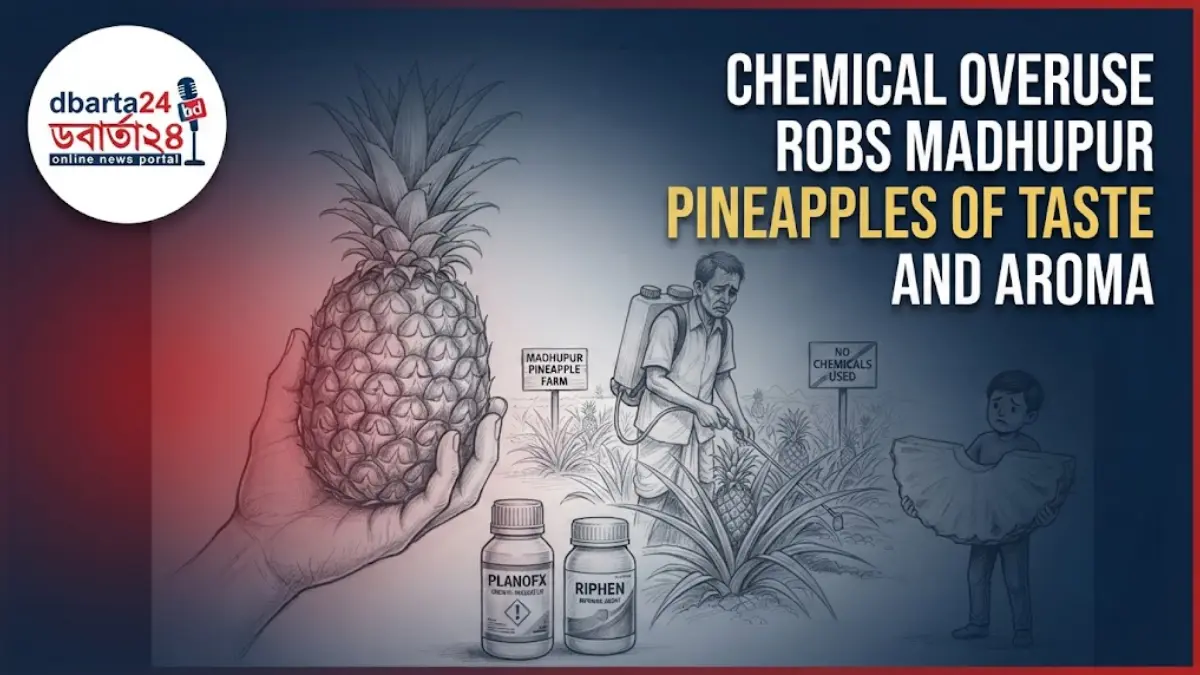
Kamrul Islam ; Dbarta Correspondent, Tangail – Famous across Bangladesh for their rich flavor and distinct aroma, the pineapples of Madhupur in Tangail are losing their authentic characteristics due to the indiscriminate use of growth hormones and chemicals.
While these fruits boast a larger size and glossy appearance, dwindling consumer interest has driven prices down compared to last year, leaving local farmers facing financial strain.
A Rich Heritage Meets Modern Shortcut Challenges
Pineapple cultivation in the Madhupur tract dates back to the mid-1950s when saplings were brought from Meghalaya. Ajay A. Mrong, an elderly resident of the local Garo community, recalled that the fruit gained nationwide fame within just a few years.
Over the past two decades, improved connectivity has drawn leaseholders and external traders to the region. In pursuit of quick profits, many growers rely heavily on chemicals and hormones—a practice that threatens the region’s agricultural heritage.
According to the Department of Agricultural Extension (DAE), Madhupur remains one of the country’s prime pineapple production hubs. This season, pineapple cultivation covers 6,638 hectares of land across the upazila.
This includes 4,375 hectares of Calendar (Giant Kew) variety, 2,245 hectares of Jaldhugi, and 18 hectares of MD-2. The local target is set at approximately 250,000 tons of production.
Although favorable weather conditions led to a bumper harvest this year, farmers selling their produce at the Garo Bazar and Jalchhatra wholesale markets are grappling with depressed market prices.
The Chemistry Behind the Crop
Interviews with farmers and traders at the wholesale markets revealed that various chemicals are deployed to artificially enlarge pineapples, force simultaneous ripening, and accelerate maturity.
Local growers apply substances like Planofix, Superfix, Crop Care, and Ankur to increase fruit size, while Riphen, Harvest, Promote, Sara Gold, Critipas, and Alpen are used to hasten ripening.
These treatments trigger fruiting prematurely on immature plants—a local practice colloquially referred to as being “pregnant.”
Farmers noted that while a healthy pineapple plant naturally bears fruit only after growing about 60 leaves, the application of these chemicals prompts fruiting when a plant has as few as 28 leaves.
Sohel Rana, a farmer from Kurigram who cultivates pineapples across four bighas of land, pointed out the economic dilemma.
Because he avoids chemical and hormone treatments, his production costs are higher, forcing him to ask for better prices that hesitant buyers are often unwilling to pay, pushing others toward chemical shortcuts.
Another grower, Mizanur Rahman, explained the logistical pressure: spraying chemicals ripens the entire crop within four to five days, enabling simultaneous market release. In contrast, natural ripening happens gradually, complicating market timing.
Wholesale trader Lokman Hossain at Garo Bazar noted that chemical use is backfiring by eroding consumer trust. Previously, pineapples arrived in phases, yielding higher sales and better profits.
Now, flooded markets lead to price drops and inferior taste. Roni Mia, a grower from Jalchhatra market, reported that pineapples he sold wholesale for 30 to 35 Taka last year are fetching only 20 to 25 Taka for the same size this season.
Expert Warnings and Official Stance
Environmental and academic experts have raised serious concerns over the trend.
Shahid Mahmud, General Secretary of the Tangail district chapter of the Bangladesh Poribesh Andolon (BAPA), stated, “Madhupur’s pineapples are a regional tradition. Excessive hormone and chemical use is damaging that legacy. Effective initiatives from relevant departments are necessary to make farmers aware.”
Prof. Dr. Md. Azizul Haque, Head of the Food Technology Department at Mawlana Bhashani Science and Technology University, noted that while moderate chemical use to protect crops from microbial attacks is acceptable, excessive levels pose severe health risks.
He emphasized that farmers must strictly follow guidelines from the agricultural department to ensure safe food production.
Meanwhile, Momtaz Muna, Madhupur Upazila Agriculture Extension Officer, assured that field-level agriculture officials are actively advising farmers against the excessive use of chemicals and that additional awareness campaigns will soon be rolled out by the agriculture department.