


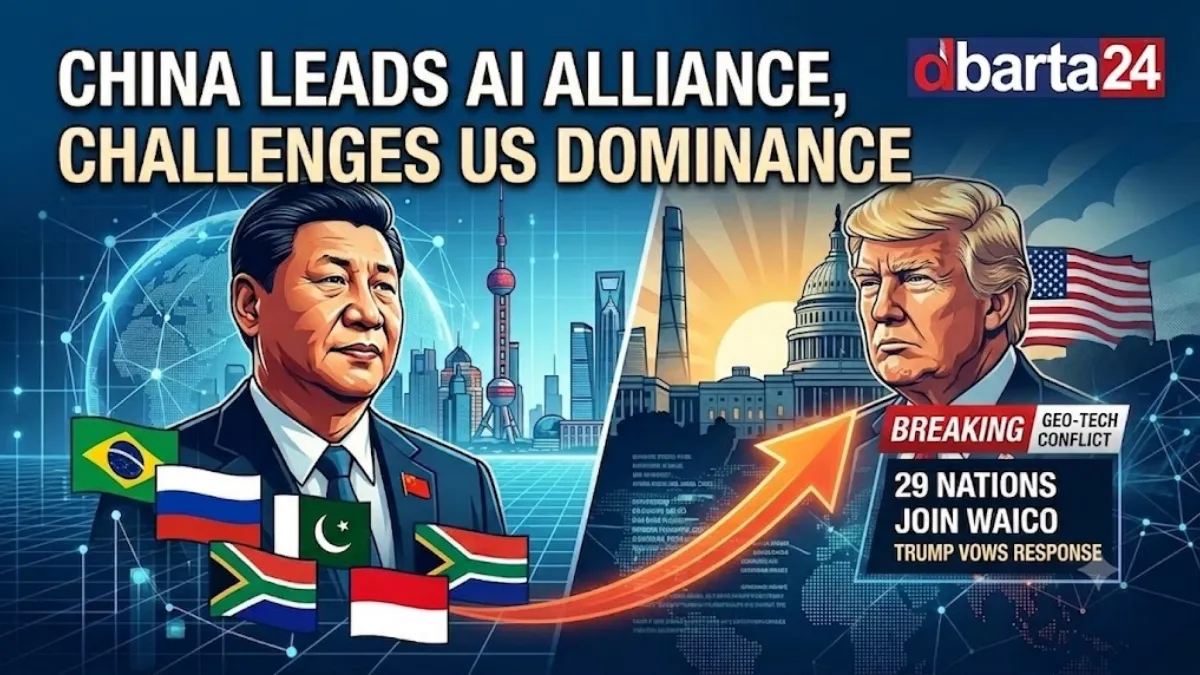
Sumon Abdullah from China — China has taken a major stride in asserting its leadership over the future of artificial intelligence by formally establishing a 29-nation intergovernmental body, the World Artificial Intelligence Cooperation Organization (WAICO).
Announced on July 16, 2026, during the ninth World Artificial Intelligence Conference (WAIC) in Shanghai, the initiative signals Beijing’s intent to counter Western influence and shape international AI standards.
The four-day conference—centered around the theme “AI Partnership for a Brighter Future”—featured an opening address by Chinese President Xi Jinping.
Speaking to delegates, President Xi advocated for deeper multilateral cooperation and warned against monopolistic practices in critical technologies.
“AI development should not be a solo performance by any single country; it should be a symphony of international cooperation,” President Xi stated. “We must jointly oppose overstretching the concept of national security or attempting to place one country’s security above that of others.”
The Chinese leader emphasized open-source technological integration, guaranteeing equitable access for developing nations to prevent “new historical inequalities,” and promised expanded AI cooperation across Africa, Latin America, and Asia.
He also stressed a human-centric approach to governance, arguing that robust regulatory frameworks, emergency measures, and technical oversight must keep AI under human control.
Building a Counterweight via the Global South
Headquartered in Shanghai, WAICO brings together 29 founding member states, including prominent Global South heavyweights such as Brazil, Indonesia, Malaysia, South Africa, Senegal, Russia, and Pakistan.
United Nations Secretary-General António Guterres and various international representatives attended the signing ceremony.
Analysts view the strategic assembly as a deliberate move to galvanize support from developing economies, building a voting block capable of shaping AI policy and governance within the United Nations.
China’s aggressive expansion comes at a pivotal moment in its ongoing semiconductor and AI conflict with Washington. While the United States continues to hold an advantage in cutting-edge semiconductor hardware, China leverages significant domestic advantages.
It commands substantial rare-earth mineral reserves, operates vast data processing facilities, and benefits from abundant electrical capacity—producing more than double the electricity of the US to power energy-intensive AI infrastructure.
Strategic Shift in Global AI Governance
Washington has repeatedly tightened export restrictions on advanced semiconductors and dual-use equipment destined for Chinese firms, citing national security concerns.
Beijing has responded in kind, restricting the export of dual-use technologies and critical raw minerals required by US manufacturers.
As western nations struggle to establish unified AI frameworks—particularly regarding military AI applications—China is leveraging its institutional initiatives to fill the leadership vacuum.
Writing for the Carnegie Endowment for International Peace, governance expert Arindrajit Basu noted that Beijing is actively stepping up as Washington scales back its cyber diplomacy funding and retreats from global tech policy forums.
“Through this, Beijing aims to legitimize a state-centric model of tech governance internationally, backed by support from Global South nations,” Basu observed.
Unlike the early days of the decentralized internet—where China remained on the defensive—Beijing is taking proactive steps to shape the multilateral rules governing artificial intelligence before they solidify globally.
By organizing a coalition of middle- and low-income allies, China has positioned itself to fundamentally challenge the US-led technological order.