


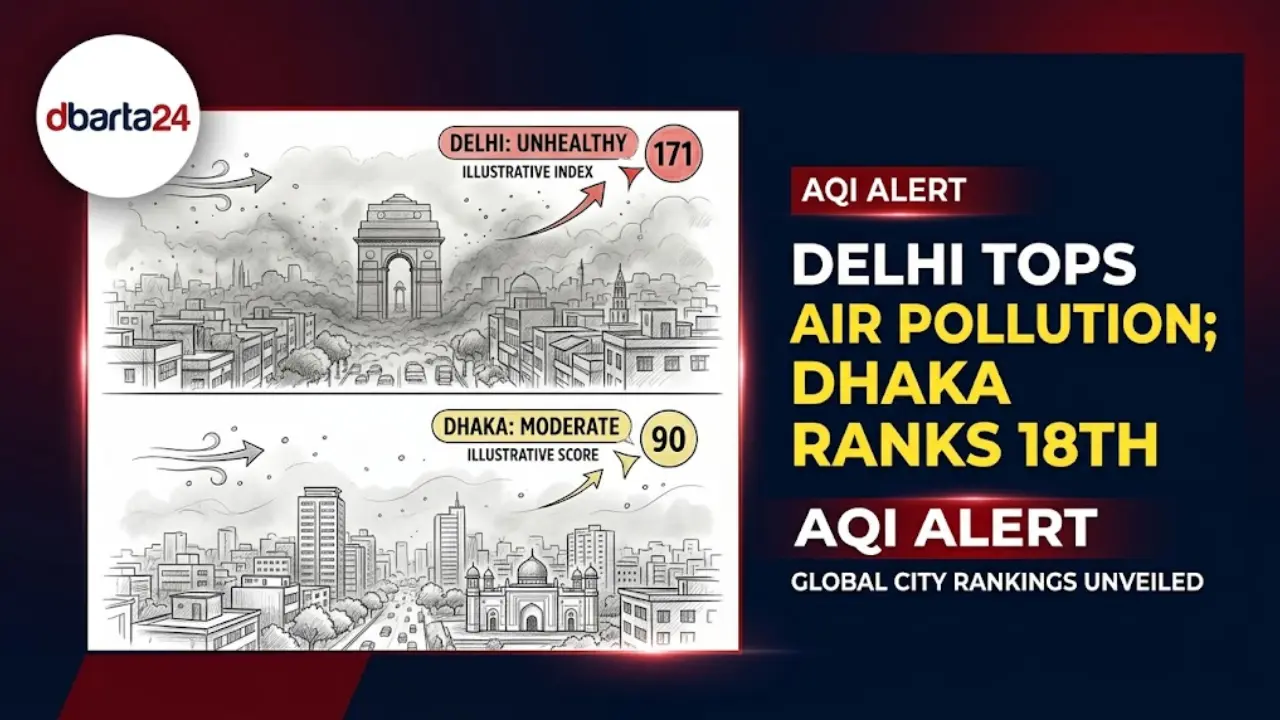
Dbarta24 Desk— India’s capital, Delhi, has recorded the worst air quality in the world today, taking the top spot on the global pollution index.
Meanwhile, Bangladesh’s capital, Dhaka, ranked 18th among major international cities, maintaining air quality categorized as “moderate.”
According to live data updated at 8:26 AM on Saturday (August 15) by IQAir—the global air quality monitoring organization—Delhi registered an Air Quality Index (AQI) score of 171, pushing its atmospheric environment deep into the “Unhealthy” category.
In contrast, Dhaka recorded an AQI score of 90, reflecting relatively tolerable conditions for city residents.
Understanding the AQI Scale
Air quality metrics are categorized according to internationally established AQI benchmarks to assess environmental health risks:
| AQI Score Range | Air Quality Category | Health Implications |
| 0 – 50 | Good | Air quality is considered satisfactory; little or no risk. |
| 51 – 100 | Moderate / Tolerable | Acceptable air quality; slight concern for extremely sensitive individuals. |
| 101 – 150 | Unhealthy for Sensitive Groups | Members of sensitive groups may experience health effects. |
| 151 – 200 | Unhealthy | General public may begin to experience health effects. |
| 201 – 300 | Very Unhealthy | Health alert: everyone may experience more serious health effects. |
| 301+ | Hazardous / Disastrous | Emergency conditions; serious risk to the entire population. |
Key Developments and Regional Analysis
Delhi’s high ranking underscores the persistent seasonal and industrial pollution challenges confronting North India, where dense urban smog regularly creates unsafe living conditions for tens of millions.
For Dhaka—a metropolis that frequently fluctuates within the top ten most polluted cities during dry winter periods—the score of 90 signals a temporary reprieve.
Favorable seasonal atmospheric patterns and weather conditions often help clear suspended particulate matter, keeping air quality within moderate bounds during this time of the year.
While Dhaka currently enjoys manageable atmospheric conditions, environmental experts emphasize that continuous monitoring and urban pollution control remain vital.
For cities like Delhi, an AQI score above 150 continues to serve as an urgent reminder of the growing public health risks driven by deteriorating regional air quality.