


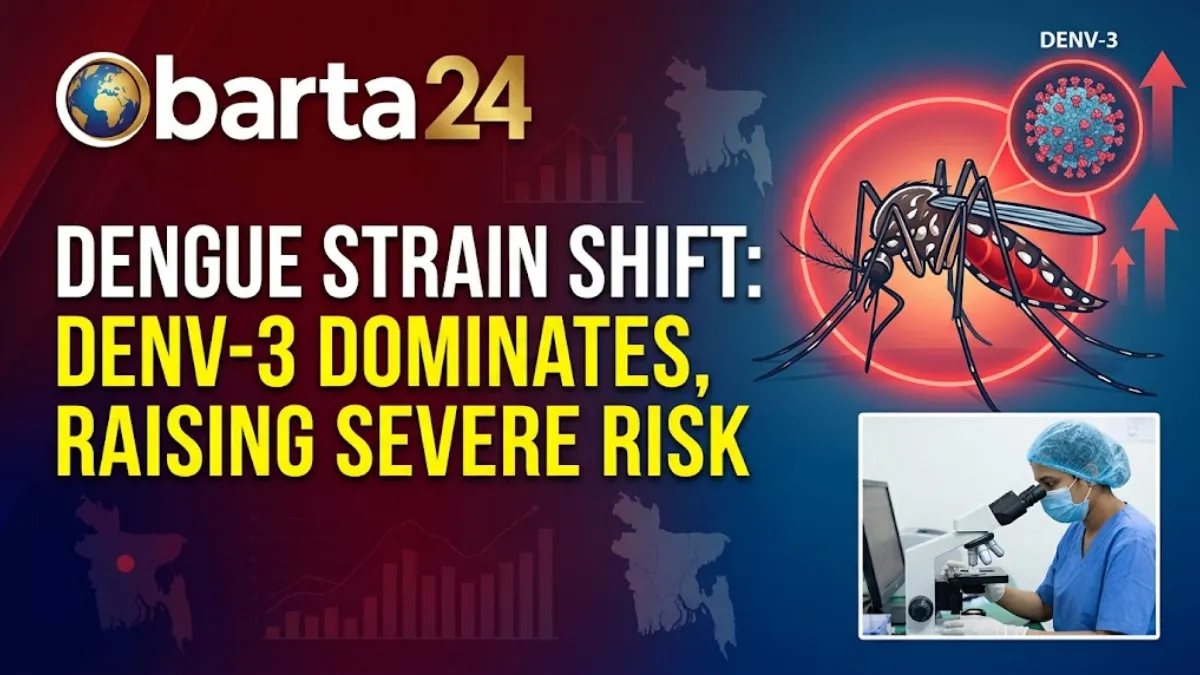
Khairul Alam — A significant mutation pattern in the circulating dengue virus serotype has raised fresh alarms among public health officials in Bangladesh.
After four years of dominance by the DENV-2 variant, the country is now experiencing a sharp surge in DENV-3 infections, significantly increasing the risk of severe complications, hospitalization, and mortality due to secondary infections.
According to the latest data from the Institute of Epidemiology, Disease Control and Research (IEDCR), an analysis of sample isolates from hospitalized patients across the nation revealed that 91.5% were infected with the DENV-3 serotype, while DENV-2 accounted for the remaining 8.5%. No other serotypes were detected in the recent sampling batch.
The shift in viral dominance comes amid escalating casualty figures. Health authorities reported three new deaths and 372 fresh hospitalizations due to dengue fever in a single 24-hour period—marking the highest single-day death toll recorded this month.
Why the DENV-3 Strain Poses a Grave Concern
Dengue is caused by four distinct viral serotypes: DENV-1, DENV-2, DENV-3, and DENV-4. Contracting one strain grants lifelong immunity against that specific variant, but leaves an individual vulnerable to the remaining three.
Public health experts caution that a secondary infection with a different strain drastically heightens the probability of developing severe dengue, such as Dengue Hemorrhagic Fever or Dengue Shock Syndrome.
Public Health Expert Dr. Mushtaq Hussain highlighted the looming threat:
“Because DENV-2 was prevalent in the country for years, a major portion of the population developed antibodies against it. However, those existing antibodies will offer no protection against DENV-3. Consequently, individuals previously infected with DENV-2 who contract DENV-3 now face a much higher likelihood of severe clinical complications.”
Dr. Hussain emphasized the importance of immediate diagnostic testing upon the onset of fever symptoms and advised hospitals to prepare for an influx of critical patients.
Echoing these concerns, Dr. Kazi Ahmed Zaki, Director of IEDCR, noted:
“Due to the DENV-3 serotype, patients are rapidly progressing toward complications like Dengue Shock Syndrome, leading to sudden deterioration. Destroying Aedes mosquito breeding grounds remains our most effective line of defense.”
Historical Trends and Epidemic Patterns
IEDCR surveillance records show that dengue serotype shifts historically precede massive outbreaks in Bangladesh.
-
2013–2016: Predominance of DENV-1 and DENV-2.
-
2019: Over 90% of cases were DENV-3, coinciding with the largest dengue epidemic in the nation’s history up to that point.
-
2023–2025: DENV-2 regained dominance, accounting for nearly 70% of tested samples in 2023 and 2024 before dropping to 48% in 2025.
-
Current Year: DENV-3 surged back to over 91% dominance in urban focal points like Dhaka.
Researchers stress that considering the historical precedents set in 2019 and 2023, the sudden resurgence of DENV-3 must be treated as a crucial public health warning.
Rising Casualty and Hospitalization Figures
Data provided by the Directorate General of Health Services (DGHS) underscores the expanding footprint of the disease. The three latest fatalities were reported from the Barishal Division, Khulna Division, and the Dhaka South City Corporation area.
Across the country, new hospital admissions spanned multiple regions, including Barishal (67), Chattogram (54), Dhaka Division outside city corporations (103), Dhaka South City Corporation (52), Khulna (43), North Dhaka (22), Mymensingh (21), Rangpur (6), and Rajshahi (4).
Total dengue cases for the current year have reached 10,857—with males accounting for 60.9% of cases and females 39.1%. While 9,786 patients have successfully recovered, the cumulative death toll has climbed to 37.
July has emerged as the most critical month of the year so far, recording 4,753 hospitalizations in its first 20 days alone.
The Path Forward
Health experts advocate for an immediate step-up in multi-faceted intervention strategies. Key priorities include expanding real-time viral surveillance, accelerating vector management initiatives by local municipalities, ensuring early diagnosis, and driving public awareness regarding stagnant water clearance around households.
Continuous monitoring of serotype mutations will remain vital for predicting future epidemic waves and fortifying clinical preparedness.